AI SDK Voyage 2.0.81 Patch Released: The Maintenance Rhythm Behind Dependency Chain Updates

The AI SDK's Voyage adapter package releases patch 2.0.81, whose core is synchronizing upstream base dependencies.
The article explains the patch-level update of @ai-sdk/voyage 2.0.81 in the AI SDK ecosystem. Automatically published by github-actions with a GitHub verified signature and marked as Patch Changes, it contains no new features or breaking changes—its substantive action is synchronizing @ai-sdk/provider-utils@5.0.80 and @ai-sdk/provider@4.0.38. Because the AI SDK is layered (provider defines a unified model interface, provider-utils provides shared utilities, and vendor adapters build on top), base-layer patches propagate upward as dependency upgrades, causing frequent version churn. Such updates are usually low-risk to upgrade directly, but lockfile compatibility with other adapter packages must be checked; the automated release and signature verification reflect a typical changeset-driven monorepo release model.
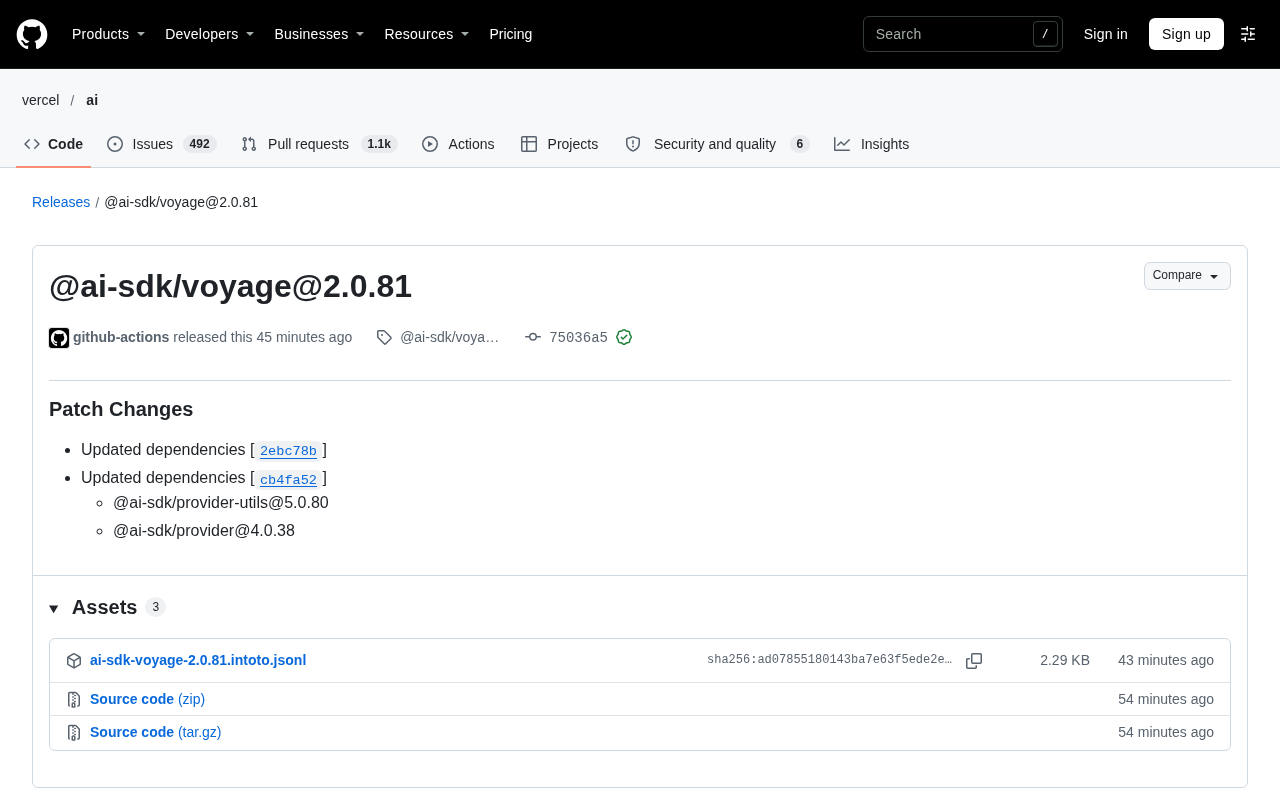
The Voyage adapter package in the AI SDK ecosystem has released version 2.0.81, a typical patch-level update. For developers following the AI coding toolchain, these small version bumps reflect how dependencies are governed under the SDK's modular architecture.
Basic Information About a Patch Update
According to the release record on GitHub, @ai-sdk/voyage@2.0.81 was published automatically by github-actions, and the commit carries a GitHub verified signature. The version type is explicitly marked as "Patch Changes", meaning this update contains no new features or breaking changes—the core action is synchronizing dependency updates.
The release notes list two dependency changes: @ai-sdk/provider-utils@5.0.80 and @ai-sdk/provider@4.0.38. These two packages form the foundation of the AI SDK's provider abstraction layer; Voyage, as a concrete model-service adapter layer, needs to follow the release cadence of the upstream base packages.
What Dependency Chain Updates Mean
The AI SDK uses a layered design: the underlying provider defines a unified model invocation interface, provider-utils provides shared utility functions, and adapter packages for each model vendor (such as Voyage, OpenAI, Anthropic, etc.) implement specific logic on top of that. When the base layer ships a patch, upper-layer adapter packages typically follow up by updating their dependency declarations.
The benefit of this pattern is that fixes and optimizations can be completed centrally in the base layer, and all adapter packages benefit simply by upgrading dependencies. The cost is that version numbers jump frequently—a patch number like 2.0.81 doesn't mean the Voyage adapter itself has substantive code changes; it's more about synchronizing the dependency tree.
For consumers, such updates can usually be upgraded directly with low risk. But if your project strictly pins dependency versions, you need to check whether changes in the provider-utils and provider versions conflict with other adapter packages.
Changesets and Semantic Versioning
The "changeset" mentioned in the article is a version management mechanism commonly used in monorepo projects, typically implemented with the @changesets/cli tool. Developers attach a changeset file describing the change type (patch / minor / major) when submitting a PR; after merging, CI aggregates these files, automatically calculates the version number each package should be bumped to according to Semantic Versioning (SemVer) rules, and generates a changelog.
SemVer defines version numbers as major.minor.patch: a major version change represents incompatible API modifications, a minor version represents backward-compatible new features, and a patch number represents only backward-compatible bug fixes. Therefore, the patch number increment to 2.0.81 semantically promises "no breaking changes," which is also the basis for the article's judgment that it can be upgraded with low risk. In multi-package repositories, a version change in a base package propagates upward along the dependency graph, triggering upper-layer packages to also release new patch versions, resulting in frequent version churn.
Observations on the Automated Release Process
The publisher is shown as github-actions, indicating this version was completed automatically by a CI pipeline rather than by manual operation. The commit signature verification passed, indicating a trustworthy code source. This kind of automated process is very common in SDK projects managed as monorepos: base package changes trigger a changeset, and after merging, the version number is automatically calculated and published.
The resource loading errors and tag filtering anomalies on the release page are common phenomena during dynamic loading of GitHub Releases pages and are unrelated to the package itself.
GitHub Actions and Commit Signature Verification
github-actions is the CI/CD bot identity provided by GitHub. When a workflow uses the repository's built-in GITHUB_TOKEN to perform a release, the resulting commits and release records are shown as that bot account. Such pipelines are usually triggered by a push to the main branch or a tag, and complete steps such as build, test, version number writing, npm publish, and creating a GitHub Release.
"GitHub verified signature" means the commit carries a cryptographic signature automatically attached by GitHub, and viewers can see a Verified badge on the commit page. It proves that the commit was indeed produced by the repository's GitHub workflow and that the content has not been tampered with, but it is not equivalent to manual review of the code logic. For consumers concerned about supply chain security, such signatures can serve as an auxiliary signal for judging the trustworthiness of a package's origin; they work even better when combined with lockfile checksums and npm's provenance attestation.
Practical Impact on Developers
If your project directly depends on @ai-sdk/voyage, this update most likely requires no code adjustments on your part. Two things are worth watching: first, after upgrading, confirm whether Voyage model invocation behavior is consistent with before; second, check whether the versions of @ai-sdk/provider and @ai-sdk/provider-utils in your lockfile are compatible with other AI SDK adapter packages.
From a longer-term perspective, the frequent patch releases of the Voyage adapter package show that the AI SDK is still actively maintained, and iterations in the base layer will continue to propagate to each vendor's adapter package. Keeping dependencies updated and following changelogs is a necessary habit when using this kind of rapidly evolving SDK.
Lockfiles and Dependency Version Compatibility
A lockfile (such as package-lock.json, pnpm-lock.yaml, yarn.lock) records the exact version and integrity hash each package resolves to in the dependency tree. In the npm ecosystem, when multiple packages share the same dependency, version hoisting or deduplication occurs; therefore, when you upgrade @ai-sdk/voyage, the @ai-sdk/provider and provider-utils versions it carries may be inconsistent with the versions required by other AI SDK adapter packages in your project, resulting in multiple copies of the same package or even runtime errors from mismatched interfaces.
Troubleshooting methods include: using npm ls @ai-sdk/provider or pnpm why to inspect where versions come from and confirm whether duplicate installations exist; using npm ci in CI to ensure installation follows the lockfile; and, when necessary, forcing a unified base package version through the overrides / resolutions fields.
One-line Summary
The AI SDK's Voyage adapter package released patch 2.0.81, whose core is synchronizing upstream base dependencies.
Paragraph Summary
The article explains the patch-level update of @ai-sdk/voyage 2.0.81 in the AI SDK ecosystem. This version was automatically published by github-actions, the commit carries a GitHub verified signature, and the type is marked as Patch Changes, with no new features or breaking changes; the substantive action is synchronizing the two base packages @ai-sdk/provider-utils@5.0.80 and @ai-sdk/provider@4.0.38. The article explains the AI SDK's layered architecture: the provider defines a unified model interface, provider-utils provides shared utilities, and each vendor adapter implements specific logic on top, so patches in the base layer propagate to upper-layer adapter packages in the form of dependency upgrades, causing frequent version number changes. For consumers, such updates can usually be upgraded directly with low risk, but attention must be paid to the compatibility of base package versions in the lockfile with other adapter packages; meanwhile, the automated release process and signature verification reflect the typical changeset-driven release pattern of monorepo projects.
Related articles

Jensen Huang Returns to Nvidia: The Power Game Behind an "Aggro Reset"
Nvidia's board reappointed Jensen Huang as CEO less than two weeks after his scandal-driven resignation. This analysis explores the board's decision-making, Trump's political intervention, media power failure, and market reaction behind the dramatic return.

Why Voice AI Can't Understand Kenyans' Everyday Conversations
Swahili speech recognition hits 3.24% error on read text, but everyday Kenyan speech mixes English, Sheng slang, and accents—leaving mainstream voice AI struggling.

Data Centers Build Their Own Natural Gas Plants: AI Compute's Breakout Around a Decade-Long Grid Wait
Grid interconnection approvals can take a decade, so xAI and others are building off-grid natural gas plants to power AI clusters. This article analyzes the drivers, costs, and impact of behind-the-meter generation on AI infrastructure.