@ai-sdk/vue 3.0.303 Released: A Dependency-Sync Patch Update
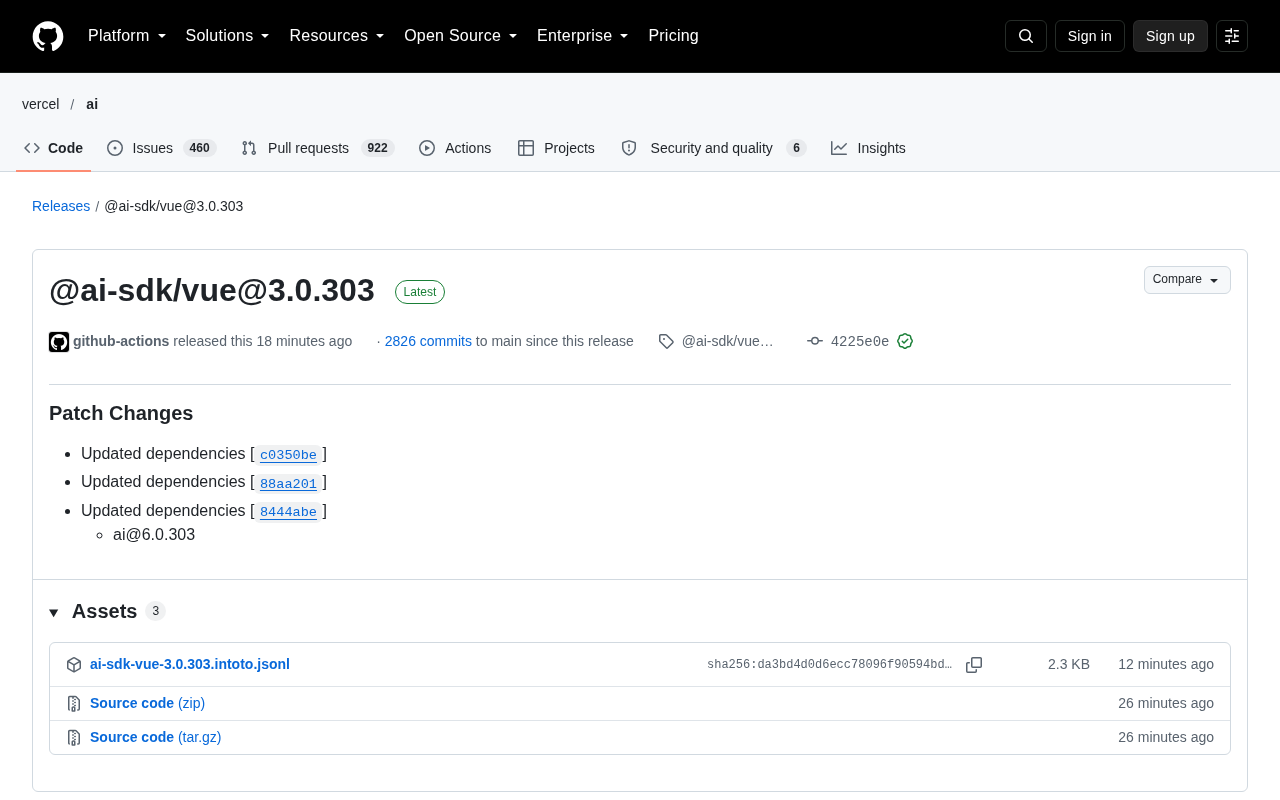
@ai-sdk/vue 3.0.303 patches by syncing the core [email protected] dependency — a low-risk routine maintenance release.
@ai-sdk/vue 3.0.303 is a patch-level update to Vercel AI SDK's Vue adapter, published via GitHub Actions with GPG signature verification. The core change is a dependency bump syncing the underlying `ai` package to `6.0.303`, a typical pattern in the SDK's Monorepo setup where sub-packages version in lockstep with the core. The update follows SemVer and should introduce no breaking changes, making it safe for production upgrades. Developers are encouraged to review the `[email protected]` changelog for details on what the dependency update specifically fixes.
Version Overview
@ai-sdk/[email protected] — the Vercel AI SDK's integration package for the Vue ecosystem — has shipped a patch-level update. This release was published via GitHub Actions automation and carries a verified GPG signature (key ID: B5690EEEBB952194), ensuring the authenticity of the release source.
The version number tells its own story: this is a continuous iteration point within the 3.0.x series. Commit history shows that 2,826 commits have accumulated on the main branch since the previous release, confirming the project remains under active, high-frequency maintenance.
What Changed
This update falls under Patch Changes, with its core modifications focused on dependency synchronization rather than the introduction of any breaking new features. The release notes list three dependency update references (corresponding to commits c0350be, 88aa201, and 8444abe), and bump the core dependency ai to 6.0.303.
This kind of version coupling is a hallmark of the AI SDK's Monorepo management approach — the core ai package and its various framework adapters (Vue, React, Svelte, etc.) stay in version lockstep, ensuring API compatibility and behavioral consistency across packages. For end users, this means that upgrading the Vue adapter automatically pulls in any corresponding fixes from the underlying core logic.
What is a Monorepo? A Monorepo (single repository) is an engineering strategy where multiple related packages or projects are maintained together in one codebase. The Vercel AI SDK uses this model to unify the core logic package
ai, framework adapters (@ai-sdk/vue,@ai-sdk/react, etc.), and model provider adapters under one roof. With tooling like Changesets, a change to the core package can automatically trigger version bumps across all dependent sub-packages, preventing the API incompatibilities that version drift causes. This explains why the changes in this@ai-sdk/vueupdate are primarily reflected as a dependency sync rather than standalone feature code — the package delegates much of its actual logic to the upstreamaipackage.
What This Means for Vue Developers
@ai-sdk/vue is designed to help Vue developers quickly integrate large language model capabilities into their applications, offering Composables for features like streaming response handling and chat state management. Patch releases typically signal bug fixes or improvements to the stability and security of underlying dependencies, rather than major feature-level changes.
For production projects, this kind of patch update is generally safe to adopt: it adheres to Semantic Versioning (SemVer) and should not, in theory, break any existing interfaces. That said, it's worth reviewing the specific changes in the associated core package [email protected] before upgrading, so you understand what issues the dependency update actually resolves.
What is SemVer? Semantic Versioning (SemVer) defines a version number as a three-part
MAJOR.MINOR.PATCHstructure. A patch increment is reserved for backward-compatible bug fixes; a minor increment adds backward-compatible new features; a major increment signals breaking changes. In@ai-sdk/vue's current version3.0.303, the303is the patch number, meaning any upgrade from a3.0.xrelease to this version should not break existing code. This convention gives automated dependency management tools likenpm updateand Renovate Bot a reliable basis for assessing upgrade risk.
Upgrade Recommendations
Because the release notes are fairly minimal — noting only dependency updates without elaborating on specific fixes — developers who need the full picture can trace the content of the corresponding commit hashes within the Monorepo.
Overall, this is a low-risk, maintenance-oriented routine release, well-suited for teams that prefer to keep their dependencies current.
The benefit of staying up to date with AI SDK releases is timely access to adapter support for the latest model provider APIs and potential performance improvements — which matters more than ever given how rapidly models are evolving.
Related articles

From Python to AI Agents: A Full-Stack Learning Path with 488 Lessons and 23 Projects
A Udemy course covering Python, machine learning, deep learning, LLMs, RAG, and AI Agents, with 488 lessons and 23 real-world projects. This article analyzes the logic of this full-stack AI learning path, who it suits, and self-study advice.

What Is a Residential Proxy? A Comparative Analysis of ISP, Datacenter, and Residential Proxies
An in-depth analysis of residential proxies (ISP proxies), their types, and how they differ from datacenter proxies, covering static vs. rotating residential IP selection criteria, use cases, and FAQs for e-commerce, social media, and data collection teams.

Creating Your Ideal Home: A Practical Guide to Curated Home Decor
Curated home decor guide: wall paintings, decorative mirrors, wall clocks, lamps, coffee tables, and more — with buying tips and styling advice for a cozy, comfortable home.