@ai-sdk/vue 3.0.306 Patch Release Syncs with ai@6.0.306 Update

@ai-sdk/vue 3.0.306 is a patch update aligned with the core package ai@6.0.306, with no independent feature changes.
@ai-sdk/vue released patch version 3.0.306 on October 14, keeping in sync with the core package ai@6.0.306. The sole entry in this Patch Changes is core package version alignment, with no independent feature changes in the Vue adapter layer. The article notes that the patch number 306 reflects the project's extremely high release frequency, embodying a strategy of small, quick steps and multi-package coordination. Such patch updates typically do not change the public API and are safe to upgrade, with benefits mainly from core package bug fixes, type corrections, or dependency adjustments. After upgrading, it's recommended to confirm the ai core package is updated in sync, run existing tests for streaming responses and tool calls, and check version constraint consistency in monorepos.
A Low-Key Patch Update
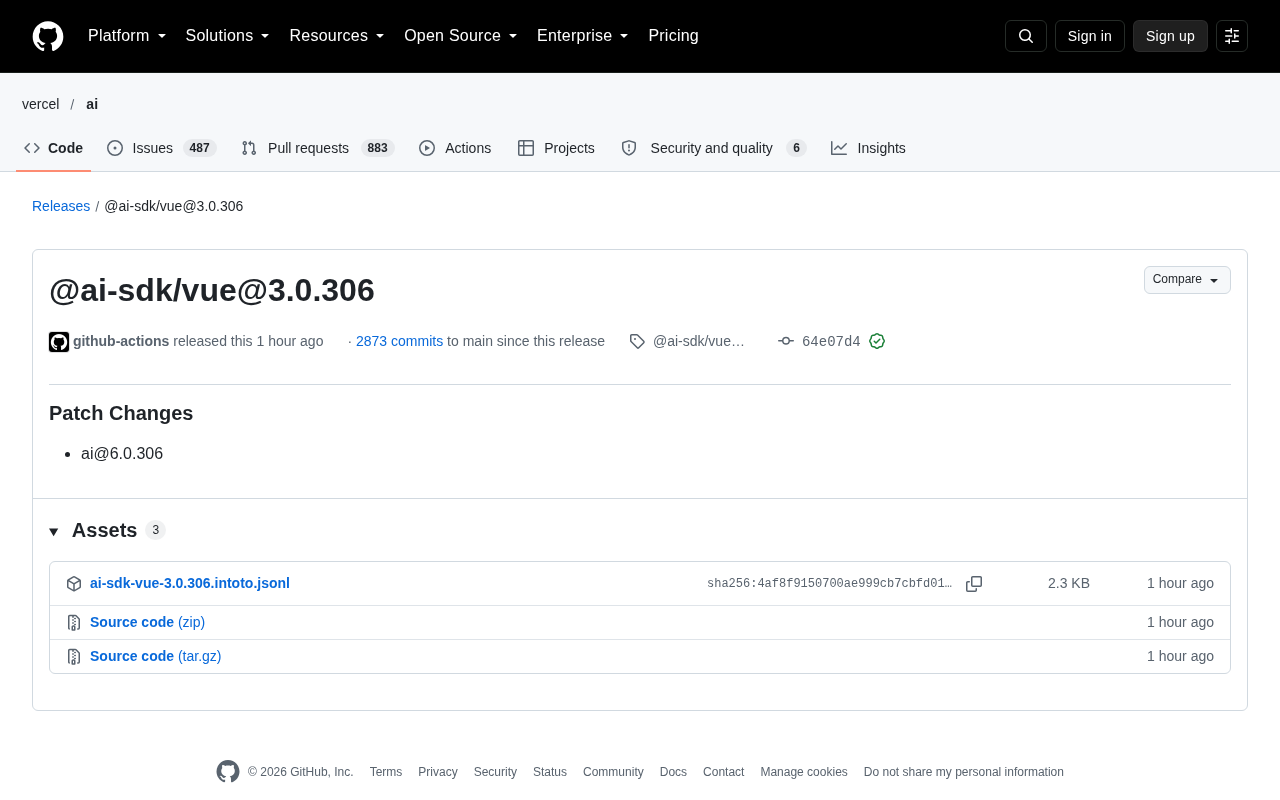
GitHub Actions released @ai-sdk/vue@3.0.306 on October 14, a standard patch version update (Patch Changes). According to the commit message, this version syncs with ai@6.0.306, following the routine maintenance cadence within the Vercel AI SDK ecosystem.
The number 306 in the version number is worth noting—it itself hints at the project's extremely high release frequency. For developers who continuously track the Vercel AI SDK, this kind of high-frequency, small-step iteration has long been the norm.
Semantic Versioning (SemVer) is the foundation for understanding what the version number in this article means. SemVer specifies the version format as MAJOR.MINOR.PATCH: the major version increments when incompatible API changes occur, the minor version increments when features are added in a backward-compatible manner, and the patch number is used for backward-compatible bug fixes. The 3.0.306 in this article indicates major version 3, minor version 0, and patch number 306—a typical patch-level change that theoretically introduces no breaking changes and adds no public API. For this reason, patch updates are generally considered safe to upgrade. It's worth noting that in the Vercel AI SDK ecosystem, the major version numbers of framework adapter packages are not synchronized with the core package (e.g., @ai-sdk/vue is at 3.x while ai is at 6.x), so determining compatibility requires consulting official release notes rather than judging solely by aligning version number digits.
Core Changes
Sync Mechanism: The vue Package Links with the Core Package
The most noteworthy piece of information in this release is that the sole entry in the Patch Changes list for @ai-sdk/vue@3.0.306 is ai@6.0.306.
This means the Vue adapter layer introduced no independent feature changes, but instead aligned its version with the core ai package. Vercel AI SDK has always adopted this multi-package coordinated release model: core logic evolves in the ai package, while framework adapter layers such as @ai-sdk/vue and @ai-sdk/react maintain synchronized or near-synchronized version numbers.
Monorepo multi-package coordinated releases are the underlying mechanism of the Vercel AI SDK's maintenance model. The core idea is to manage core logic (the ai package) and the various framework adapter layers (@ai-sdk/vue, @ai-sdk/react, @ai-sdk/svelte, etc.) in the same code repository, using tools (such as Changesets) to uniformly calculate each package's version number and changelog at release time. The advantage of this model is that a single fix in the core package can be synchronized to all adapter layers at once, avoiding time gaps in the capabilities available to users of different frameworks. The cost is a more complex release process, and every core change requires regression verification of the adapter layers. For users, this mechanism also explains why the patch notes for @ai-sdk/vue often contain only a single entry—ai@x.y.z—which expresses the version alignment relationship rather than a new feature addition.
Impact on Users
From an engineering practice perspective, patch updates like this typically do not change the public API. When developers upgrade, the main benefit comes from bug fixes, type definition corrections, or dependency adjustments that the core package may contain.
Because the release notes for this version contain very limited information, the GitHub page itself even had some content fail to load (the screenshot shows the message "Sorry, something went wrong"), and no more granular change entries were listed.
Why This Kind of Release Is Worth Noting
The Ecosystem Strategy Behind High-Frequency Iteration
The patch number 306 indicates that the project has completed hundreds of releases within a short cycle. This cadence reflects the Vercel AI SDK team's preference for taking small, quick steps: each patch may contain only one or two minor fixes, but cumulatively they enable rapid response to community feedback.
For application-layer developers, this means security patches and compatibility fixes reach production environments faster; at the same time, however, it also requires a more robust dependency locking strategy to avoid the potential risks brought by frequent upgrades.
The Maintenance Cost of Multiple Framework Adapter Layers
As the official adapter for the Vue ecosystem, @ai-sdk/vue's version tracking means Vue users always get underlying capabilities consistent with the core SDK. This design reduces the cognitive cost of using the AI SDK across frameworks, but it also requires the team to verify the compatibility of each framework adapter layer in sync after every core update.
Developer Recommendations
If your project depends on @ai-sdk/vue, this 3.0.306 version is a patch update that is safe to upgrade. After upgrading, it's recommended to pay attention to the following points:
- Confirm whether the
aicore package in your project's lockfile is also updated in sync to 6.0.306 - Run existing test cases to verify that features such as streaming responses and tool calls in Vue components work properly
- If you use a monorepo structure, check whether the version constraints among sub-packages are consistent
Summary
@ai-sdk/vue@3.0.306 is a typical ecosystem-linked patch release, whose core value lies in version alignment with ai@6.0.306 rather than introducing new features. For developers tracking the evolution of the Vercel AI SDK ecosystem, the significance of such releases lies more in the maintenance cadence and version strategy.
One-line Summary
@ai-sdk/vue 3.0.306 is a patch update aligned with the core package ai@6.0.306, with no independent feature changes.
Paragraph Summary
@ai-sdk/vue released patch version 3.0.306 on October 14, keeping in sync with the core package ai@6.0.306. The sole entry in this Patch Changes is the core package version alignment, and the Vue adapter layer introduced no independent feature changes. The article notes that the patch number 306 itself reflects the extremely high release frequency of the Vercel AI SDK project, embodying its maintenance strategy of taking small, quick steps and coordinating multiple packages. For developers, such patch updates typically do not change the public API and are safe to upgrade, with the main benefit coming from bug fixes, type corrections, or dependency adjustments in the core package. After upgrading, it is recommended to confirm whether the ai core package in the lockfile is updated in sync, run existing tests to verify features such as streaming responses and tool calls, and check the consistency of version constraints among sub-packages in monorepo scenarios.
Related articles

Why Does the Tesla Roadster Need to Fly? A Deep Dive into Musk's Wild Demo
Tesla's Roadster launch showed wall-climbing, upside-down driving, and flying stunts—but The Vergecast notes the demo car may lack a battery, the Rocket version is invite-only and not street-legal, and the website terms don't guarantee delivery. After nine years of delays, why does this car still need to exist?

AI Is Not a Replacement: Human-AI Collaboration Through the Lens of Factory Root Cause Analysis
Starting from factory root cause analysis, this article explains how AI accelerates evidence chain construction rather than replacing human experts, exploring the pragmatic implementation logic and business value of 'AI supporting people rather than replacing them.'

AI Agent Decision Auditing: Building an Evidence Chain in Regulated Workflows
Starting from a Reddit discussion, this article analyzes three core issues in AI agent decision auditing within regulated workflows: what fields audit records should contain, how to handle feedback latency for erroneous decisions, and how to continuously calibrate LLM judge consistency with human judgment.