AI SDK Vue 3.0.315 Patch Release: How Vue Developers Should Respond
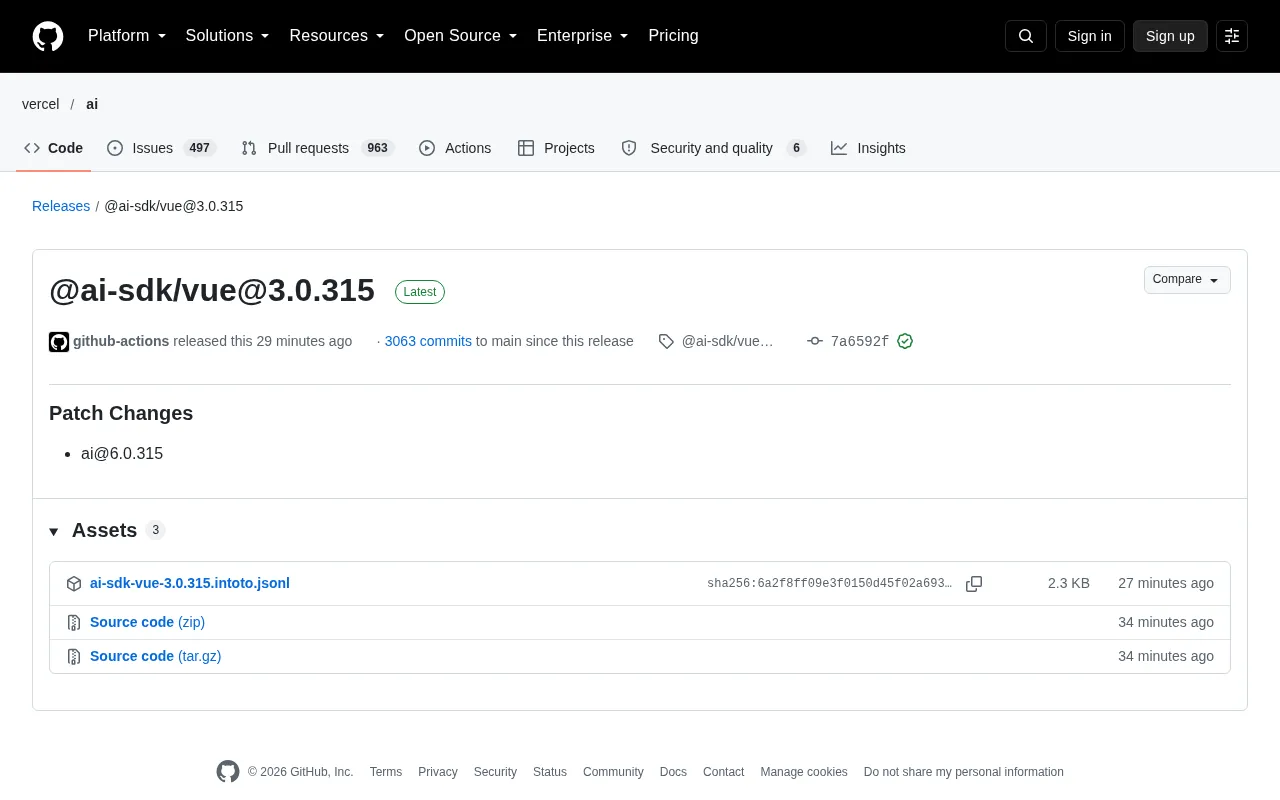
@ai-sdk/vue releases 3.0.315 patch, syncing with core package ai@6.0.315, no breaking changes.
Vercel's AI SDK project released @ai-sdk/vue@3.0.315, auto-built by GitHub Actions with a verified signature. The only listed change is syncing with core package ai@6.0.315—a routine dependency alignment. Since @ai-sdk/vue is just a thin wrapper mapping ai's streaming and tool calling into Vue composables, there are no new features or behavior changes, making upgrade risk very low.
Vercel's AI SDK project has released the patch version @ai-sdk/vue@3.0.315 on GitHub. For developers building AI chat interfaces with Vue, these frequent small version updates are worth noting, but there's no need to overanalyze them.
Basic Release Information
According to the GitHub Releases page, this version was automatically published by the github-actions bot on October 23 at 19:41, corresponding to the 3063rd commit on the main branch. The commit carries a GitHub-verified signature (GPG key ID: B5690EEEBB952194), indicating the release went through the standard CI pipeline rather than being manually uploaded.
This release is a Patch Changes type, meaning it's a patch-level update that doesn't involve new features or breaking changes.
Semantic versioning (SemVer) follows the format MAJOR.MINOR.PATCH. A MAJOR change indicates incompatible breaking changes, and upgrading usually requires code modifications; MINOR indicates backward-compatible new features that can generally be upgraded directly but with attention to new APIs; PATCH indicates backward-compatible bug fixes that can theoretically be replaced without risk. The article treats the second and first segments of the version number as "signal lights," precisely using this convention to quickly assess upgrade costs. Note that pre-release versions (such as 3.0.0-beta.1) and packages in the 0.x stage don't fully follow this rule—MINOR upgrades in 0.x may contain breaking changes. Additionally, adapter packages like @ai-sdk/vue often maintain the same version cadence as the core package, but this isn't mandatory; mixing patch versions is usually compatible, and only mixing across MINOR or MAJOR requires careful validation.
Behind the Patch: Synchronized Upgrade to ai@6.0.315
The only change listed in the release notes is ai@6.0.315. This indicates that this release of @ai-sdk/vue is primarily to follow the patch version of the core package ai, keeping the dependency chain consistent.
This rhythm of "core package moves, framework adapter packages follow" is the norm for multi-framework SDKs like AI SDK. @ai-sdk/vue itself doesn't carry model invocation logic—it's more of a thin wrapper that maps capabilities like streaming responses and tool calling provided by the ai package into Vue's Composition API. So when the core package gets a patch, the Vue adapter layer releases in sync—this is normal maintenance activity.
It's important to distinguish between several core packages in AI SDK: ai is the framework-agnostic core library that provides low-level capabilities like streamText, generateText, tool definitions, and the streaming response protocol; @ai-sdk/vue and @ai-sdk/react are adapter layers for their respective frameworks, primarily exporting composables/hooks like useChat and useCompletion. The Vue adapter layer internally depends on the ai package, converting the core stream parts into Vue's reactive state (ref/reactive), allowing components to automatically update with the message stream. Therefore, their releases are typically linked: the adapter layer handles only state bridging and lifecycle management, while actual model invocation and message parsing happen in ai. Understanding this layering explains why the adapter package follows when the core package gets a patch, and helps avoid looking for APIs in the adapter layer that actually belong to the core package.
Practical Impact on Vue Developers
Based on the release notes, this update introduces no new APIs and doesn't flag any behavior changes. If you've pinned the @ai-sdk/vue version in your project, the urgency to upgrade is low; if you typically follow latest, a routine dependency update carries low risk.
One thing to note: there's a version correspondence between @ai-sdk/vue and the ai package. Matching patch version numbers (both 315) typically means they're designed to be used together. Mixing different patch versions generally won't cause problems, but when troubleshooting streaming rendering or state synchronization bugs, checking whether the two package versions are aligned is a time-saving diagnostic approach.
How to View High-Frequency Releases
AI SDK's release frequency is quite high, with commit counts exceeding three thousand, and bot-automated releases being the norm. For users, what's more worth paying attention to isn't "there's a new version again," but the type of change behind each version: Patch can usually be ignored or upgraded casually, Minor requires checking new capabilities, and only Major requires serious evaluation of migration costs.
Treating the second and first segments of the version number as signal lights is more efficient than reading release notes line by line. This 3.0.315 falls in the Patch range, belonging to the category that can be safely followed.
Summary
@ai-sdk/vue@3.0.315 is a routine patch release following the core package ai@6.0.315, with no feature changes or breaking modifications. Vue developers can update dependencies at their normal pace, while keeping in mind the version compatibility relationship between the two packages to avoid detours when issues arise.
AI SDK is an open-source TypeScript toolkit from Vercel, designed to provide a unified interface for different frontend frameworks and model providers. It includes built-in adapters for multiple model providers including OpenAI, Anthropic, and Google—developers only need to switch providers to change the underlying model without rewriting invocation logic. Its core abstractions include: a unified model interface (LanguageModelV1, etc.), structured output and tool calling, and a stream part protocol for streaming scenarios. Adapter packages for Vue, React, Svelte, and others are all built on the same core protocol, so any patch to the core package propagates synchronously to each framework layer. This is the fundamental reason the project has a large commit count and frequent releases—it simultaneously maintains an adaptation matrix across two dimensions: "multi-provider" and "multi-framework."
One-line Summary
@ai-sdk/vue releases 3.0.315 patch, syncing with core package ai@6.0.315, no breaking changes.
Paragraph Summary
Vercel's AI SDK project has released the @ai-sdk/vue@3.0.315 patch version, automatically built by the GitHub Actions bot with a verified signature, corresponding to the 3063rd commit on the main branch. The only change listed in the release notes is syncing with the core package ai@6.0.315—a routine dependency alignment in multi-framework SDKs where "the core package moves, the adapter package follows." Since @ai-sdk/vue is itself just a thin wrapper that maps the ai package's streaming and tool calling capabilities into Vue's Composition API, this update has no new features and no behavior changes, with very low upgrade risk. The article suggests developers use version numbers to judge change types: Patch can be safely followed, Minor requires attention to new capabilities, and only Major requires evaluating migration costs; it also reminds that when troubleshooting issues, prioritize checking whether the two packages' versions are compatible.
Related articles
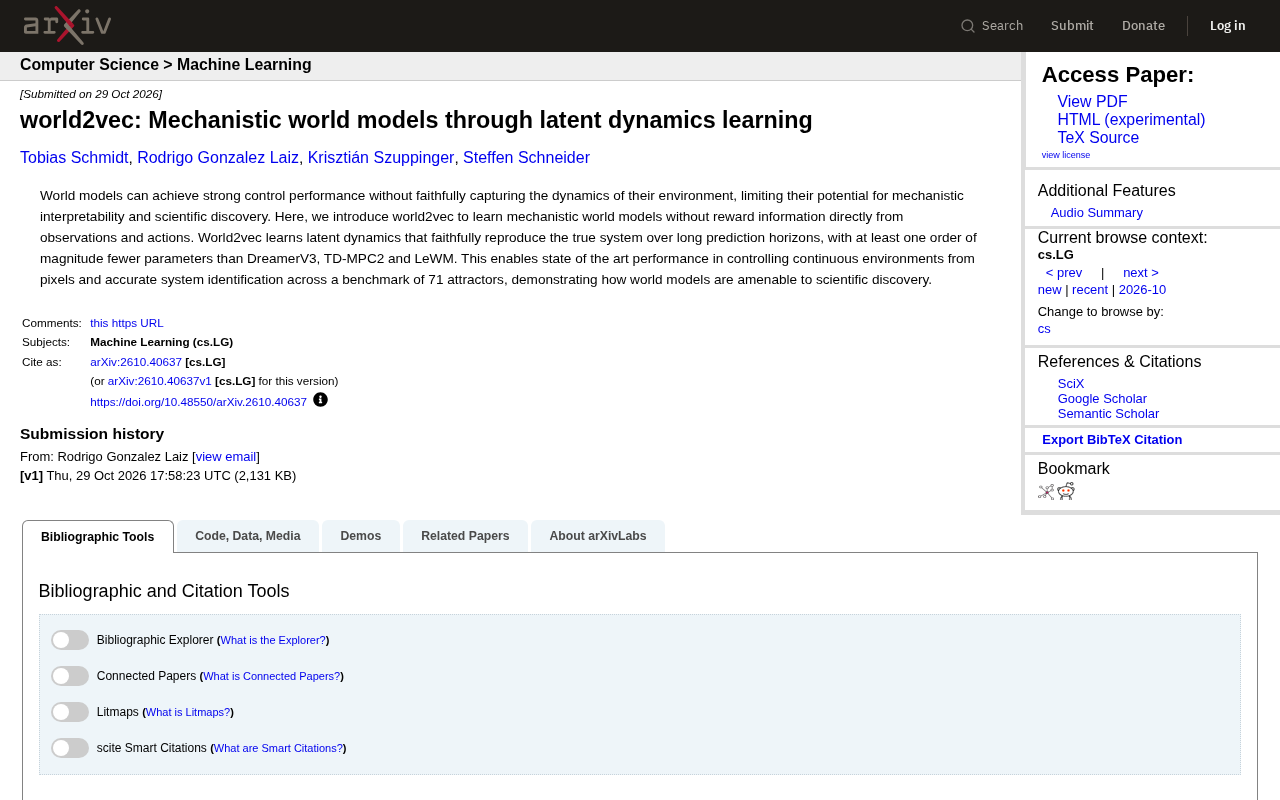
world2vec: Building Mechanistic World Models with Latent Dynamics Learning
world2vec proposes a reward-free method for learning mechanistic world models via latent dynamics, faithfully reproducing systems over long horizons with at least an order of magnitude fewer parameters than DreamerV3, TD-MPC2, and LeWM, and achieving accurate system identification on 71 attractor benchmarks.

A New KL-DRO Paradigm: Adaptive Scenario Generation Around a Learned Density Model
KL-DRO research proposes centering the KL ball on a learned density model instead of the empirical distribution, with adaptive scenario generation guiding sampling toward the worst case. Experiments show lower cost under distribution shift when records are scarce and the model can extrapolate, with comparable in-distribution cost.

ODE Samplers for Discrete Diffusion Models: Exponential Residual Flows Accelerate Generation
Discrete diffusion models lack deterministic ODE sampling? This article introduces Exponential Residual Flows (ERFs), which introduce continuous residual variables per token to construct piecewise ODEs for deterministic sampling and support consistency distillation acceleration. Superior to prior methods on code and text generation tasks.