@ai-sdk/vue 3.0.319 Released: Routine Maintenance and Version Alignment in the AI SDK Ecosystem

@ai-sdk/vue releases patch 3.0.319, syncing only core package ai@6.0.319, no feature changes.
@ai-sdk/vue 3.0.319 is a patch release automatically completed by GitHub Actions, limited to aligning with core package ai@6.0.319—no new APIs, no behavior changes. The AI SDK uses a layered architecture where the core package handles streaming, tool calls, and message management, and the Vue adapter provides composables like useChat. Version mismatches between layers can cause type inconsistencies or runtime exceptions, so synchronized patch releases eliminate these risks. For Vue developers, no code changes are needed; setting consistent version ranges for both packages is recommended.
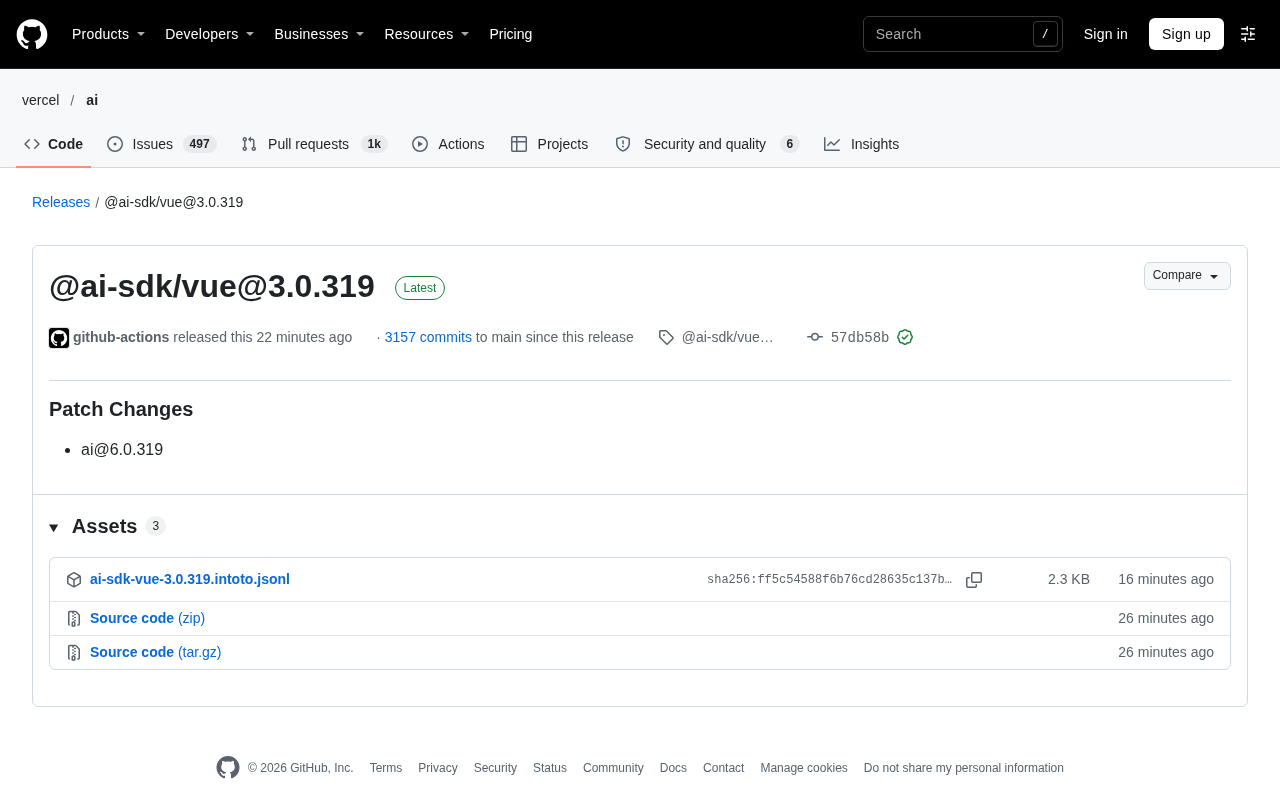
The AI SDK ecosystem under Vercel has received a routine patch version update. @ai-sdk/vue@3.0.319 was recently auto-published via GitHub Actions—a typical patch release primarily involving alignment with the underlying core package ai@6.0.319. For frontend developers building AI applications with Vue, this update contains no new features, but it reflects the standardized version management and ecosystem maintenance practices of the AI SDK project.
The Significance of Patch Releases: Maintaining Dependency Consistency
Looking at the release log, the changes in @ai-sdk/vue@3.0.319 are minimal—it only includes a reference to the patch change in ai@6.0.319. This release pattern is common in the AI SDK project: when the core package ai ships patch fixes or internal optimizations, the framework adapter packages follow suit with synchronized version numbers, ensuring that developers installing via npm or pnpm get compatible dependency combinations.
For projects using the Vue wrapper to call LLM capabilities, version alignment is not a trivial matter. The AI SDK architecture follows a layered design: the core package handles low-level logic such as streaming responses, tool calls, and message management, while @ai-sdk/vue provides composables like useChat that adapt core capabilities to Vue's reactivity system. Version mismatches between the two layers can lead to inconsistent type definitions or runtime behavior anomalies. Synchronized patch releases are precisely meant to eliminate such risks.
Semantic Versioning (SemVer) is the foundation for understanding what a patch release means. SemVer splits version numbers into three parts: major.minor.patch. Major version changes indicate incompatible API modifications, minor versions indicate backward-compatible feature additions, and patch versions contain only backward-compatible bug fixes. Therefore, the bump of the final digit to 319 in 3.0.319 semantically promises that existing calling patterns will not break—this is also the basis for the article's recommendation that developers can safely upgrade.
It's worth noting that the AI SDK's core package and framework adapter packages do not share synchronized major version numbers (ai is at 6.x, @ai-sdk/vue at 3.x). This practice of "same release batch, different major version lines" is common in monorepos. It means you cannot directly infer compatibility from version number digits alone; instead, you should rely on the peerDependencies declarations in the package manager or the compatibility matrix provided in the official documentation.
peerDependencies is the key mechanism by which such layered packages avoid version mismatches. Framework adapter packages typically declare the core package as a peer dependency rather than a regular dependency, requiring the consumer to explicitly install the core package in their project. This way, if npm or pnpm finds that the version range is not satisfied during installation, it will warn or even error out rather than silently installing a duplicate copy. pnpm is particularly strict about peer dependencies, flagging unmet ones in red immediately—so the article's advice to "keep the version ranges of both packages consistent" is especially practical in a pnpm environment.
The Maturity of the Automated Release Pipeline
This release was completed automatically by the github-actions bot. The commit record shows that this version was built from commit 3157 on the main branch and includes a GitHub verified signature. This detail reveals the engineering maturity of the AI SDK project's release process: automatic version number increments, automatic changelog generation, automatic upload of release artifacts—the entire process requires no manual intervention.
For open-source projects, the value of an automated release mechanism lies in reducing the probability of human error. As infrastructure relied upon by many production environments, the stability of AI SDK's release cadence directly affects downstream projects' upgrade decisions. Developers can confidently keep @ai-sdk/vue on a relatively recent patch version without worrying that each upgrade will introduce breaking changes.
The "GitHub verified signature" mentioned in the article corresponds to npm's provenance mechanism. During publishing, the CI environment (GitHub Actions in this case) generates verifiable build provenance information, using OIDC tokens to bind the published artifact to its source repository, specific commit, and build pipeline, with public records in a transparency log. Users can run npm audit signatures to verify that the downloaded package was indeed produced by the declared repository and pipeline. For widely depended-upon infrastructure packages, provenance can effectively mitigate the risk of supply chain poisoning and counterfeit packages.
Practical Impact for Vue Developers
If you are using @ai-sdk/vue to build chat interfaces, intelligent assistants, or other AI-driven frontend features, this update brings no code-level changes. That's exactly what a patch release is—it adds no new APIs, changes no behavior, and only performs the necessary version synchronization.
The real concern is the upgrade strategy. We recommend that developers set consistent version ranges for both @ai-sdk/vue and ai in package.json, leveraging the identical patch version numbers to simplify dependency management. At the same time, regularly check the changelog on the GitHub Releases page—even for patch releases, you can learn about the upstream core package's fix activity.
A Long-Term Perspective on Ecosystem Maintenance
From a broader perspective, high-frequency patch releases like @ai-sdk/vue@3.0.319 indicate that the AI SDK project is still in a rapid iteration phase. The core package ai has already reached patch version 6.0.319, meaning the project continues to fix issues and optimize internal implementations. For developers who depend on this ecosystem, staying informed about release activity is more meaningful than chasing every version number.
This release includes no visual changes beyond the screenshot, nor does it introduce new features—it falls under routine infrastructure-level maintenance. Its value lies not in what it brings, but in maintaining the stable operation of the entire dependency chain.
One-line Summary
@ai-sdk/vue releases patch version 3.0.319, only syncing with core package ai@6.0.319, no feature changes.
Paragraph Summary
@ai-sdk/vue 3.0.319 is a patch release automatically completed by GitHub Actions, with changes limited to aligning with the core package ai@6.0.319—no new APIs, no behavior changes. The article notes that the AI SDK uses a layered architecture: the core package handles streaming responses, tool calls, and message management, while the Vue adapter layer provides composables like useChat to integrate with the reactivity system. Version mismatches between the two layers can cause inconsistent type definitions or runtime exceptions, making synchronized patch releases a necessary step to eliminate risks. Automated publishing and GitHub verified signatures demonstrate the project's engineering maturity in version increments, changelog generation, and artifact upload, while also reducing the probability of human error. For Vue developers, this update requires no code changes—setting consistent version ranges for both packages and staying informed about upstream patch fixes is recommended.
Related articles
Build a Reasoning Model from Scratch: An 11-Hour Open-Source Course Breakdown
Sebastian Raschka releases a free 8-episode, ~11-hour video course teaching you to build a reasoning model from scratch with Python and PyTorch—from a small Qwen3 model through Verifier, Inference Time Scaling, GRPO, and distillation, with open-source code on GitHub.

An 11-Hour Reasoning Model Course in Practice: How Small Models Learn to Think
Starting from Sebastian Raschka's 11-hour reasoning model course and HN buzz, this analyzes small-model training, legal text version control, Anthropic data policy, and product reliability reviews.

Lightpanda: A Headless Browser Built for AI and Automation
Lightpanda is a headless browser built from scratch in Zig for AI and automation, with 37,852 GitHub stars. This analysis covers its technical approach, design choices, and use cases.