AI SDK Vue 3.0.325 Patch Released: Dependency Sync Update

@ai-sdk/vue releases 3.0.325 patch, syncing core and utility package versions.
The AI SDK's Vue adapter @ai-sdk/vue releases patch 3.0.325, introducing no new features or breaking changes; the core action is syncing dependencies to ai@6.0.325 and @ai-sdk/provider-utils@4.0.65. Such patch releases matter for version alignment: misalignment between framework adapters and the core package can cause type mismatches or runtime differences. Upgrading usually just means updating the version and reinstalling, but run existing tests to verify streaming and tool calls.
Title
AI SDK Vue 3.0.325 Patch Released: Dependency Sync Update
Meta Description
AI SDK's Vue adapter package releases patch version 3.0.325, syncing dependencies to ai@6.0.325 and @ai-sdk/provider-utils@4.0.65. No breaking changes; maintenance release.
Article Content
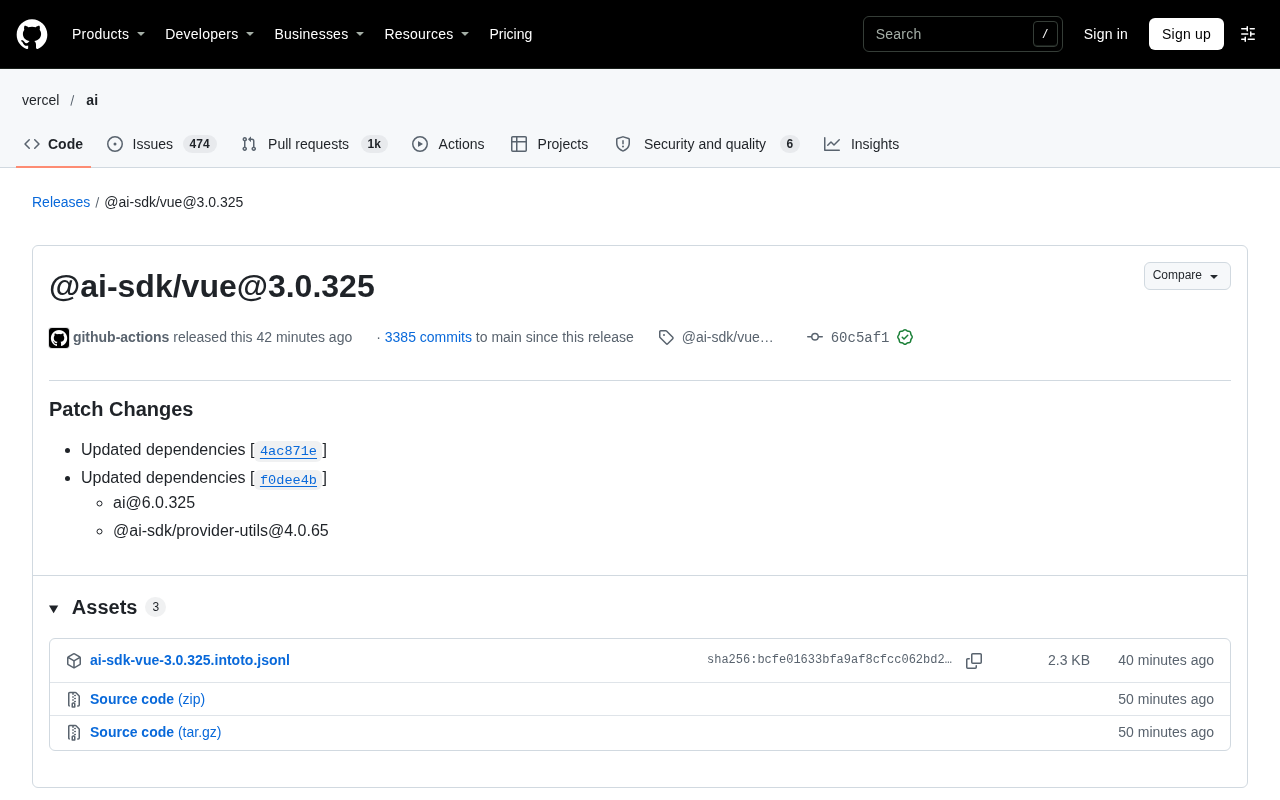
The AI SDK's Vue adapter layer has released a small patch version, bringing the version number to 3.0.325. According to the changelog, this update introduces no new features; the core action is following the version progression of the upstream core package ai and the utility package @ai-sdk/provider-utils.
Specifics of the Patch Changes
This release is explicitly labeled as Patch Changes, meaning it is a patch-level update that does not involve breaking changes and does not alter how existing APIs are called. The changelog entry lists only two dependency updates, along with their corresponding commit hashes.
Specifically, the dependencies of @ai-sdk/vue have been synced to ai@6.0.325 and @ai-sdk/provider-utils@4.0.65. This pattern is quite common in AI SDK's release cadence: the core package leads, and the framework adapter packages follow, ensuring that Vue users receive versions consistent with the core capabilities.
Why Dependency Sync Matters
For those building Vue applications directly with the AI SDK, the significance of a patch version update often lies not in "what new things it uses" but in version alignment. There is an implicit contract between framework adapter packages and the core package; if the two versions are misaligned, issues such as type definition mismatches and runtime behavior differences can easily arise.
From this perspective, 3.0.325 is more of a maintenance release, bringing the Vue package back to a baseline consistent with the mainline.
The AI SDK consists of multiple packages. ai is the core package, providing main APIs such as generateText and streamText; @ai-sdk/provider-utils is the utility package, encapsulating common logic needed for model provider adaptation, such as request construction, streaming response parsing, and error handling. @ai-sdk/vue is the framework adapter package, wrapping core capabilities into Vue composables. The adapter package declares these two packages as dependencies in package.json, so after the core package releases a new version, the adapter package needs to bump its dependency versions in sync to ensure that matching implementations are pulled during installation. If versions are misaligned, problems may occur such as inconsistent signatures when the adapter package calls internal interfaces of the core package, or type definitions becoming disconnected from runtime code.
Semantic Versioning (SemVer) stipulates that a version number consists of three segments: major, minor, and patch, in the form 3.0.325. A major version change indicates incompatible API modifications, a minor version change indicates backward-compatible feature additions, and a patch version change indicates backward-compatible bug fixes. This release is marked as Patch Changes, meaning the last segment of the version number is incremented, making it the least impactful of the three types of changes. In multi-package repositories like the AI SDK, patch versions are also commonly used for dependency syncing—even if the adapter package's own code has not changed, as long as the version of the core package it depends on changes, a new patch version needs to be released so that downstream users can obtain the aligned dependency combination through the regular upgrade process.
Practical Impact on Vue Developers
If you have pinned @ai-sdk/vue in your project, upgrading to 3.0.325 usually only requires updating the version number and reinstalling dependencies. Since it is a patch version, no code-level modifications are expected.
It is worth noting that this release also updates @ai-sdk/provider-utils, a package responsible for common utilities for model provider adaptation. Its version change may indirectly affect behavior when interfacing with various model services, although the changelog does not elaborate on the specifics.
Upgrade Recommendations
For production projects prioritizing stability, patch versions can generally be followed with confidence, but it is still recommended to run existing tests after upgrading to confirm that key paths such as streaming responses and tool calls are functioning normally. For projects that have not yet upgraded to the 3.x series, this patch is not a reason to upgrade; proceed according to your existing migration plan.
Lockfiles (such as package-lock.json and pnpm-lock.yaml) record the exact version and integrity hash of each dependency, ensuring that team members and CI environments install an identical dependency tree. Version ranges are written in package.json, with common notations including ^3.0.325 (allowing patch and minor updates within the 3.x range) and ~3.0.325 (allowing only patch updates). For packages that release patches frequently, using ^ ranges together with lockfiles is a common strategy: daily installs are locked to verified versions, and when proactive updates are needed, run the upgrade command and commit the new lockfile. This avoids accidentally pulling unverified new versions on every install while retaining the flexibility to follow up as needed.
Release Cadence Observations
This release was completed automatically by github-actions and carries a GitHub verified signature. The commit is on the main branch, with a cumulative commit count reaching 3385. The automated release process indicates that the AI SDK team employs a continuous delivery model, pushing versions in small, rapid increments.
For users, the benefit of this cadence is that fixes and syncs land quickly; the cost is frequent version number updates, which need to be managed through lockfiles or version range strategies.
Conclusion
@ai-sdk/vue@3.0.325 is a typical patch release, focused on dependency syncing rather than feature evolution. It reminds Vue developers using the AI SDK that version coordination between framework adapter packages and the core package is a detail that maintains project stability and deserves attention in dependency management.
One-line Summary
@ai-sdk/vue releases 3.0.325 patch, syncing core and utility package versions.
Paragraph Summary
The AI SDK's Vue adapter package @ai-sdk/vue releases patch version 3.0.325. The changelog shows that this update introduces no new features and involves no breaking changes; the core action is syncing dependencies to ai@6.0.325 and @ai-sdk/provider-utils@4.0.65. The article notes that the value of such patch releases lies in version alignment: there is an implicit contract between framework adapter packages and the core package, and version misalignment can cause type definition mismatches or runtime behavior differences. For developers building AI applications with Vue, upgrading usually only requires updating the version number and reinstalling dependencies, but it is recommended to run existing tests after upgrading to confirm that key paths such as streaming responses and tool calls are functioning normally. The release was completed automatically by github-actions, reflecting the AI SDK team's continuous delivery, small-and-fast release cadence.
Related articles
 Tech Frontiers
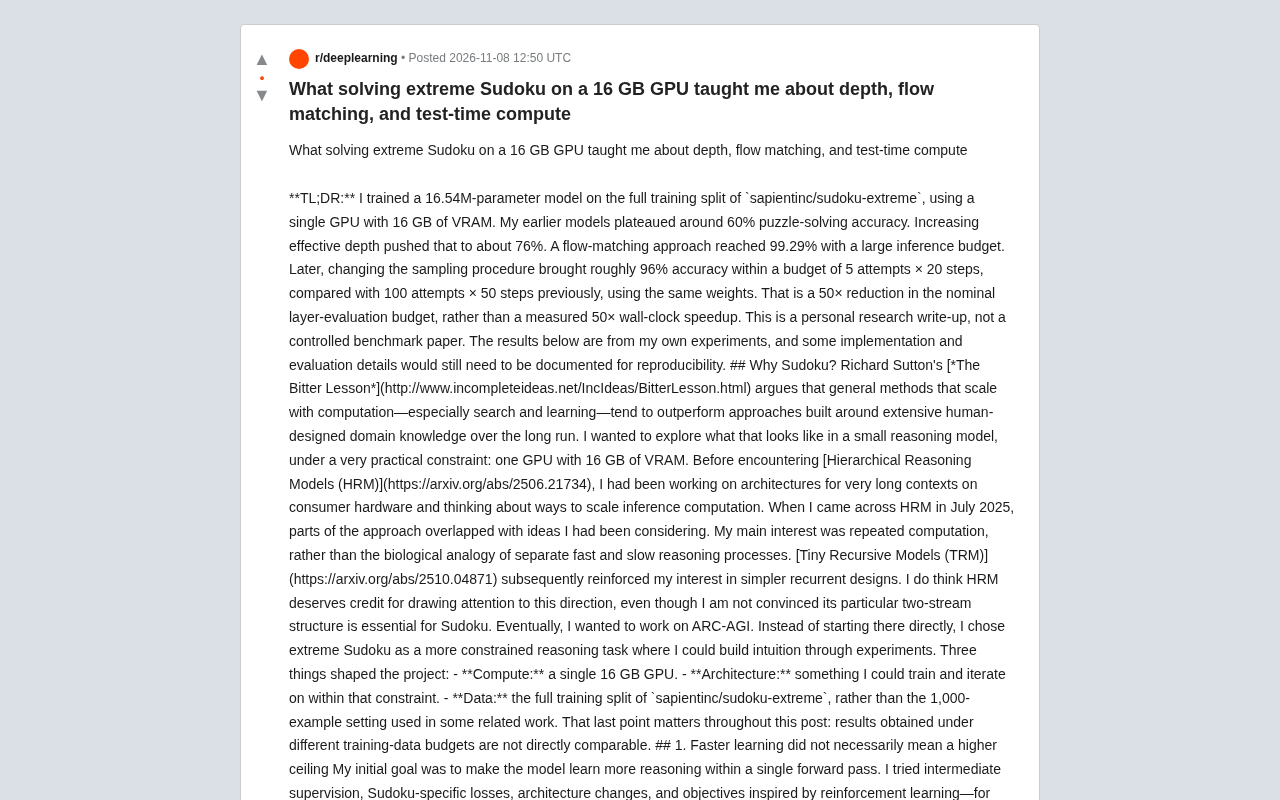
Pushing the Limits of Extreme Sudoku on a 16GB GPU: Insights from Depth and Flow Matching
A researcher trained a 16.54M-parameter model on a 16GB GPU to solve extreme Sudoku, finding effective depth breaks the 60% plateau and flow matching with improved sampling pushes accuracy past 99% with ~50× lower layer-evaluation budget.
 Tech Frontiers
AI Agent Approval Workflows: Why Human Confirmations Always Get Mindlessly Clicked
Why do AI agent approval workflows always get mindlessly clicked? A Reddit discussion shows that separating rules from keys, low-frequency high-risk approvals, and GitHub Environments-style gates are the keys to effective approvals.
 Tech Frontiers
MuJoCo: An Analysis of DeepMind's Open-Source General-Purpose Physics Simulator
An in-depth analysis of Google DeepMind's open-source physics simulator MuJoCo: high-performance C++ kernel, MJCF modeling format, contact solving principles, MJX GPU acceleration, and robot reinforcement learning use cases.