AI SDK Vue 3.0.337 Patch Release: Dependency Update Breakdown
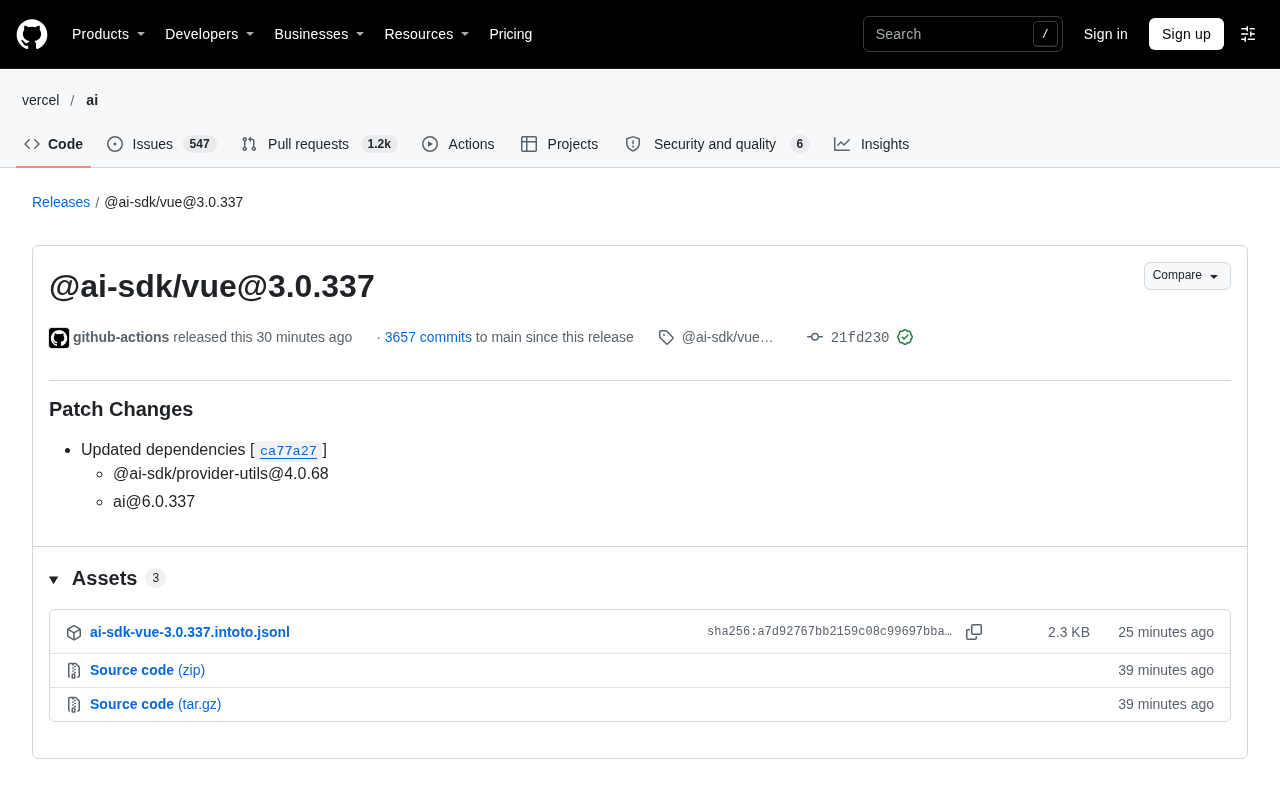
@ai-sdk/vue releases 3.0.337 patch, synchronizing dependency versions with no functional changes.
AI SDK's Vue package @ai-sdk/vue releases patch 3.0.337, with the core change being dependency version synchronization: @ai-sdk/provider-utils upgraded to 4.0.68, and the core ai package aligned to 6.0.337. The Vue package itself has no new APIs or behavioral changes. The article breaks down the monorepo release mechanism behind this update, highlights the structure of same-number main packages and independent version lines for utility packages, and recommends keeping @ai-sdk/vue and ai at the same version while checking whether provider-utils is pinned to an outdated version. Since this is a dependency-synchronization-level patch, running type checks and key interaction flows after upgrading confirms no behavioral differences. Overall, frequent patch iterations reflect the project's rapid maintenance phase and a highly automated, traceable release process.
A Small but Important Patch Update
The Vue package of AI SDK, @ai-sdk/vue, has released version 3.0.337. Based on the release information, this is a typical patch update, with the core action being synchronizing dependency versions: @ai-sdk/provider-utils is upgraded to 4.0.68, while the ai package is aligned to 6.0.337. The high consistency of version numbers indicates that the entire AI SDK ecosystem maintained strict synchronization in this release cycle.
At first glance, this type of update seems like routine maintenance, but for frontend teams building Vue applications on AI SDK, dependency version alignment is meaningful in itself—it often determines whether type hints are consistent and whether interfaces between different packages work together properly.
Breakdown of the Update
Specific Dependency Changes
The release notes indicate the change type as "Patch Changes" and point to a commit that updated two dependencies: @ai-sdk/provider-utils@4.0.68 and ai@6.0.337.
This means @ai-sdk/vue itself did not introduce new APIs or behavioral changes; its changes come from version advances in the underlying utility package and core package. provider-utils belongs to the public utility layer for provider integration, while ai is the core package of the SDK. After these two are updated, the Vue package synchronously references them, which is standard practice in monorepo release workflows.
@ai-sdk/provider-utils plays the role of a public utility layer for provider adaptation in the AI SDK architecture: it encapsulates the underlying capabilities shared by various model providers (such as OpenAI, Anthropic, etc.) during integration, including request wrapping, streaming response parsing, schema validation, and error type definitions. The Vue package itself does not communicate directly with model services but indirectly depends on these capabilities through the core ai package and this utility layer. Therefore, although patch upgrades to provider-utils do not change upper-level APIs, they may affect parsing details of streaming data or the precision of type definitions—such changes often only manifest in edge cases.
The Release Mechanism Behind Version Synchronization
You may not have noticed that the version numbers of the three packages show an obvious correspondence: both the Vue package and the core ai package fall on the 6.0.337 sequence, while provider-utils is on the 4.0.68 sequence.
This structure of "same number for main packages, independent numbers for utility packages" reflects AI SDK's strategy of using independent version lines for each package but advancing them uniformly at release time. The direct implication for users is: when upgrading, it is best to keep @ai-sdk/vue and ai at the same version number to avoid type or behavioral mismatches caused by mixing different release batches. The release notes show that this commit was verified with a GitHub signature, indicating that the release pipeline is automated and traceable.
Monorepo (single code repository) is the key background for understanding this release mechanism. Multiple packages of AI SDK (@ai-sdk/vue, ai, @ai-sdk/provider-utils, etc.) coexist in the same code repository, sharing build configurations, test suites, and release pipelines. The advantage of this structure is that cross-package changes can be completed atomically in a single commit, avoiding the version drift commonly seen in multi-repository coordination; with release tools like Changesets, each package can maintain an independent version number sequence, but all affected packages in the same release will generate new versions together. Therefore, when you see the Vue package and core package version numbers strictly aligned while the utility package follows an independent sequence, this is a typical product of the monorepo plus Changesets workflow, not a coincidence.
Practical Impact on Developers
Upgrade Recommendations
Since there are no functional changes in this release, the benefits of upgrading are mainly in dependency consistency rather than new capabilities. It is recommended to check and upgrade @ai-sdk/vue, ai, and @ai-sdk/provider-utils together to the corresponding versions in your project, especially when the project has manually pinned the provider-utils version, which can easily lead to inconsistencies between the utility package and the version referenced by the Vue package.
When to Pay Attention
If the project has previously encountered subtle issues related to provider adaptation, or if type definitions are misaligned across multiple AI SDK packages, such patch versions often fix them along the way. After upgrading, run existing type checks and key interaction flows to confirm there are no behavioral differences caused by dependency advances.
Observations and Judgments
Looking at this release within the overall rhythm of AI SDK, the high-frequency patch iterations indicate that the project is still in a rapid maintenance phase, and the release process is already highly automated—triggered by GitHub Actions, commits with verified signatures, and version numbers advancing continuously.
For users, this type of update does not require excessive concern, but it is also not advisable to stay on old versions for long. Keeping pace with the official release rhythm is the lowest-cost strategy when using this type of rapidly evolving toolchain.
Frequently Asked Questions
Does this update require code changes? Based on the release notes, no—it is a patch update at the dependency synchronization level.
Must the version numbers of the three packages be consistent? It is recommended to keep @ai-sdk/vue and ai consistent; provider-utils can be upgraded along its independent version line, but avoid manually pinning it to an outdated version.
How to confirm the update took effect? Check the version numbers of the corresponding packages in the lock file and run the project's type checks and key flow tests.
One-line Summary
@ai-sdk/vue releases 3.0.337 patch, synchronizing dependency versions with no functional changes.
Paragraph Summary
The Vue package of AI SDK, @ai-sdk/vue, has released patch version 3.0.337. The core change is synchronizing dependency versions: @ai-sdk/provider-utils is upgraded to 4.0.68, and the core ai package is aligned to 6.0.337. The Vue package itself has no new APIs or behavioral changes. The article breaks down the monorepo release mechanism behind this update, points out the structural characteristics of same-number main packages and independent version lines for utility packages, and provides upgrade recommendations: keep @ai-sdk/vue and ai at the same version number, and check whether provider-utils has been manually pinned to an outdated version. Since this is a patch at the dependency synchronization level, running type checks and key interaction flows after upgrading is sufficient to confirm no behavioral differences. Overall, the high-frequency patch iterations reflect that the project is still in a rapid maintenance phase, and the release process is already highly automated and traceable.
Related articles

Nothing CMF Buds 2A Drops to $17.89 on Black Friday: A New Low for ANC Earbuds
Nothing CMF Buds 2A wireless earbuds Black Friday deal: just $17.89 on Amazon, about $11 off retail and a record low. ANC earbuds at an entry-level price.

When AI Creation Gets Accused of "Spitting": Hacker News Heats Up Over the Glaude Controversy
A Hacker News post, "Spitting in the Face of Glaude," sparks debate on AI creation transparency and attribution ethics. This analysis examines the blurred creator identity behind the controversy and offers practical advice for AI content production.

Akai Embraces Custom Firmware: MPC Sample 1.4 Lets Users AI-Program Their Sampler
Akai embraces the modding community with MPC Sample 1.4 firmware, supporting vibe-coded custom firmware and effects. We analyze the impact of this open strategy on music hardware and AI-assisted programming.