@ai-sdk/vue 4.0.111 Released: A Dependency-Update Patch
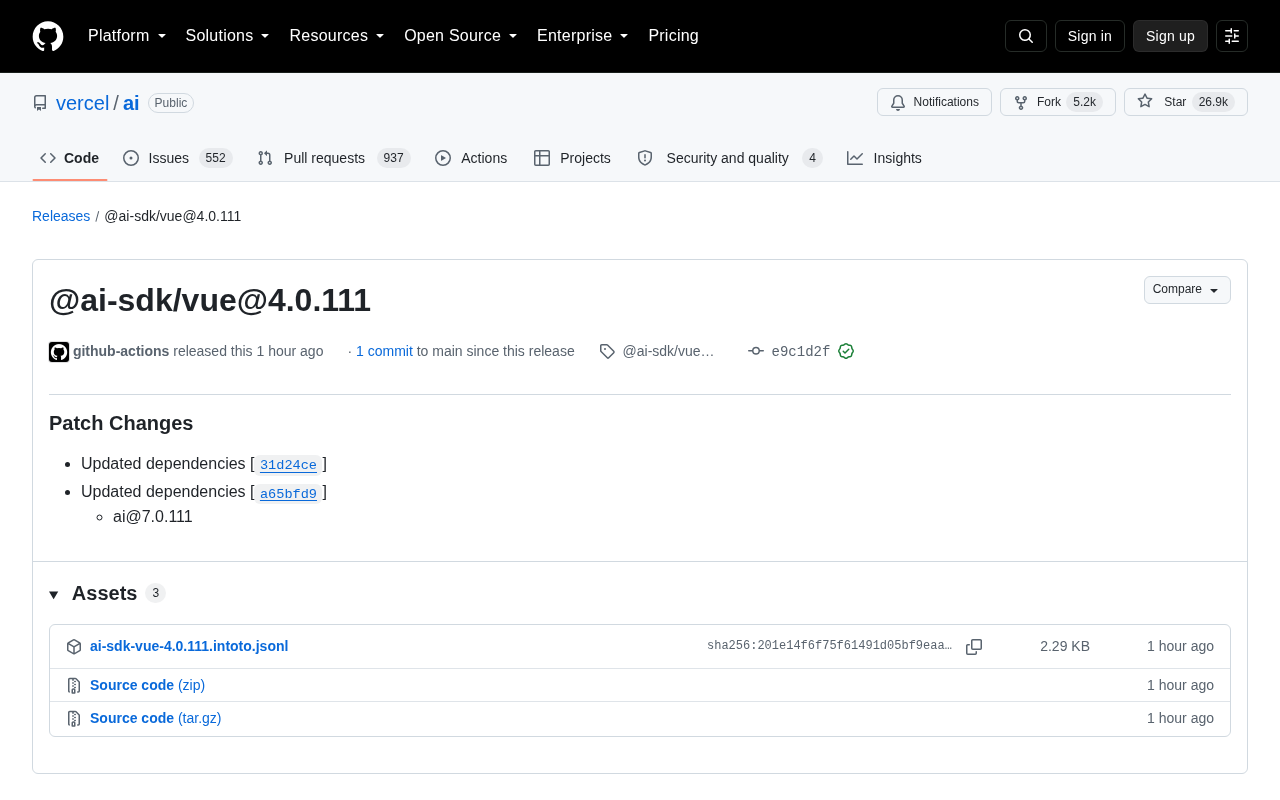
@ai-sdk/[email protected] is a routine patch syncing with the core [email protected] package — no breaking changes.
Vercel AI SDK recently released `@ai-sdk/[email protected]`, a patch version focused on syncing with the upgraded core package `[email protected]`. Per SemVer, a PATCH increment means no breaking changes and no new public APIs — just keeping the Vue adapter aligned with the core. Published automatically via GitHub Actions with GPG signature verification, the release is trustworthy and low-risk for production upgrades. Projects using standard dependency ranges will pick it up automatically on next install; running your test suite afterward is recommended.
Vercel's AI SDK ecosystem has received another minor iteration. GitHub Actions recently auto-published @ai-sdk/[email protected], a patch release focused primarily on dependency updates. For developers integrating AI capabilities into Vue projects, understanding the nature of such updates helps inform upgrade timing decisions.
Release Highlights
According to the release records in Vercel's ai repository, @ai-sdk/[email protected] falls under Patch Changes, with the core content being upstream dependency synchronization:
- Updated dependency reference
31d24ce - Updated dependency reference
a65bfd9 - Synced with core package
[email protected]
This version was automatically published by github-actions with commit hash e9c1d2f, and was verified via GitHub's GPG signature (key ID: B5690EEEBB952194). This means the release source is trustworthy and developers can pull it with confidence.
GPG (GNU Privacy Guard) signature verification is a critical mechanism for open-source software supply chain security. Publishers sign commits or tags with their private key, and anyone can verify the authenticity of the signature using the corresponding public key — confirming the code genuinely comes from an authorized publisher rather than a tampered third party. GitHub displays a green "Verified" badge next to verified commits. The GPG key ID B5690EEEBB952194 used in this release belongs to the GitHub Actions bot, indicating the entire release process was completed automatically by CI with full traceability, reducing the risk of human error or malicious code injection. For teams consuming npm packages directly in production, this serves as a useful indicator when evaluating dependency trustworthiness.
What a Patch Version Means
From a Semantic Versioning (SemVer) perspective, 4.0.111 increments only the patch number compared to 4.0.110, indicating this update contains no breaking changes and introduces no new public APIs. Its primary purpose is to keep the Vue adapter layer in sync with the underlying [email protected].
The AI SDK uses a multi-package design where @ai-sdk/vue serves as the Vue framework binding layer, exposing the core ai package's capabilities — such as streaming responses, message state management, and the useChat composable — to Vue components. When the core package upgrades, the various framework bindings (Vue, React, Svelte, etc.) typically publish corresponding versions to align dependencies.
Semantic Versioning (SemVer) is the most widely adopted software versioning convention, using the format MAJOR.MINOR.PATCH. A MAJOR increment signals incompatible API changes, MINOR signals backward-compatible new features, and PATCH signals only backward-compatible bug fixes or internal adjustments. The upgrade of @ai-sdk/vue from 4.0.110 to 4.0.111 is a textbook PATCH increment. In the npm ecosystem, caret ranges like ^4.0.0 automatically resolve to the latest version within the same MAJOR, so most projects receive patch updates without manual intervention. Tilde ranges like ~4.0.110 allow only PATCH changes, which also includes this update. Understanding SemVer semantics helps developers establish sound dependency locking strategies across different projects.
What Developers Should Pay Attention To
For production projects, patch releases focused purely on dependency updates carry low upgrade risk. Recommended steps for developers:
- If using dependency ranges like
^4.0.0or~4.0.110, your package manager will automatically pick up this version on the next install; - After upgrading, run your existing test suite to confirm that features like streaming conversations and message rendering have no regressions;
- Check the full changelog for upstream
[email protected]to understand exactly which underlying issues were fixed.
It's worth noting that the release record itself only lists "updated dependencies" as a summary, without detailing the specific fixes in those dependencies. Developers wanting to track the specifics should further examine commits 31d24ce and a65bfd9, as well as the standalone release notes for the ai package.
Summary
@ai-sdk/[email protected] is a routine patch release in Vercel AI SDK's continuous iteration cycle, focused on dependency synchronization with no significant functional changes. It reflects the SDK's high-frequency, incremental maintenance style — using frequent automated releases to ensure all framework adapter layers stay consistently aligned with the core package, providing a stable foundation for AI application development in the Vue ecosystem.
Related articles

Fish Audio Drama 3 Open-Source Launch Sparks Debate: The 35B Speech Model's Selling Points and Licensing Controversy
Fish Audio Drama 3 sparks debate with 35B parameters and open weights, ranking first on pronunciation benchmarks with director-style control and word-level inpainting, but its community license restricts commercial resale, API prices are rising, and local runs need ~39GB VRAM.

curl 8.23.0 Fixes 24 CVEs, AI-Assisted Research Contributed 20
curl 8.23.0 fixes 24 CVEs, 20 found by AI-assisted research, including a High-severity HTTP/2 use-after-free that could become RCE. Here's the source, fix details, and upgrade checklist.

MP3 vs WAV: Which Format Should You Choose for Voice Recording
MP3 vs WAV for voice recording: compare lossy vs uncompressed formats for interviews, transcription, and archiving—and learn the common mistake of converting formats after the fact.