@ai-sdk/vue 4.0.123 Released: Build Tooling Migrated to tsdown

@ai-sdk/vue 4.0.123 migrates its build tooling from tsup to tsdown in a low-risk patch release.
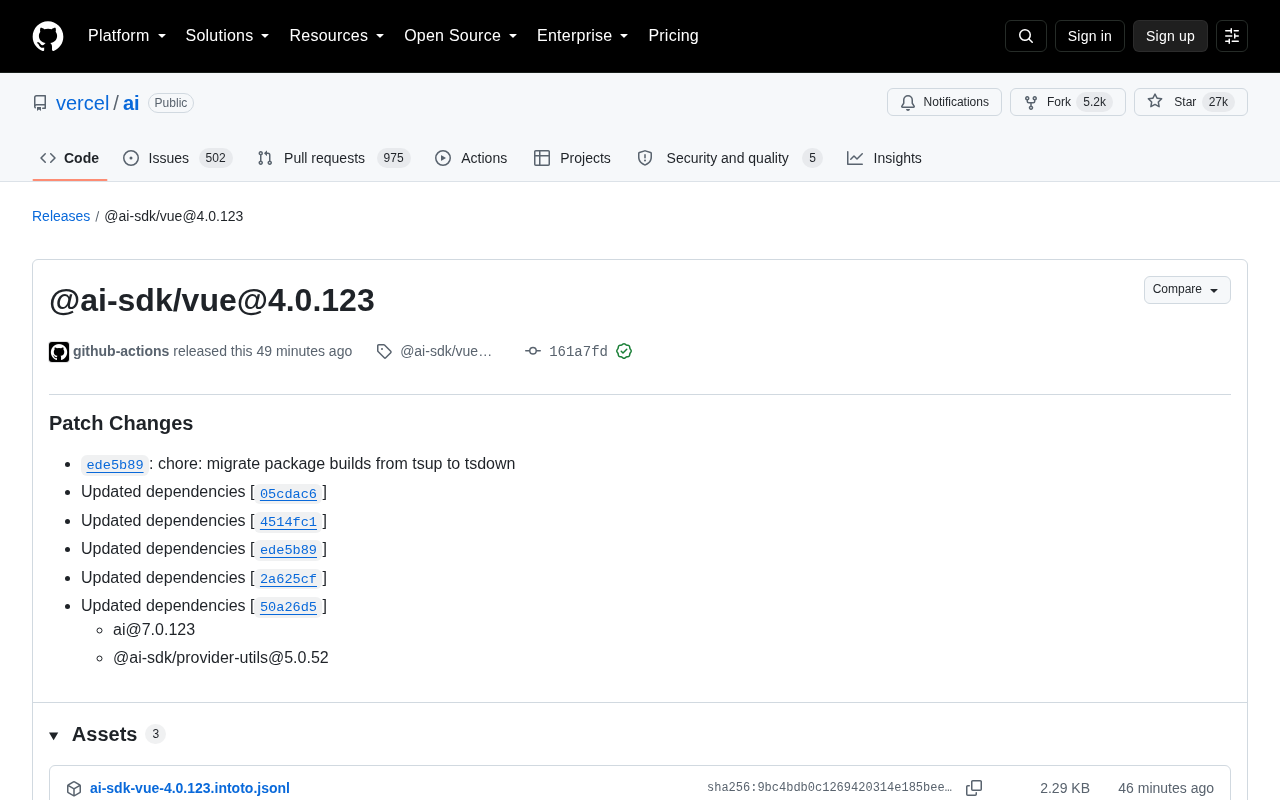
Vercel AI SDK's Vue integration package `@ai-sdk/vue` has released patch version 4.0.123, migrating its build toolchain from `tsup` to the Rust-powered `tsdown`, and bumping core dependencies `ai@7.0.123` and `@ai-sdk/provider-utils@5.0.52`. No API changes are introduced — the upgrade is largely transparent to end users, with the main benefits being faster builds and a unified monorepo release cadence. Developers should run standard regression tests on streaming and SSR scenarios after upgrading, as build output format changes can occasionally surface edge-case compatibility issues.
Vercel's AI SDK ecosystem continues to evolve, with the Vue integration package @ai-sdk/vue recently releasing version 4.0.123. This is a patch-level update focused on build toolchain adjustments and dependency upgrades. While it doesn't introduce major new features, it's still worth noting for developers who care about the stability of their AI application toolchain.
What Changed in 4.0.123
The primary change in this release is migrating the package's build process from tsup to tsdown (commit ede5b89). This is a classic infrastructure-level upgrade: tsup is a widely-used TypeScript bundler in the community, while tsdown is a newer alternative that emphasizes faster build speeds and better support for modern output formats.
For end users, this kind of change is typically transparent — the API remains unchanged, and only the bundling mechanism and build efficiency are affected. From a maintenance perspective, however, unifying the build toolchain helps the entire AI SDK project maintain consistent release quality and developer experience across its many sub-packages.
tsup is built on esbuild and is known for its zero-config, ultra-fast bundling — it's been the go-to choice for TypeScript library authors over the past few years. tsdown, on the other hand, is a higher-level wrapper powered by Rolldown (a next-generation bundler rewritten in Rust by the Vite team). Its goal is to preserve tsup's ease of use while leveraging Rust's native performance for even faster builds, with finer control over ESM/CJS dual-format output and tree-shaking. For a monorepo like Vercel AI SDK with dozens of sub-packages, build time directly impacts release velocity — migrating to tsdown aligns with the broader industry trend toward Rust-based tooling.
Dependency Updates
Alongside the build tool migration, this release also bumps several upstream dependencies. The most notable are:
ai@7.0.123: The core AI SDK package that powers the Vue integration layer@ai-sdk/provider-utils@5.0.52: Utilities for model provider integrations
One interesting detail worth noting: @ai-sdk/vue (4.0.123) and the core ai package (7.0.123) have different major versions, yet their patch numbers (123) stay in sync. This reflects Vercel AI SDK's unified release cadence — likely managed via a tool like changesets in a monorepo setup — where all sub-packages increment their patch version together in each release, ensuring inter-package compatibility.
Changesets is currently the most popular versioning and release tool for monorepo projects, originally open-sourced by Atlassian. Developers attach a "changeset" file describing the change level (major/minor/patch) when committing, and the tool automatically aggregates all pending changes at release time, bumps each sub-package's version following semver rules, and generates a CHANGELOG. This explains why
@ai-sdk/vue(4.x) andai(7.x) have different major versions yet keep their patch numbers in sync — they're processed together in the same changeset release pipeline, making it a "coordinated release" rather than strict version alignment.
What This Means for Vue Developers
@ai-sdk/vue is designed to provide Vue developers with out-of-the-box AI integration capabilities — things like streaming conversations and component-level AI interactions. It lets Vue developers call large model APIs using the familiar Composition API style, without having to manually handle streaming responses, state management, and other low-level concerns.
For projects currently using this package, upgrading to 4.0.123 is a low-risk operation. The semantic versioning convention for patch releases means no breaking changes should be introduced. The main benefits are more stable build artifacts and alignment with the latest core packages. That said, it's still advisable to run standard regression tests after upgrading — particularly for streaming response and SSR (server-side rendering) scenarios — since changes in build output format can occasionally surface compatibility issues in edge cases.
SSR scenarios with streaming AI responses require particular attention to module format compatibility in the build output. Node.js server environments and browser clients have different levels of ESM and CJS support, and frameworks like Nuxt and Vite SSR each have their own module resolution strategies. A build tool migration may alter how the
exportsfield is declared or how chunks are split in the output. If the server and client end up loading artifacts in different formats, you can occasionally encounter state-sharing anomalies caused by inconsistent module instances — which is the primary reason official guidance recommends targeted regression testing for SSR scenarios.
The Continued Evolution of AI SDK
Vercel AI SDK has now accumulated over 27k stars and 5.2k forks on GitHub, making it one of the most active AI application development frameworks in the JavaScript/TypeScript ecosystem. Built around a "framework-agnostic" design philosophy, it provides adapter layers for major frontend frameworks beyond Vue, including React and Svelte.
The high-frequency patch releases (the version numbers alone indicate hundreds of iterations) reflect the team's active maintenance commitment. This incremental release strategy is a net positive for production users — bug fixes and dependency security updates land quickly, while semantic versioning keeps upgrade costs low. For teams evaluating technology choices, this level of maintenance activity is itself an important signal worth weighing.
Related articles

Gemini 4 Argon Hands-On: AI Builds Board Games, Constructs Temples, and Trains Robots Autonomously
Gemini 4 Argon hands-on roundup: AI autonomously builds a desk racetrack and temple in Blender, writes a ray tracing engine, trains a humanoid robot to sink 7 shots, plus API pricing and developer access.

The Magic Octagonal Coin: Why Only 9% of People Can Predict Its Flip?
Only 9% of people can correctly predict the Magic Octagon coin flip. This article explains its spatial rotation mechanism, common cognitive pitfalls, and a new hypothesis based on Relevance Theory, exploring the limits of human spatial reasoning.

Sam Altman: AI Is Entering the Era of Scientific Discovery — Math Breakthroughs Will Replicate in Biology and Energy
Sam Altman says AI is entering the era of scientific discovery — math breakthroughs will replicate in biology, materials science, and energy to help develop new drugs and energy sources.