@ai-sdk/vue 4.0.128 Released: Dependency Sync Update Explained

Vercel AI SDK's Vue adapter gets a patch release syncing core dependencies — safe to upgrade with no breaking changes.
`@ai-sdk/[email protected]` is a routine patch release from Vercel AI SDK for the Vue framework, primarily syncing multiple changes from `[email protected]` and `@ai-sdk/[email protected]` into the Vue adapter layer without introducing new features or breaking API changes. This dependency-alignment release is a typical outcome of monorepo multi-package management, ensuring version consistency across all SDK layers. As a patch update under SemVer, existing Vue/Nuxt projects can upgrade directly without modifying business code. The release is produced by GitHub Actions with a GPG-verified signature, making it a low-risk, low-effort routine maintenance update for production projects.
Vercel's AI SDK has released @ai-sdk/vue version 4.0.128 as a patch release. This is a routine maintenance update focused on dependency upgrades, introducing no breaking changes — making it a smooth, safe upgrade for existing Vue projects.
What's in This Update
According to the GitHub Release page, @ai-sdk/[email protected] is classified as a Patch Change, with its core changes centered on dependency version bumps rather than feature-level modifications.
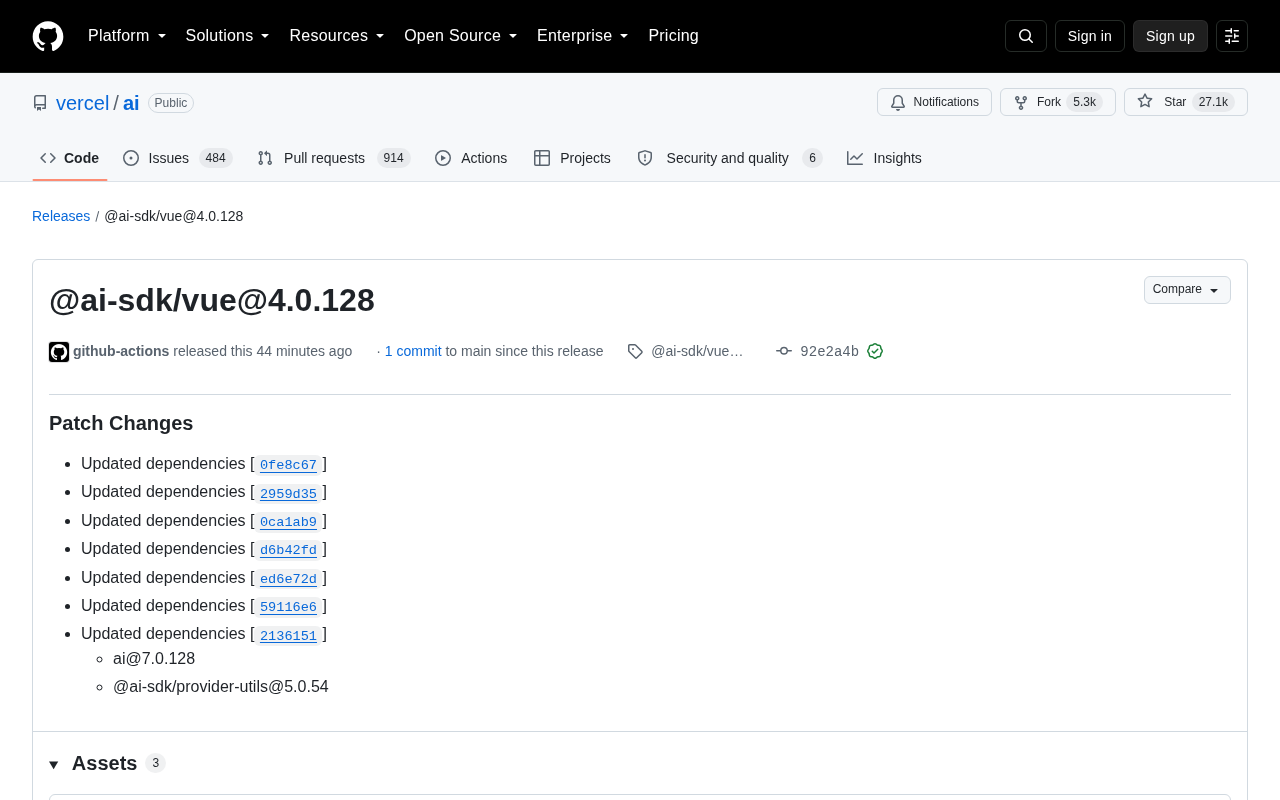
The release notes list multiple Updated dependencies entries, referencing commits 0fe8c67, 2959d35, 0ca1ab9, d6b42fd, ed6e72d, 59116e6, and 2136151. These updates ultimately bump two key underlying packages:
[email protected]@ai-sdk/[email protected]
This means the Vue adapter layer itself has not had its logic rewritten — it simply aligns with the latest iterations of the core ai package and the provider-utils utility package. For developers building Vue applications with the Vercel AI SDK, this kind of release ensures version consistency across the entire SDK ecosystem.
Why Dependency Syncing Matters
In the Vercel AI SDK architecture, @ai-sdk/vue is a higher-level wrapper for the Vue framework, relying on the core ai package and @ai-sdk/provider-utils for shared capabilities. When the core package fixes issues or refines its interfaces, the framework-specific packages need to align their versions so developers can benefit from the latest fixes and improvements.
Patch versions follow Semantic Versioning (SemVer) and typically contain only backwards-compatible fixes with no breaking API changes. Projects currently on the 4.0.x series can therefore upgrade safely without needing to rewrite any existing code.
The fact that this update references seven dependency commits reflects how a series of changes in the underlying ai package were bundled together into a single release. This cascading update pattern is a hallmark of modern monorepo multi-package publishing workflows.
What is a Monorepo? A monorepo (monolithic repository) is a development pattern where multiple related packages are managed together in a single code repository. Vercel AI SDK uses this architecture, meaning
@ai-sdk/vue,@ai-sdk/react, theaicore package, and others all evolve together in the same repo. When an underlying package changes, tooling like Changesets can automatically compute dependency relationships and generate cascading version updates, ensuring interface contracts between packages always stay in sync. This explains why this release references as many as seven commit hashes — each corresponds to a specific change deeper in the stack, all rolled up into a single patch release for the framework package. For developers, this model means upgrading a single package name is all it takes to get the latest state of the entire dependency chain, without manually aligning sub-package versions one by one.
What This Means for Vue Developers
For teams integrating LLM capabilities into Vue or Nuxt projects, @ai-sdk/vue provides out-of-the-box Composables for things like streaming responses and chat state management. Staying in sync with the [email protected] core package ensures these tools always benefit from the latest provider support and underlying optimizations.
The upgrade path is straightforward:
- Run
npm install @ai-sdk/[email protected](or the equivalent pnpm / yarn command) to get the latest patch. - Since this is a patch update, no changes to your business logic should be required after upgrading.
- This release was produced by an automated GitHub Actions workflow and carries a GitHub Verified signature (GPG key ID:
B5690EEEBB952194), confirming a trustworthy source.
What are Composables? Composables are a logic-reuse pattern introduced in Vue 3, essentially leveraging
setup()and the reactivity API to encapsulate stateful logic that can be shared across components.@ai-sdk/vuewraps LLM interactions into a set of Composables — for example,useChatmanages the message list and streaming input state for multi-turn conversations, whileuseCompletionhandles single-shot text completion requests. The response data, loading state, and error information returned by these functions are all Vue reactive refs, bindable directly in templates without needing to manually manage WebSocket or Fetch stream lifecycles. This design makes integrating LLM streaming output in SSR frameworks like Nuxt feel nearly identical to working with any ordinary data request.
Summary
@ai-sdk/[email protected] is a classic dependency-sync patch release, with its core value lying in alignment with [email protected] and @ai-sdk/[email protected]. It introduces no new features on its own, but upholds the stability and consistency of the Vercel AI SDK within the Vue ecosystem. For production projects that prioritize stability, these small, continuously iterated patch versions are exactly what healthy SDK maintenance looks like.
Related articles

Astro 7 Rewrote Every Page, So IndexNow Now Hashes What a Crawler Reads
NeuraGrowth documents how an Astro 7 upgrade caused 273 pages to be misjudged as updated, and switched IndexNow hashing from file bytes to crawler-readable content—text, links, title, meta, and JSON-LD only.

From Python to AI Agents: A Full-Stack Learning Path with 488 Lessons and 23 Projects
A Udemy course covering Python, machine learning, deep learning, LLMs, RAG, and AI Agents, with 488 lessons and 23 real-world projects. This article analyzes the logic of this full-stack AI learning path, who it suits, and self-study advice.

What Is a Residential Proxy? A Comparative Analysis of ISP, Datacenter, and Residential Proxies
An in-depth analysis of residential proxies (ISP proxies), their types, and how they differ from datacenter proxies, covering static vs. rotating residential IP selection criteria, use cases, and FAQs for e-commerce, social media, and data collection teams.