@ai-sdk/vue 4.0.134 Released: Incremental Update for the Vue AI SDK

@ai-sdk/vue 4.0.134 patch release syncs core dependency to ai@7.0.134 — routine maintenance update.
@ai-sdk/vue 4.0.134 is a patch release for Vercel AI SDK's Vue adapter layer, with the primary change being a dependency upgrade to `ai@7.0.134` and no breaking changes. The package provides Vue 3 developers with composables like `useChat` and `useCompletion`, abstracting streaming output and message state management for LLM interactions. This release reflects the AI SDK ecosystem's practice of keeping framework adapters in sync with the core library to prevent type mismatches and compatibility issues. For teams using the SDK in production, staying current with small patch updates is an effective strategy for reducing future major version migration costs.
Release Overview
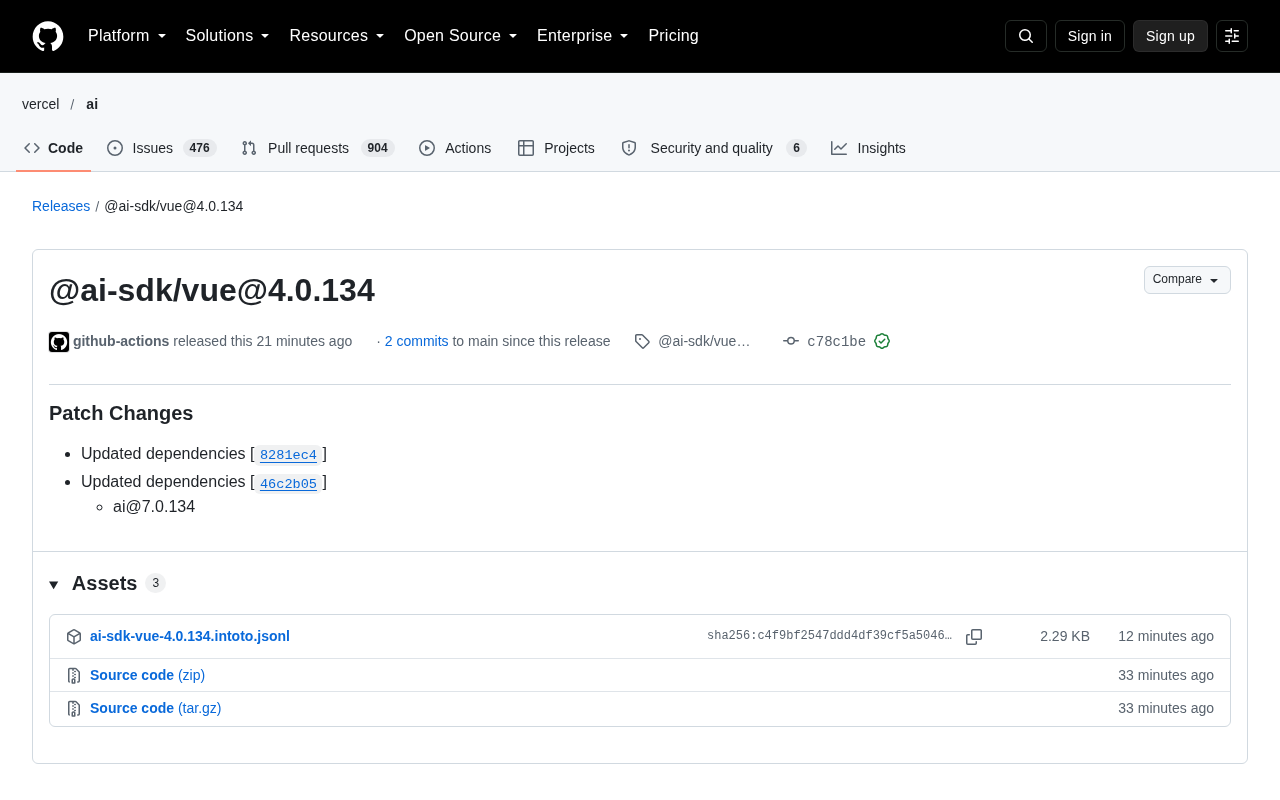
@ai-sdk/vue has shipped version 4.0.134, a patch release for Vercel AI SDK's official Vue ecosystem wrapper. Released on October 8th via GitHub Actions and verified with a GitHub signature, this update is a routine dependency sync with no breaking changes. The core change is version alignment with the upstream dependency ai@7.0.134, ensuring Vue developers have timely access to the latest capabilities and fixes from the underlying AI SDK.
What's in This Update
According to the release log, the changes in 4.0.134 are classified as Patch Changes, consisting of two dependency updates (commits 8281ec4 and 46c2b05) and a core dependency upgrade to ai@7.0.134.
Patch releases typically fall into two categories: bug fixes and dependency chain synchronization. For a framework adapter like @ai-sdk/vue, most of the functional logic lives in the core ai package. The Vue layer is primarily responsible for providing composable APIs that fit Vue's reactive paradigm — things like useChat, useCompletion, and so on. Whenever the core package is updated, the framework adapters follow suit with matching patch versions.
Why Dependency Sync Matters
Staying in lockstep with the upstream ai package is key to avoiding potential compatibility issues. If the Vue adapter lags behind the core library, you risk type definition mismatches, inability to call new features, or even runtime errors. The significance of 4.0.134 is precisely that it keeps Vue users aligned with the broader AI SDK ecosystem.
What This Means for Vue Developers
Vercel AI SDK is one of the more popular toolchains for building AI chat and generative applications today. @ai-sdk/vue lets Vue 3 developers quickly integrate large language models through composable functions, handling common requirements like streaming output and message state management.
For teams already using this SDK in production, it's worth keeping up with patch releases like this one. While any single patch update may seem minor, incremental upgrades lower the cost of future major version migrations and ensure you benefit from performance improvements and bug fixes in the core library as soon as they land.
Upgrading is straightforward — just use your package manager:
npm install @ai-sdk/vue@4.0.134
Composables are a core programming paradigm introduced in Vue 3, allowing developers to encapsulate stateful logic into reusable functions. @ai-sdk/vue builds on this paradigm to provide hooks like useChat, useCompletion, and useObject. Take useChat as an example: it internally handles streaming communication with AI models, message history maintenance, and loading state tracking. Developers simply call the function in a component and bind the returned reactive data to build a chat interface — no need to manually parse SSE (Server-Sent Events) or ReadableStream details. This encapsulation approach is conceptually similar to custom Hooks in the React ecosystem, but it fully leverages Vue's reactivity system (built on ref and reactive), so state updates automatically trigger component re-renders.
# or
pnpm add @ai-sdk/vue@4.0.134
Summary
@ai-sdk/vue 4.0.134 is a typical maintenance release, with the core change being dependency alignment with ai@7.0.134. It doesn't introduce major new features, but it reflects the engineering practice of keeping AI SDK ecosystem adapters in sync with frequent core library iterations. For Vue developers, this kind of update doesn't require much analysis — just keep pace with it, and you'll maintain a stable, compatible development experience.
Related articles

Why Does the Tesla Roadster Need to Fly? A Deep Dive into Musk's Wild Demo
Tesla's Roadster launch showed wall-climbing, upside-down driving, and flying stunts—but The Vergecast notes the demo car may lack a battery, the Rocket version is invite-only and not street-legal, and the website terms don't guarantee delivery. After nine years of delays, why does this car still need to exist?

AI Is Not a Replacement: Human-AI Collaboration Through the Lens of Factory Root Cause Analysis
Starting from factory root cause analysis, this article explains how AI accelerates evidence chain construction rather than replacing human experts, exploring the pragmatic implementation logic and business value of 'AI supporting people rather than replacing them.'

AI Agent Decision Auditing: Building an Evidence Chain in Regulated Workflows
Starting from a Reddit discussion, this article analyzes three core issues in AI agent decision auditing within regulated workflows: what fields audit records should contain, how to handle feedback latency for erroneous decisions, and how to continuously calibrate LLM judge consistency with human judgment.