AI SDK Vue 4.0.140 Released: Dependency Synced to ai@7.0.140

@ai-sdk/vue 4.0.140 patch update syncs dependency to ai@7.0.140 to maintain version alignment.
@ai-sdk/vue 4.0.140 is a patch version automatically published by github-actions, containing just one commit that updates the dependency to ai@7.0.140. The article explains why this sync matters: the AI SDK's monorepo structure means each framework adapter package must align its dependency declaration after a core package release, otherwise multiple versions of the ai package may coexist, inflating bundle size or blocking bug fixes from reaching users. With no breaking changes, the upgrade is low-risk. The article also discusses the SDK's versioning strategy and recommends using a lockfile.
A Low-Key but Noteworthy Patch Update
In the iteration rhythm of open-source projects, not every release comes with new features or major improvements. @ai-sdk/vue version 4.0.140 is a typical patch update of this kind—it introduces no new APIs and doesn't change how the library is used, but it completes a necessary synchronization at the dependency management level.
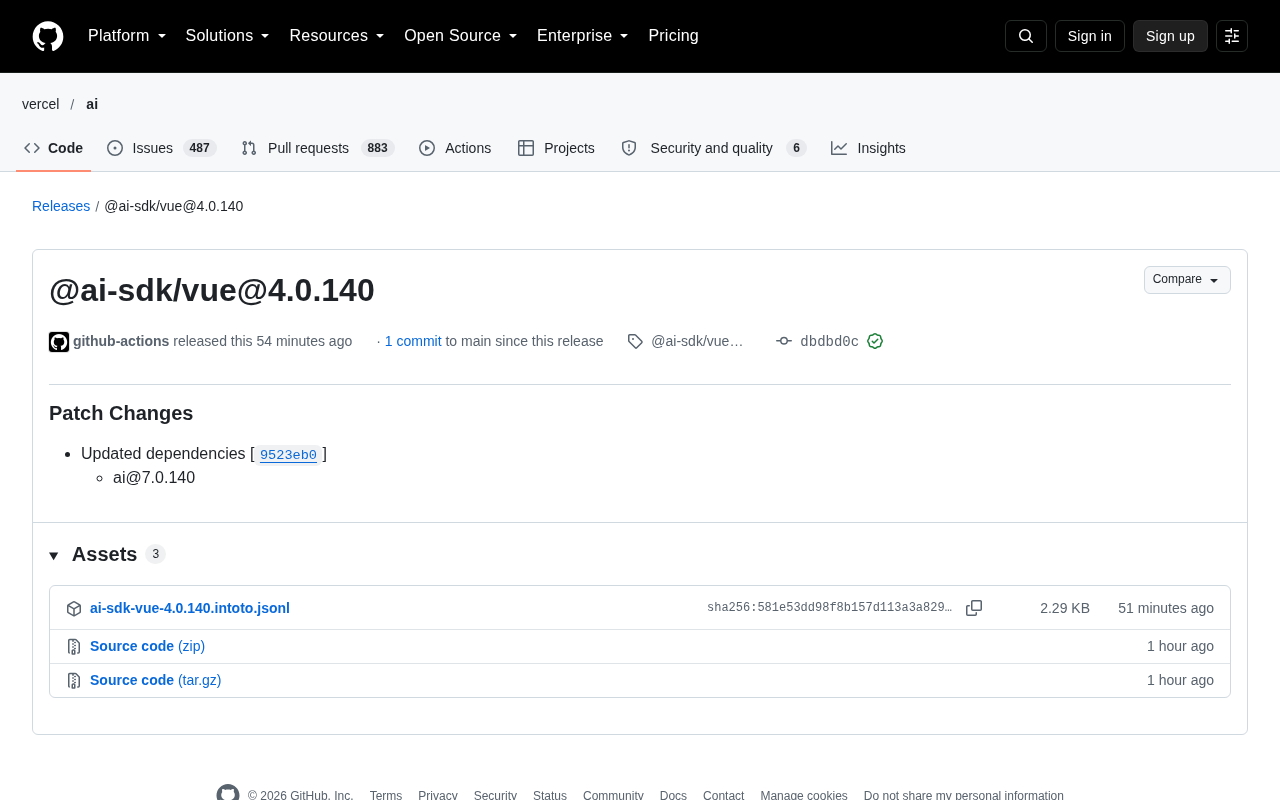
According to the release record on GitHub, this update was automatically published by github-actions and contains only a single commit (dbdbd0c). The core change is updating the dependency ai@7.0.140. This kind of automated, tool-driven release has become standard practice in the mature JavaScript ecosystem.
Why Dependency Synchronization Matters
Version Alignment Avoids Potential Conflicts
For developers using @ai-sdk/vue, the significance of this patch version lies in ensuring version alignment between the Vue adapter layer and the core SDK. The AI SDK uses a monorepo structure to manage multiple framework adapter packages. When the core package ai releases a new version, each framework adapter package needs to update its dependency declaration to maintain version consistency.
Without this synchronization, developers could run into two types of problems: first, dependency resolution could result in multiple versions of the ai package coexisting, inflating bundle size; second, bug fixes in the core package couldn't be passed down to end users through the adapter layer. Version 4.0.140 eliminates these risks by pointing its dependency to ai@7.0.140.
Monorepo is an engineering practice of managing multiple interrelated packages within a single code repository. The AI SDK places the core package ai together with framework adapters for React, Vue, Svelte, and others in one repository, where each package references the others via workspace protocols (such as pnpm workspace or npm workspaces). The benefit is that during version releases, a unified changesets workflow can coordinate version numbers across packages, avoiding version drift caused by independent releases. The cost is that nearly every release of the core package triggers cascading updates across all adapter packages—this is precisely the direct reason for this @ai-sdk/vue patch update.
Dependency resolution conflicts are a common issue in the Node.js ecosystem. When multiple different versions of the same package exist in a project at once, package managers (npm, pnpm, yarn) adopt different strategies: npm and yarn tend to nest multiple copies in node_modules, causing the same code to be bundled multiple times; pnpm uses symlinks and content-addressable storage to deduplicate. Regardless of strategy, multiple instances of the ai package coexisting can cause instanceof checks to fail and singleton state to be fragmented. Declaring a version range consistent with the core package in the adapter's dependencies or peerDependencies is the standard practice to avoid these hidden bugs.
The Reliability of Automated Releases
This release was carried out by the github-actions bot, with a commit bearing a GitHub-verified signature (GPG key ID: B5690EEEBB952194). This automated workflow ensures the timeliness and consistency of version releases while reducing errors that manual operations might introduce. For maintainers, delegating mechanical work like dependency updates to CI/CD pipelines frees up energy for more valuable feature development.
github-actions automated releases typically rely on GitHub's OIDC and npm's provenance mechanism. The release pipeline is generally triggered by changesets or semantic-release: after a PR is merged and the version bump is recorded, CI builds the artifacts, runs tests, tags the Git commit, and pushes to npm under the repository bot's identity. The GPG signature in the commit record (whose key ID can be verified on GitHub) indicates that the commit genuinely came from GitHub's hosted key rather than being forged by an individual developer. This mechanism allows high-frequency, low-risk changes like dependency synchronization to proceed without manual intervention, while also ensuring that release records correspond one-to-one with source commits.
Practical Impact for Developers
Upgrade Recommendations
If you're using @ai-sdk/vue to build AI-powered Vue applications, upgrading to 4.0.140 is a low-risk operation. Since this is a patch version update with no breaking changes, you can confidently update the version number in package.json or simply run your package manager's update command.
After upgrading, your project will automatically receive the improvements and fixes in ai@7.0.140. Although the release notes do not detail the specific changes in ai@7.0.140, based on the version number we can infer that it is likewise a patch-level update.
The Signal Behind the Version Numbers
The evolution of version numbers reveals the maintenance strategy of the AI SDK project. The ai package has already iterated to the 7.x series, while @ai-sdk/vue is at 4.x. This version number disparity reflects the differing maturity and change frequency of the packages. The core package has gone through more major version iterations, while the framework adapter layer remains relatively stable.
For technology selection, active version iteration is usually a positive signal—it means the project is continuously maintained, security issues are fixed promptly, and community feedback gets addressed. At the same time, note that frequent patch updates can add some burden to dependency management; it's recommended to use a lockfile to pin versions.
Semantic Versioning (SemVer) specifies that version numbers follow the form MAJOR.MINOR.PATCH, where an increment in the patch position indicates a backward-compatible bug fix. Therefore, the major version difference between ai@7.0.140 and @ai-sdk/vue@4.0.140 (7 vs. 4) does not mean API incompatibility, but rather reflects the independent evolution of the two packages. The key to judging whether an upgrade is safe is whether the major version number changes, not the patch number. Also, since there are no breaking changes, upgrading from 4.0.x to 4.0.140 typically requires no changes to business code, but it's still recommended to pin via lockfile and run a full build and test cycle to confirm that the dependency tree hasn't been unexpectedly hoisted.
An Ecosystem Perspective
By providing multi-framework adapter packages for React, Vue, Svelte, and others, the AI SDK project builds a unified abstraction layer for AI application development. This design lets developers call large model capabilities using familiar framework syntax without worrying about differences in the underlying API. This update to @ai-sdk/vue is a microcosm of this ecosystem continuously operating.
Although a single patch update has limited impact, it is precisely these seemingly minor version synchronizations that form the foundation for the stable operation of the entire toolchain. For projects that depend on the AI SDK, paying attention to such updates and keeping dependencies up to date is a necessary habit for maintaining project health.
One-line Summary
@ai-sdk/vue 4.0.140 patch update syncs dependency to ai@7.0.140 to maintain version alignment.
Paragraph Summary
@ai-sdk/vue 4.0.140 is a patch version automatically published by github-actions, containing just one commit whose core change is updating the dependency to ai@7.0.140. The article explains the significance of this version synchronization: the AI SDK uses a monorepo structure, and after the core package releases, each framework adapter package must synchronize its dependency declaration—otherwise multiple versions of the ai package may coexist, bundle size may inflate, or bug fixes may fail to propagate down. Since it's a patch update with no breaking changes, developers can upgrade at low risk. The article also uses the version number disparity to point out the AI SDK's ongoing maintenance strategy and recommends using a lockfile to pin versions and stay attentive to the ecosystem's stable operation.
Related articles

Apple Opens Multiseat Subscription Purchasing: App Subscriptions Can Now Be Sold in Bulk to Businesses and Schools
Apple opens multiseat purchasing for auto-renewable subscriptions: businesses and schools can bulk-buy via Apple Business and Apple School Manager, adding or removing seats anytime. Enabled by default in App Store Connect—developers should verify settings; group purchasing sandbox testing opens October 2026.

FCC Takes First Action: Devices Containing "Foreign Surveillance Chips" Banned
The FCC exercises its new power for the first time, banning two devices for containing "foreign surveillance chips." This article analyzes the impact on hardware supply chain compliance, chip procurement decisions, and market access.
Meta Restarts Muse Sharing Feature: A Security Gamble After Privacy Controversy
Meta re-enabled Muse AI sharing after researchers found public chat links exposed sensitive data like revenue reports and loan applications. Privacy vs. convenience.