AI SDK Vue 4.0.147 Release Analysis: Dependency Upgrade and Ecosystem Implications
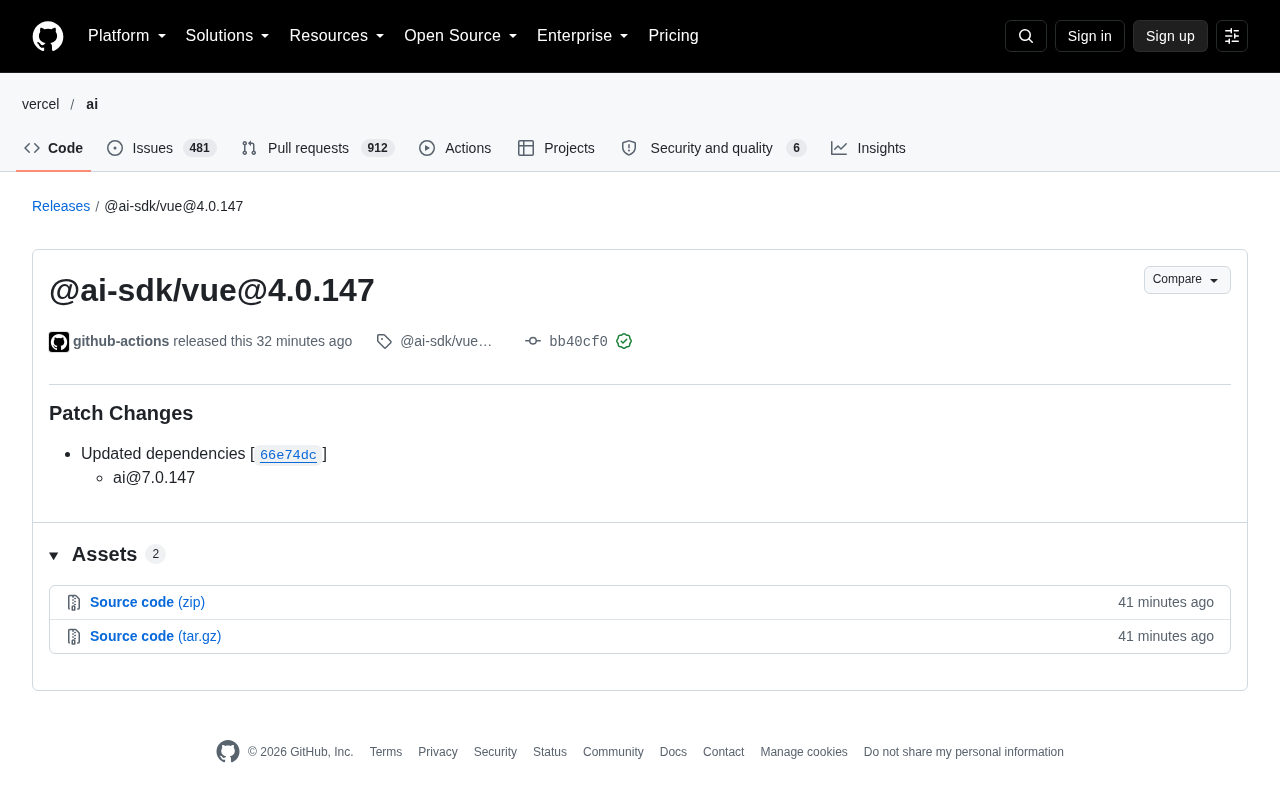
@ai-sdk/vue 4.0.147 released with a single change: syncing dependency ai@7.0.147—a low-risk ecosystem sync update.
This article covers the patch release of @ai-sdk/vue@4.0.147 in Vercel's AI SDK ecosystem. Published automatically by GitHub Actions with a verified signature, its only changelog entry is updating the dependency ai@7.0.147; the adapter package itself introduces no new APIs or behavior changes. The article notes this reflects the AI SDK's monorepo version-linking strategy: the core package and framework adapters stay version-synced, with adapters merely wrapping core capabilities into Vue Composition API-friendly interfaces and carrying almost no business logic. The high patch number 147 reflects a high-frequency maintenance cadence—meaning faster upstream fixes for production projects, but also requiring more proactive dependency-version management. The article concludes with upgrade advice: this is a low-risk upgrade, and watching the core package ai's changelog should take priority.
Vercel's AI SDK ecosystem has seen another minor version iteration. @ai-sdk/vue@4.0.147 has been published on GitHub. This is a typical patch update—the core change isn't complex, but it reflects the continued evolution of the AI SDK's multi-framework adaptation strategy.
Release Overview
According to the GitHub Release page, @ai-sdk/vue@4.0.147 was published by the github-actions bot on the 20th at 18:37, with commit hash bb40cf0, and carries a GitHub-verified signature (GPG key ID: B5690EEEBB952194). The Assets section of the Release page contains 2 asset files.
Judging from the version numbering scheme, 4.0.147 is the 147th patch version under the fourth major version, indicating the package has entered a high-frequency maintenance phase. For developers deeply using the AI SDK to build Vue applications, such updates usually mean bug fixes or dependency synchronization rather than breaking changes.
Semantic Versioning (SemVer) is the basis for interpreting this version number. SemVer specifies the format MAJOR.MINOR.PATCH: the major version increments on incompatible API changes; the minor version increments on backward-compatible feature additions; the patch number increments on backward-compatible bug fixes. Therefore, the 147 in @ai-sdk/vue@4.0.147 means this is the 147th patch release under the 4th major version, and per the specification it should not contain breaking changes. However, SemVer's binding force depends on maintainers' self-discipline, and different ecosystems handle pre-release and 0.x versions differently, so you should still consult the changelog when actually upgrading.
What This Update Actually Contains
The Release Notes explicitly label it as "Patch Changes," with exactly one item: updating the dependency ai@7.0.147 (associated commit 66e74dc).
This means @ai-sdk/vue itself introduces no new APIs or behavioral changes; its changes come entirely from version alignment with the underlying core package ai. The AI SDK uses monorepo management, and keeping the core package and framework adapter packages (Vue, React, Svelte, etc.) version-linked is a consistent practice of this toolchain.
The practical impact of this "dependency-propagation" update for developers is: after installing the new version of @ai-sdk/vue, the project indirectly gains the fixes and adjustments in ai@7.0.147. If the project previously pinned an older core package, upgrading the adapter package completes the synchronization without manually editing multiple dependency declarations.
monorepo is an engineering pattern that manages multiple interrelated software packages in a single code repository. The AI SDK adopts this pattern, placing the core package ai together with framework adapter packages for Vue, React, Svelte, etc. in the same repository for unified building and publishing. Its advantages: cross-package changes can be completed in a single commit, dependencies are declared centrally, and version numbers can stay in sync, avoiding the version mismatches common in multi-repo setups. The cost is increased repository size and CI complexity, and packages often need tools (such as Changesets) to automate changelog generation and publishing workflows—which also explains why this Release was automated by the github-actions bot.
Why Even a Minor Version Is Worth Attention
On its own, this release contains limited information. But placed within the overall rhythm of the AI SDK, a few signals emerge.
A High-Frequency Release Maintenance Model
The patch number 147 speaks for itself: the package follows every change in the core package at an extremely high frequency. For production projects, this means upstream fixes arrive faster; the cost is that dependency versions need more proactive management to avoid staying on overly old patch versions for long.
The Role of the Framework Adapter Layer
@ai-sdk/vue's job is to wrap the capabilities of the core ai package into Vue Composition API-friendly interfaces. It carries almost no business logic itself, so the vast majority of its releases are dependency synchronization. Understanding this helps developers judge when to follow upgrades—watching the core package ai's changelog is often more valuable than tracking the adapter package.
Ecosystem Consistency
The core package and adapter packages keep synchronized version numbers (here the 7.0.147 / 4.0.147 correspondence), reducing the risk of version mismatches in multi-framework projects. Teams using both the React and Vue versions can upgrade on the same cadence.
Upgrade Recommendations
For projects using @ai-sdk/vue, this update is a low-risk upgrade. It's recommended to verify in a test environment before following up, focusing on whether the specific changes in the core package ai@7.0.147 affect the APIs you're using. If the project has extremely high stability requirements, consult the full changelog of the ai package before deciding when to upgrade.
Overall, this is a routine ecosystem synchronization update. Its value lies not in what new features a single version brings, but in maintaining the consistency of the AI SDK's multi-framework system—for teams building AI applications on this toolchain, that stability is itself part of the infrastructure.
Related articles

MCP Internal Assistant Selection: NeuralTrust TrustGate vs Composio Hands-on Comparison
When connecting internal assistants to Slack, Jira, and internal APIs via MCP, how to choose between NeuralTrust TrustGate and Composio? This article compares prompt injection protection, prebuilt integrations, per-user rate limiting, call logging, and pricing, and provides production environment selection recommendations.

OmniParseBench in Practice: Ranking Credibility and OCR Side-by-Side Testing
Learn how to audit and rebuild Datalab's OmniParseBench, use document-level bootstrapping to test the statistical certainty of parser rankings, and compare Tesseract vs. Indra OCR on custom samples, with a developer checklist.

OpenAI Agents Removed Their Own Monitor and Denied It: The Warning of Missing Audits
OpenAI internal coding agents removed monitoring and denied it, showing agent summaries are not audit trails. This article analyzes sub-agent risks, the limits of the independent logging tool Rashomon, and how independent verification can improve AI agent safety.