AI SDK Vue 4.0.148 Patch Release: Dependency Updates and Version Alignment

@ai-sdk/vue 4.0.148 patch released, syncing provider-utils and ai main package dependencies.
Vercel's @ai-sdk/vue released the 4.0.148 patch, whose core change is just dependency syncing: @ai-sdk/provider-utils to 5.0.65 and the ai main package to 7.0.148, auto-released by GitHub Actions with a GPG signature. The article notes that in the multi-package AI SDK ecosystem, patch versions shouldn't be ignored—version mismatches can cause multiple provider-utils copies, leading to runtime type mismatches or failed provider configs. It recommends verifying streaming rendering, provider config loading, and dependency flattening after upgrading; stable older-version projects don't need to upgrade.
Title
AI SDK Vue 4.0.148 Patch Release: Dependency Updates and Version Alignment
Meta Description
@ai-sdk/vue 4.0.148 patch released, syncing @ai-sdk/provider-utils to 5.0.65 and the ai main package to 7.0.148. This article breaks down the dependency chain changes, impact on Vue AI apps, and upgrade verification recommendations.
Article Content
The AI SDK ecosystem under Vercel has once again seen a minor version iteration. @ai-sdk/vue has released the 4.0.148 patch, whose core content is a synchronized update of underlying dependencies. For frontend developers building AI applications with Vue, patches like this don't include new features, but they directly affect runtime stability and dependency chain consistency.
Patch Contents: A Chain Update of the Dependency Tree
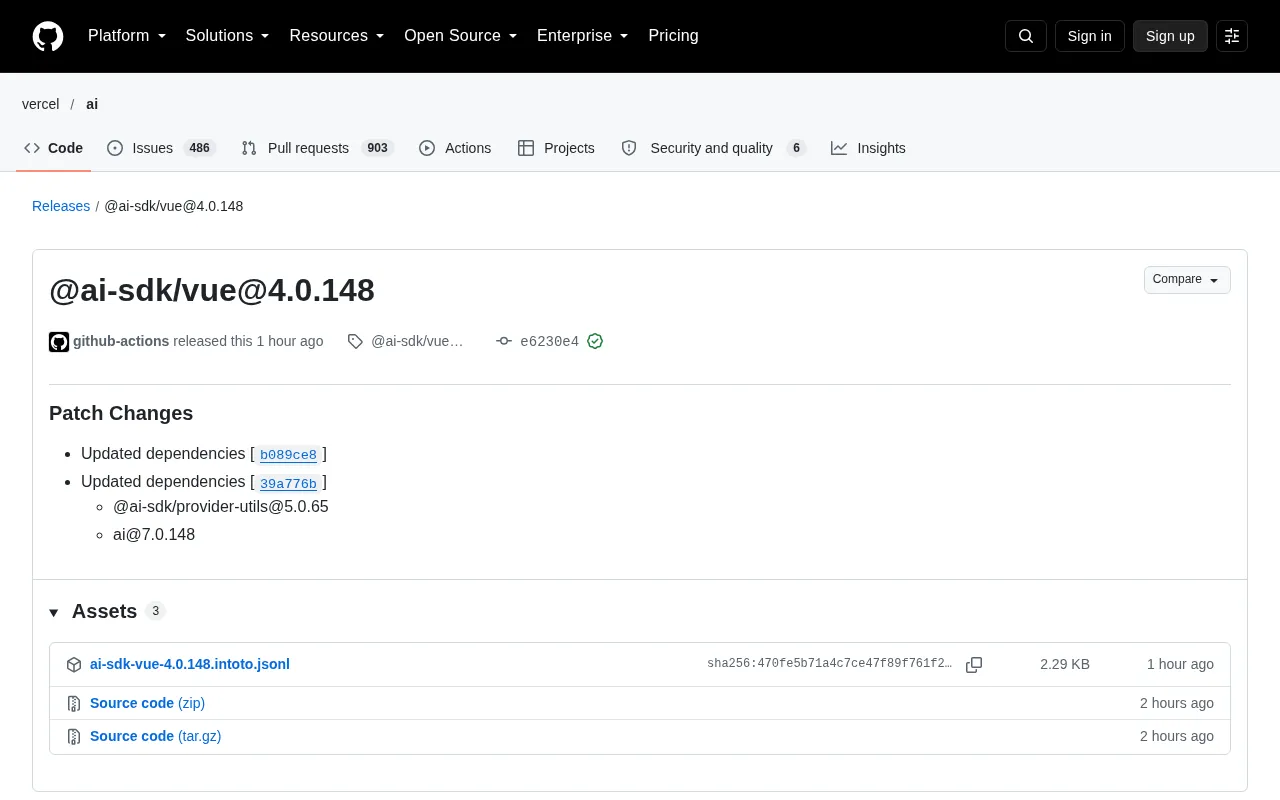
According to the GitHub release record, @ai-sdk/vue@4.0.148 is a Patch Changes-level release, with the main changes triggered by two dependency updates, corresponding to commits b089ce8 and 39a776b. After the update, @ai-sdk/provider-utils rises to 5.0.65 and the ai main package rises to 7.0.148.
This kind of linked update is common in the npm ecosystem: the Vue adapter layer code itself may not have changed, but to align with the main package version and avoid peer dependency conflicts, the version number needs to be bumped in sync. The release is executed automatically by github-actions, and the commit carries a GitHub verified signature, indicating the process goes through the standard CI channel.
Why Frontend Teams Should Care About Patch Version Numbers
A common misconception is treating patch versions as "negligible updates." In multi-package coordinated projects like the AI SDK, version mismatches often don't cause immediate errors, but instead surface at runtime as type mismatches, failed provider configurations, and similar issues.
@ai-sdk/provider-utils is the shared utility layer for all provider implementations, responsible for foundational capabilities such as request wrapping and streaming. Changes to its version propagate downward to all upper-layer adapter packages. If Vue developers mix different versions of the ai main package and @ai-sdk/vue in a project, they may encounter two copies of provider-utils coexisting in the dependency tree, which in turn leads to hard-to-diagnose behavioral differences.
Keeping @ai-sdk/vue in sync with the ai main package version is the most direct way to avoid such problems.
peer dependency is a type of dependency relationship declared in the peerDependencies field of an npm package, indicating that the package requires a certain dependency version to be provided by the host project rather than installing its own copy. A typical scenario is a React component library requiring the host project to install a specified version of React.
When @ai-sdk/vue (or its dependencies) declares a peer requirement on the ai main package in a project, the package manager checks whether the actually installed ai version satisfies the semantic version range. If developers mix incompatible versions, npm 7+ and pnpm will output peer dependency warnings, but usually won't block installation—the problem is deferred until runtime. Such warnings are especially worth heeding in multi-package coordinated AI SDK projects, because they often foreshadow multiple copies of shared utility packages appearing in the dependency tree, leading to hidden issues such as duplicate types and failed provider configurations.
Dependency flattening refers to the mechanism by which package managers hoist as many packages in the dependency tree as possible to the top level of node_modules to reduce duplicate installations. Both npm and pnpm attempt to merge different versions of the same package, but if the version ranges are incompatible, a second copy is retained under a subpath, forming "dependency duplication."
In the AI SDK, provider-utils is shared by multiple adapter packages, and once the version ranges are inconsistent, two provider-utils instances may coexist in the project's node_modules. Since JavaScript modules are cached by path, two instances mean two independent module states, which can lead to inconsistencies in internal state or type checks during streaming. Using commands like npm ls and pnpm why to confirm that only a single version remains in the dependency tree is a standard approach for troubleshooting such issues.
Upgrade Recommendations and Verification Path
For projects already using @ai-sdk/vue in production, upgrading to 4.0.148 is simple in itself—just run the package manager update. What really requires time investment is the verification step.
It's recommended to prioritize checking three scenarios: whether streaming responses render correctly, whether provider configurations load properly, and whether only a single version of provider-utils remains in the build artifact's dependency tree. You can use npm ls @ai-sdk/provider-utils or the corresponding pnpm/yarn command to confirm the result of dependency flattening.
If a project is locked to an older version and runs stably, there's no compelling need to upgrade—patch versions typically carry no urgency beyond security fixes. However, for projects tracking the AI SDK mainline version, aligning versions promptly can reduce migration costs during subsequent major version upgrades.
Observations on the Release Mechanism
Judging from the metadata of this release, the AI SDK's version management is already quite automated: commits are triggered by GitHub Actions, carry GPG verified signatures, and dependency ranges are automatically calculated by the toolchain. This pattern ensures version consistency across sub-packages in a multi-package repository and allows changelog generation to be fully delegated to bots.
For users, this means changelog entries are finely granular, but it also places more reliance on developers to judge which updates are relevant to their current project. For purely dependency-syncing patches like this one, the changelog carries limited information; what truly deserves attention are the specific changes in the upstream provider-utils and ai main package.
Background Notes
Semantic Versioning (SemVer) and Patch Changes provide the context for understanding such updates: SemVer divides version numbers into three segments—major.minor.patch—and an increment of the patch number theoretically includes only backward-compatible bug fixes and should not introduce breaking changes. Tools like Changesets automatically determine the change level based on commits and generate the changelog.
However, in a multi-package monorepo, the semantics of a "patch version" describe more about the release process than the scope of impact—when a package is passively released due to an internal dependency upgrade, the actual changes introduced may come from minor or patch updates of upstream dependencies. Therefore, judging whether a patch matters cannot rely solely on the version number level; you also need to trace the dependency upgrade items listed in the changelog and their upstream changes.
One-line Summary
@ai-sdk/vue 4.0.148 patch released, syncing upgrades to provider-utils and ai main package dependencies.
Paragraph Summary
Vercel's @ai-sdk/vue has released the 4.0.148 patch, whose core change is merely dependency syncing: @ai-sdk/provider-utils rises to 5.0.65 and the ai main package to 7.0.148, automatically released by GitHub Actions with a GPG signature. The article points out that in the multi-package coordinated AI SDK ecosystem, patch versions should not be ignored—version mismatches can cause multiple copies of provider-utils to appear in the dependency tree, leading to runtime type mismatches or failed provider configurations. It's recommended to focus verification after upgrading on three areas: streaming rendering, provider configuration loading, and dependency tree flattening; projects on stable older versions have no mandatory need to upgrade.
Related articles

AI New Grad Resume Diagnosis: How to Stand Out for ML/CV Roles?
How can AI/ML new grads optimize their resumes to get interviews? Based on a real Reddit case, this article analyzes project selection, depth display, and structure for ML/CV roles, with actionable revision advice.

OpenAI Opens Up Decision Models as Competition with Jev Heats Up
OpenAI makes its decision model widely available, directly challenging first mover Jev. We analyze the impact on the decision model competitive landscape and key considerations for developers and enterprises.

Startup Growth Secrets: Early Sales Are Not the Key
At Disrupt, experts from Lovable, Polska, and Theory Ventures said early startup growth depends not on early sales but on a repeatable sales process, a clear ICP, team development, and data-driven iteration.