@ai-sdk/vue 4.0.156 Patch Release: Stability Fixes for Vue-Side AI Integration

@ai-sdk/vue releases 4.0.156 patch, syncing core package ai to 7.0.156 and fixing Vue integration issues.
The Vue adapter package for AI SDK, @ai-sdk/vue, has released patch version 4.0.156, syncing the core package ai to 7.0.156. Automatically built by GitHub Actions with 5 commits, this routine patch fixes issues in the Vue integration layer and aligns with the core package. The article explains why the Vue adapter layer releases frequently, emphasizes version alignment to avoid runtime errors, and offers low-cost upgrade advice.
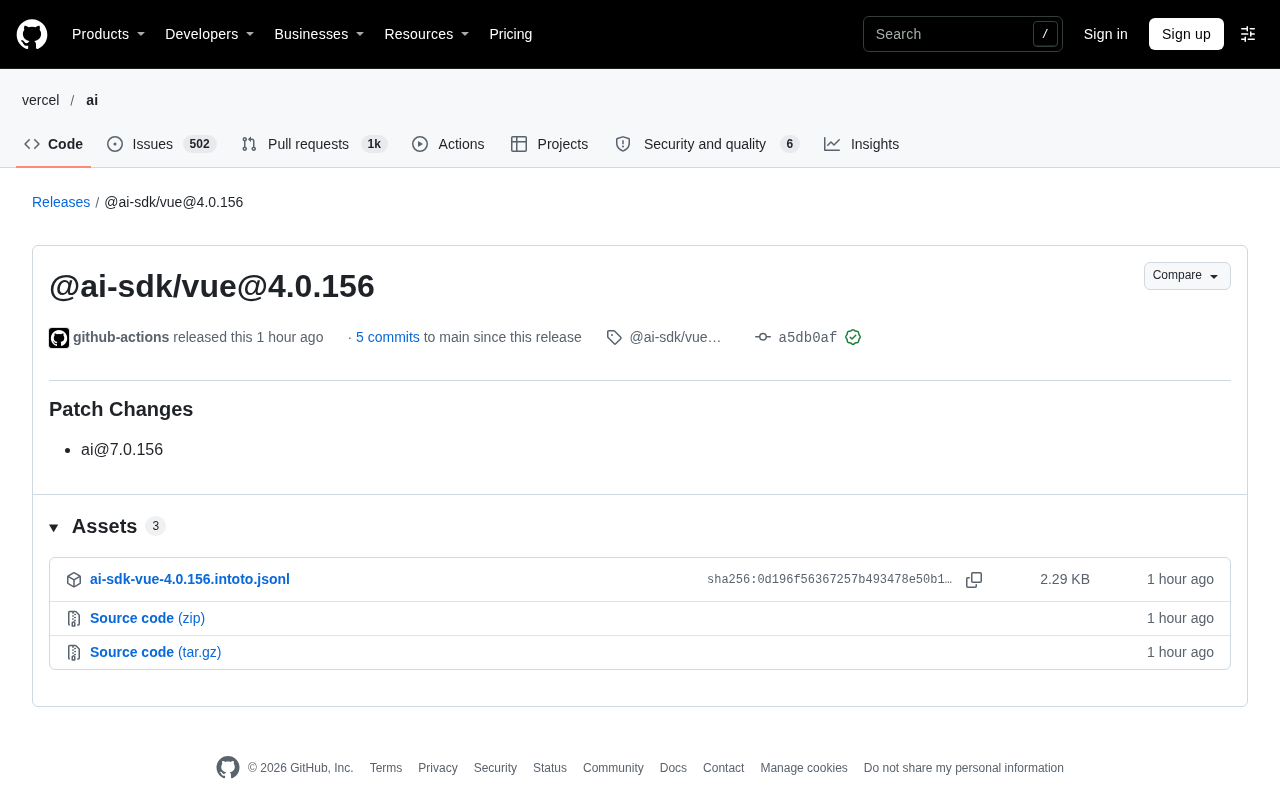
The Vue adapter package for AI SDK, @ai-sdk/vue, has released version 4.0.156, simultaneously updating the core package ai to 7.0.156. This release is a routine patch iteration, automatically built by GitHub Actions and comprising 5 commits. Its main purpose is to fix issues exposed during use of the Vue integration layer and to align versions with the core package.
Release Information and Background
According to the GitHub Release page, @ai-sdk/vue@4.0.156 was published on October 28 at 18:36 by github-actions, with the commit record pointing to the signed and verified a5db0af. The patch changelog lists ai@7.0.156, indicating a dependency linkage between the Vue package and the core ai package — the two versions must be kept in sync to avoid API incompatibilities.
This release does not include detailed changelog notes and is simply labeled as Patch Changes. Judging from the version number progression, the 4.0.x series represents an ongoing refinement phase for the Vue adapter layer, with a focus on maintaining behavioral consistency with the core AI SDK rather than introducing new features.
The Integration Logic Worth Noting Behind the Patch
Why the Vue Adapter Layer Releases Frequently
The AI SDK architecture places core logic in the ai package, while framework adapter layers (such as React, Vue, and Svelte) are responsible for wrapping core capabilities into reactive interfaces that follow framework conventions. The Vue side depends on its reactivity system, so any change to hook signatures or streaming data processing logic in the core package may require a synchronized patch in the adapter layer.
In the AI SDK, composables refer to reusable logic units encapsulated using Vue 3's Composition API, typically named with a use prefix. In @ai-sdk/vue, these composables are responsible for converting the streaming responses, state management, and other capabilities of the core ai package into Vue's reactive references (ref, computed, etc.), enabling developers to directly bind and observe them within components. Since composable return values depend on Vue's reactivity system, when the core package adjusts the timing of streaming data pushes or the state structure, the adapter layer must synchronously adjust the ref update logic inside the composables — otherwise issues such as the view not updating or stale state can occur. This is one of the technical root causes behind the adapter layer's frequent patch releases.
The Significance of Version Alignment
The Vue package jumping to 4.0.156 in this release, synchronized with ai@7.0.156, means the two follow a strictly corresponding release cadence. For production users, when locking the @ai-sdk/vue version, they should also confirm the ai version it depends on to avoid runtime errors caused by a mismatch between the core package and the adapter layer.
In Semantic Versioning (SemVer), the patch version number (third digit) is typically used for backward-compatible bug fixes, the minor version number (second digit) for new features, and the major version number (first digit) for breaking changes. However, @ai-sdk/vue and ai are separate packages, each with its own independent version sequence, and compatibility between them is not automatically guaranteed by SemVer. Therefore, the strict synchronization of the two package version numbers (e.g., 4.0.156 corresponding to 7.0.156) is in effect a人为 convention — a人为 agreed-upon release strategy designed to signal to users that "these two versions have been jointly tested and can be safely used together." In monorepos, this kind of coordinated release is typically automated by tools such as Changesets, ensuring that dependency declarations and published versions remain consistent.
Practical Impact on Users
Upgrade Recommendations
This is a patch version and contains no breaking changes. If your project is already using the 4.0.x series, upgrading to 4.0.156 can usually be done by simply replacing the version number. Before upgrading, it is recommended to check the lock file and confirm that the ai package is also updated to 7.0.156.
Directions for Troubleshooting Potential Issues
If your team encounters issues such as abnormal streaming responses or unsynchronized composable state in a Vue project, you can prioritize trying this patch upgrade. Patch-level updates typically target specific edge-case fixes without changing the public API, so the upgrade cost is low.
Signals from an Ecosystem Perspective
The continued patch-style iteration of @ai-sdk/vue reflects the AI SDK's approach to multi-framework support: unified core logic with adapter layers that follow quickly. For developers in the Vue ecosystem, this means they can obtain fixes consistent with the core SDK without waiting for a major version release. Although this release carries limited information, it confirms that the Vue adapter layer remains actively maintained and that the release process is fully automated, ensuring a stable release cadence.
One-line Summary
@ai-sdk/vue releases 4.0.156 patch, syncing core package ai to 7.0.156 and fixing Vue integration issues.
Paragraph Summary
The Vue adapter package for AI SDK, @ai-sdk/vue, has released patch version 4.0.156, simultaneously updating the core package ai to 7.0.156. This version was automatically built by GitHub Actions and includes 5 commits. It is a routine patch iteration that primarily fixes issues exposed in the Vue integration layer and aligns the version with the core package. The article analyzes why the Vue adapter layer releases frequently — adjustments to core hook signatures or streaming data processing logic require synchronized adapter layer changes; emphasizes the importance of version alignment in avoiding runtime errors; and provides upgrade recommendations: patch versions contain no breaking changes and have low upgrade costs, but users should confirm that the ai package is updated as well. Overall, this reflects the AI SDK's architectural strategy of unified core logic with adapter layers that follow quickly.
Related articles

A New Paradigm for Text Editing in Compose: TextFieldState Replaces the Old API
Jetpack Compose introduces the TextFieldState API to fix dropped characters and cursor jumps from async input. The old value/onValueChange callbacks will be deprecated in 1.13. This article covers InputTransformation, OutputTransformation, four state hoisting patterns, and new formatted text editing capabilities.

Remote Compose: A New Document-Driven Paradigm for Cross-Platform UI on Android
Remote Compose transmits compact binary documents instead of screen pixels, enabling efficient UI rendering on remote surfaces like Wear OS and widgets. This article covers its document creation API, expression animations, size optimization techniques, and Wear OS progress.

How Crashlytics Eliminates Android Memory and Responsiveness Issues
Through the Chroma Clip case study, this article explains how Firebase Crashlytics uses Application Exit Info, Profiling Manager, GWP ASAN, and ARM MTE to pinpoint ANRs, OOMs, memory limit terminations, and native memory corruption—solving the challenge of stack traces that don't point to the real culprit.