@ai-sdk/vue 4.0.165 Released: The Version Sync Logic Behind Dependency Chain Updates

@ai-sdk/vue 4.0.165 is a pure dependency-sync patch with no new features; safe to upgrade directly.
@ai-sdk/vue released patch version 4.0.165 with all changes being dependency syncing: ai updated to 7.0.165 and @ai-sdk/provider-utils to 5.0.76, published automatically by github-actions with no feature or behavior change notes. The article notes this reflects the AI SDK's strategy of rapid iteration on core packages with thin framework adapter layers: the adapter's job is to integrate upstream capabilities into Vue's reactivity system, hence fast-growing patch numbers and fine-grained releases. Developers can upgrade directly but should check the version matrix in lock files; multi-adapter projects should align packages to the same release batch to avoid duplicate provider-utils copies causing type or runtime differences.
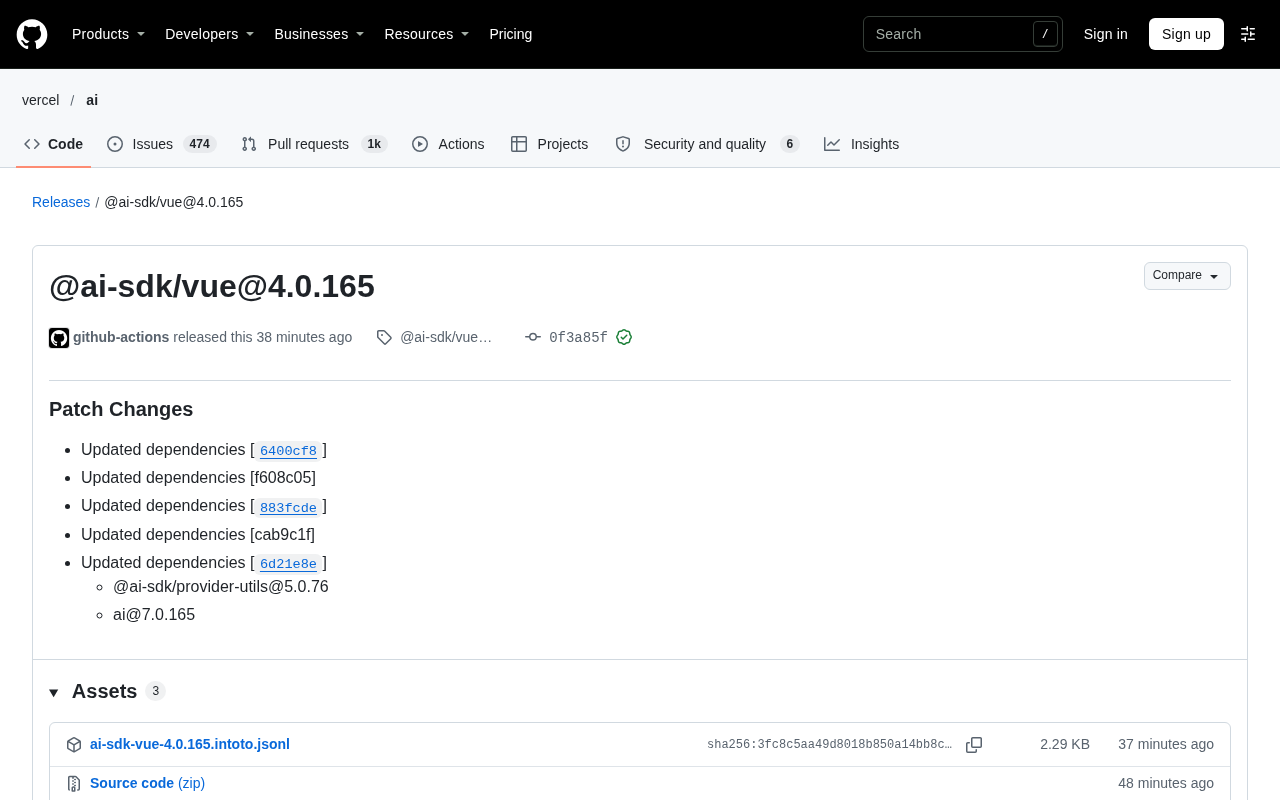
Vercel's AI SDK ecosystem has seen another routine version iteration. @ai-sdk/vue has released version 4.0.165, a typical patch update whose core action is syncing upstream dependencies. For developers building AI applications with Vue, this update, while not introducing new APIs, reflects the day-to-day rhythm of version linkage under the AI SDK's multi-package architecture.
What Exactly Changed in This Update
According to the release records on GitHub, 4.0.165 is marked as Patch Changes with commit hash 0f3a85f. The changes are entirely focused on dependency updates, corresponding to five commits: 6400cf8, f608c05, 883fcde, cab9c1f, 6d21e8e. The explicitly listed updated dependencies include @ai-sdk/provider-utils@5.0.76 and ai@7.0.165.
One detail worth noting: the release notes themselves contain no feature descriptions, fix explanations, or behavior change notices, which is consistent with the AI SDK series' established automated release process. The github-actions bot completed this release on November 7 at 19:31, and the commit carries a GitHub verified signature. In other words, 4.0.165 is not a version that requires developers to read a migration guide.
Why a Patch Version Is Worth Noticing
Looking at @ai-sdk/vue's version number alone, the patch position has accumulated to a fairly high 165. This itself illustrates the AI SDK's release strategy: core logic is carried by the underlying packages, while framework adapter layers (Vue, React, Svelte, etc.) maintain behavioral consistency primarily through dependency syncing. @ai-sdk/vue's responsibility is to integrate the capabilities provided by the ai package and provider-utils into Vue's reactivity system, so when upstream releases a new patch, the adapter layer needs to follow up with a release that locks dependency versions to the latest.
From an engineering perspective, the benefit of this approach is version traceability—any given @ai-sdk/vue version maps to a specific combination of ai and provider-utils versions. The cost is very fine-grained releases with fast-growing patch numbers; if developers don't proactively upgrade, they can end up with multiple provider-utils copies in their dependency tree, leading to type inconsistencies or runtime behavior differences.
Semantic Versioning (SemVer) and the Patch Position: SemVer divides version numbers into three segments: MAJOR.MINOR.PATCH. The PATCH position is used for backward-compatible bug fixes that introduce no new features or breaking changes. @ai-sdk/vue has remained on 4.0.x for an extended period with the patch number accumulating to 165, indicating that this package publishes at an extremely fine granularity within the 4.0 major version. This has practical implications for dependency management: on one hand, patch upgrades are generally safe and can be accepted automatically; on the other hand, high-frequency patches cause lock files to change frequently, so teams need to agree on whether to pin exact versions or allow floating within the ^4.0.0 range.
Thin Wrapper Adapter Layer: The AI SDK places core logic such as streaming parsing and request building in ai and provider-utils, while the Vue package is only responsible for bridging these capabilities into Vue's reactivity system (such as ref, computed). This layering keeps the adapter layer small and easy to maintain, but it also means the adapter layer itself produces almost no independent changes—its version number is primarily driven by upstream dependencies.
Dependency Chain Propagation
This update involves a chain relationship across three packages. @ai-sdk/vue depends on ai and @ai-sdk/provider-utils; the patch changes in ai@7.0.165 directly prompted the adapter layer to follow suit; provider-utils@5.0.76, as the provider utility layer, typically carries shared logic such as streaming response parsing and request building. When either of these two releases a new patch, @ai-sdk/vue republishes through the automated process.
This also means that if you use multiple AI SDK adapter layers in your project simultaneously (for example, Vue plus another framework's package), you should try to align them to the same batch of releases when upgrading, to avoid divergence in the provider-utils versions locked by each adapter layer.
Dependency Divergence and Duplicate Copies: In the npm/pnpm dependency tree, if different packages have non-overlapping version constraints on @ai-sdk/provider-utils, the package manager will install multiple copies. If type definitions in provider-utils (such as TypeScript types for messages and tool calls) exist as two instances, this leads to type incompatibility errors, or runtime differences in scenarios like instanceof checks and global registries. pnpm's strict mode explicitly flags peer/duplicate dependencies, while npm's flattening may silently hoist one version and mask the problem.
Lock Files and Version Matrix: package-lock.json and pnpm-lock.yaml record the exact resolved versions. After upgrading the adapter layer, you should check whether the final versions of ai and provider-utils match those of other AI SDK packages in the project, and if necessary use overrides/resolutions to enforce uniformity and avoid version matrix misalignment.
Upgrade Recommendations and Caveats
For the vast majority of projects, 4.0.165 can be upgraded directly since it introduces no breaking changes. When upgrading, it's recommended to check the final resolved versions of ai and @ai-sdk/provider-utils in your lock file to confirm compatibility with the version matrix of other AI SDK-related packages. If your project uses a monorepo or pnpm's strict dependency mode, pay special attention to duplicate dependency warnings.
If your current project is running stably and you haven't encountered the specific issues fixed by upstream patches, you can also upgrade at your own pace—the main value of patch versions lies in keeping dependencies fresh and reducing the gap when future major version migrations come, rather than solving a particular known defect.
Observations on the AI SDK's Version Strategy
From this release, we can see the AI SDK's maintenance philosophy: rapid iteration of underlying capability packages, thin wrappers for framework adapter layers, and a high degree of release automation. For Vue developers, the benefit is faster access to upstream improvements; the cost is having to keep an eye on the dependency version matrix. Incorporating AI SDK-related packages into a unified dependency update process (for example, periodic checks and grouped upgrades) is more hassle-free than manually following each one.
One-line Summary
@ai-sdk/vue 4.0.165 is a pure dependency-sync patch with no new features and can be upgraded directly.
Paragraph Summary
@ai-sdk/vue has released patch version 4.0.165, with all changes consisting of dependency syncing: ai updated to 7.0.165 and @ai-sdk/provider-utils updated to 5.0.76, published automatically by github-actions with no feature descriptions or behavior change notes. The article notes that this reflects the AI SDK's release strategy of rapid iteration of underlying capability packages and thin wrappers for framework adapter layers: the adapter layer's job is to integrate upstream capabilities into Vue's reactivity system, hence fast-growing patch numbers and fine-grained releases. Developers can upgrade directly, but should check the version matrix in lock files; projects with multiple adapter layers need to align related packages to the same batch of releases to avoid duplicate provider-utils copies causing type or runtime differences.
Related articles
 Tech Frontiers
Pushing the Limits of Extreme Sudoku on a 16GB GPU: Insights from Depth and Flow Matching
A researcher trained a 16.54M-parameter model on a 16GB GPU to solve extreme Sudoku, finding effective depth breaks the 60% plateau and flow matching with improved sampling pushes accuracy past 99% with ~50× lower layer-evaluation budget.
 Tech Frontiers
AI Agent Approval Workflows: Why Human Confirmations Always Get Mindlessly Clicked
Why do AI agent approval workflows always get mindlessly clicked? A Reddit discussion shows that separating rules from keys, low-frequency high-risk approvals, and GitHub Environments-style gates are the keys to effective approvals.
 Tech Frontiers
MuJoCo: An Analysis of DeepMind's Open-Source General-Purpose Physics Simulator
An in-depth analysis of Google DeepMind's open-source physics simulator MuJoCo: high-performance C++ kernel, MJCF modeling format, contact solving principles, MJX GPU acceleration, and robot reinforcement learning use cases.