@ai-sdk/vue 4.0.174 Released: Dependency Sync Update for the Vue SDK

@ai-sdk/vue releases 4.0.174 patch, syncing core dependencies with no functional changes.
@ai-sdk/vue has released version 4.0.174, a patch update introducing no new APIs or breaking changes. The release notes list multiple dependency updates, primarily syncing the core package ai@7.0.174 and @ai-sdk/provider-utils@5.0.82. This version was completed by the GitHub Actions automation pipeline with verified signature commits, following the standard CI release process. The purpose of dependency sync is to prevent version drift between the core package and the Vue adapter layer, ensuring upstream fixes reach the frontend promptly. For developers, the upgrade can be adopted directly without migration; if the project has manually pinned the ai version, it's worth checking whether overrides are still needed. The article also notes that patch updates can usually be absorbed directly, while functional changes are concentrated in minor/major versions.
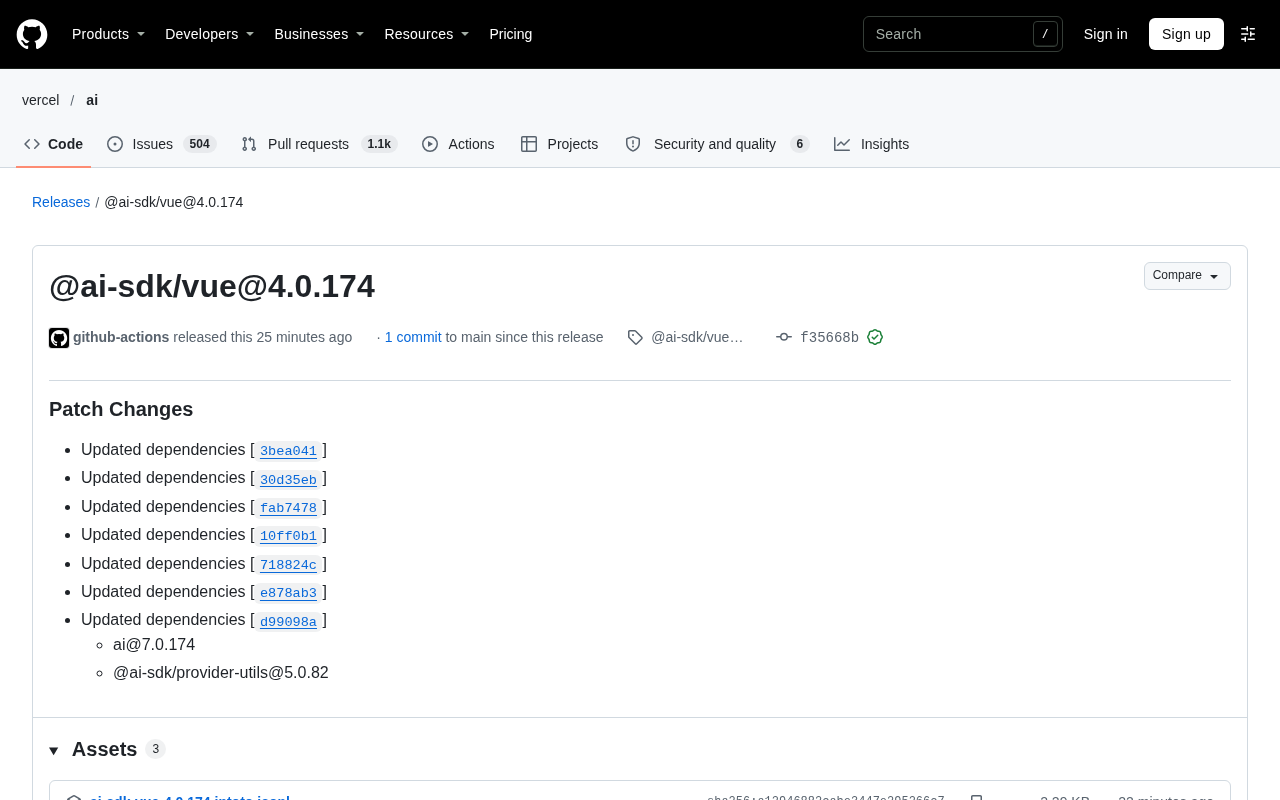
In the AI SDK's multi-framework ecosystem, the Vue adapter package @ai-sdk/vue has always played the role of bridging underlying model capabilities to the frontend component layer. It has just released version 4.0.174, and judging from the release notes, this version does not introduce new APIs but is a patch update focused on dependency alignment.
The Rhythm Behind the Version Number: Small, Frequent Patch Releases
The release notes for @ai-sdk/vue@4.0.174 are brief: marked as Patch Changes, listing multiple "Updated dependencies" records corresponding to seven different commit references. This type of release is quite common in the AI SDK's maintenance mode—when upstream packages change, downstream adapter packages are rebuilt and given a new patch number to ensure projects installing @ai-sdk/vue get a consistent dependency tree.
Looking at the timestamp, this release was completed by the github-actions automation pipeline at 18:43 on November 17, with a single commit merged into the main branch. The commit carries a GitHub verified signature (GPG key ID ending in B5690EEEBB952194), indicating the release pipeline follows the standard trusted CI process rather than manual packaging. For consumers, this means upgrades can proceed as usual without additional migration steps.
Which Dependencies Were Synced: ai and provider-utils
The release notes explicitly list two dependency versions brought in: ai@7.0.174 and @ai-sdk/provider-utils@5.0.82. The former is the core package of the AI SDK, while the latter handles common utility logic at the provider layer; together they form the foundation of the Vue adapter package.
The significance of this dependency sync lies in preventing version drift. The hooks and components of the Vue adapter package ultimately call interfaces exposed by the core package. If the core package fixes edge cases in streaming response handling or provider utility functions in a patch version, the adapter package following up in time prevents users from encountering inconsistencies where "the core is fixed but the adapter layer still exhibits old behavior." The seven dependency update commits also suggest this sync covered more than one upstream change.
Practical Impact on Vue Projects
For developers already using @ai-sdk/vue in their projects, the most direct effect of upgrading to 4.0.174 is dependency version convergence. The versions of ai and provider-utils in the lock file will be closer to the officially recommended combination, reducing type errors or runtime behavior differences caused by inconsistent indirect dependency versions. If your project has manually pinned the ai version via pnpm or npm overrides, it's worth checking before upgrading whether these overrides are still needed.
AI SDK's Package Layering Structure: The AI SDK adopts a design that separates the core package from framework adapter packages. ai is the core package, providing underlying capabilities such as model invocation, streaming responses, and tool calls, independent of any specific UI framework; @ai-sdk/provider-utils is a lower-level utility package that encapsulates common logic needed for provider implementations, such as HTTP request handling, stream parsing, and error normalization. @ai-sdk/vue, as the adapter layer, does not implement model interaction logic itself but bridges the capabilities of the ai core package into Vue's reactive system through composables (such as useChat). Therefore, although the adapter package's version number evolves independently, its actual behavior depends heavily on the bound versions of ai and provider-utils. Understanding this layering helps determine: when the adapter package only updates dependencies, the behavioral changes actually come from upstream packages, and the adapter package merely ensures these changes can be correctly consumed by Vue users.
Version Drift and Dependency Overrides (overrides): In the npm ecosystem, when multiple packages share the same indirect dependency, the package manager attempts to hoist or merge versions, but the version ranges declared by different packages may be inconsistent, causing multiple copies of the same package to appear in the lock file—this is version drift. The AI SDK's core package ai is referenced by adapter packages, provider packages, and others. If the adapter package does not keep up with the core package's patch versions, two versions of ai may coexist in the project, causing type mismatches or inconsistent streaming behavior. overrides (pnpm) or resolutions (yarn) are means to force unification of indirect dependency versions, commonly used to temporarily fix version conflicts. However, manual overrides bypass the dependency ranges declared by adapter packages, potentially causing redundancy or conflicts after adapter package upgrades. Therefore, checking whether overrides are still necessary when upgrading adapter packages is a key step in avoiding hidden issues.
How to View This Kind of "No Functional Change" Release
Content-wise, this release note has limited information: no new features, no breaking change descriptions, only dependency sync. But it reflects the AI SDK ecosystem's maintenance strategy—the core package iterates frequently, and framework adapter packages follow with patch versions, allowing users across different tech stacks to receive upstream fixes at approximately the same time.
For frontend teams focused on AI application development, what's worth noting is not this particular version number but the stability convention implied by the release rhythm: patch number changes can usually be adopted directly, while functional-level changes will appear in minor or major versions. Pinning @ai-sdk/vue within a certain minor range and regularly absorbing patch updates is a relatively safe upgrade strategy.
This release comes with no migration guide or behavioral change notes, so there are no compatibility issues requiring special verification. Only if future versions introduce new composables or adjust hook signatures in the Vue adapter layer would item-by-item checking against the changelog be necessary.
Related articles

Gemini 4 Neon Leak: A Potential Strong Contender Against Opus 5.5
A Hacker News thread suggests Gemini 4 Neon looks like an Opus 5.5 competitor. This article unpacks the product positioning behind this community signal, shifts in the top-model competitive landscape, and what it means for developers' model selection strategy.

Claude Fable 5.2's Self-Authored Short Film 'Fable' Sparks Discussion
A short film 'Fable,' credited to Claude Fable 5.2 for script, visuals, and directing, appears on Hacker News. This article analyzes the significance of full-pipeline AI creation, community reactions, and what it means for content creators.

Anthropic IPO Pricing: A Signal of AI Giants Going Public
Anthropic's IPO pricing draws attention. This article analyzes its potential impact on AI industry valuation, commercialization paths, and the competitive landscape, and highlights public-market expectations and challenges for AI companies.