@ai-sdk/vue 4.0.182 Patch Release: What the Dependency Chain Sync Signals
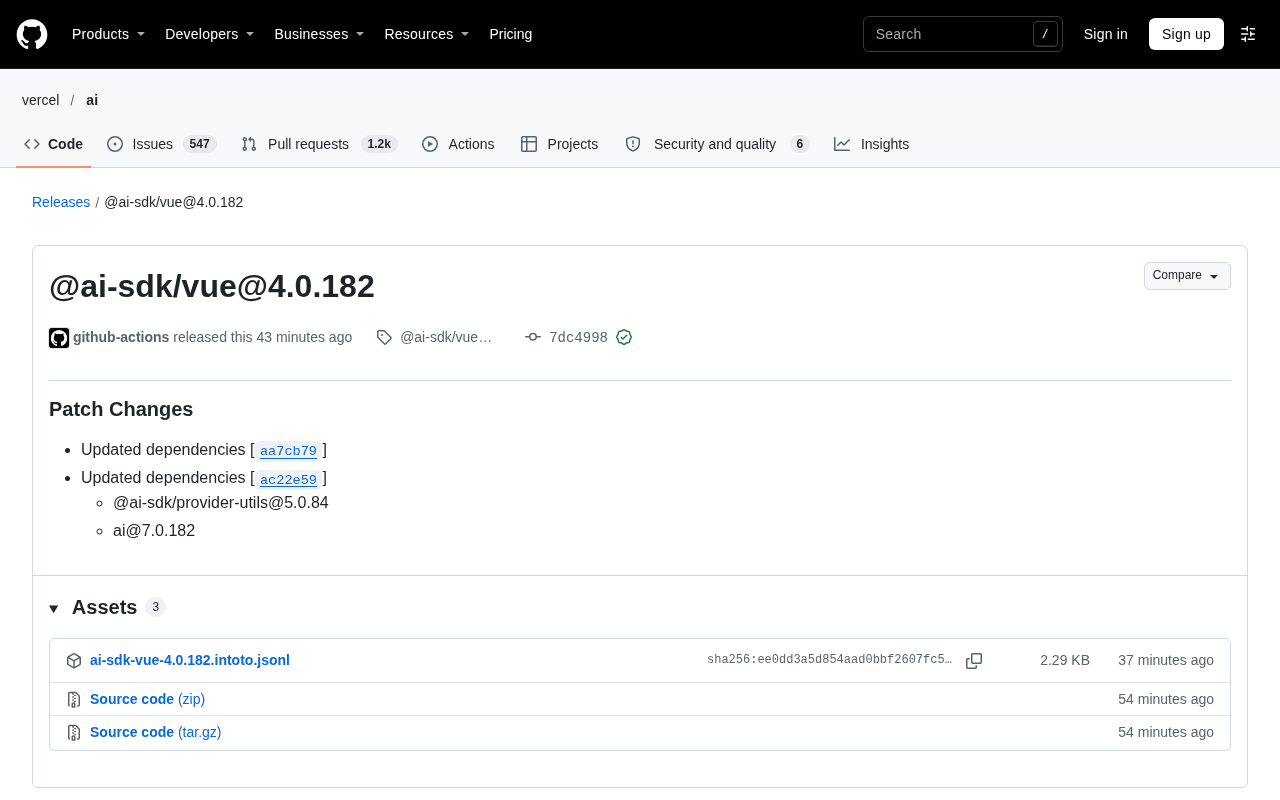
@ai-sdk/vue 4.0.182 only syncs dependencies, highlighting the need for version alignment between binding layer and core package.
This article interprets the significance of the @ai-sdk/vue 4.0.182 patch release in Vercel AI SDK. It introduces no new APIs; the substantive change is syncing two dependencies: @ai-sdk/provider-utils@5.0.84 and the core package ai@7.0.182. The article explains that AI SDK uses a layered "core package + framework binding" architecture, with the Vue binding exposing streaming responses and tool calling to components via the Composition API, so it must track the core package version—otherwise subtle issues like inconsistent streaming chunk parsing and misaligned tool call state callbacks can occur. The release is automated by github-actions with GPG signing. The article advises keeping major version ranges matched, verifying indirect dependencies, and documenting version relationships.
A Seemingly Uneventful Patch Version
The AI SDK project under Vercel continues to maintain a high-frequency iteration cadence. According to the official GitHub release record, @ai-sdk/vue@4.0.182 has been officially released as a patch version, automatically built by github-actions with a GPG signature. For developers using the Vue ecosystem to integrate LLM capabilities, this kind of three-digit rolling version number often means a "seamless upgrade"—but the dependency changes behind the patch are precisely a window into understanding the architectural evolution of the AI SDK.
Core Change: Dependency Sync Takes Center Stage
Judging from the release notes, the substantive content of this patch centers on dependency updates, involving two commits. The first is the version sync of @ai-sdk/provider-utils@5.0.84, and the second is the follow-up to the core package ai@7.0.182. The description is quite restrained, with no accompanying feature or behavior change notes, consistent with the positioning of a Patch Changes release.
This "dependency-update-only" release pattern is common in SDK ecosystems. @ai-sdk/vue itself is a binding layer for the Vue framework, primarily responsible for exposing the core ai package's streaming responses, tool calling, and other capabilities to components in the form of Vue Composition API. Therefore, whenever the upstream ai core package and provider-utils tooling layer have any fixes or adjustments, the binding layer needs to follow with a release to ensure that Vue developers get behavior consistent with the core.
Worth noting is the transitive structure of the dependencies: @ai-sdk/vue → ai and @ai-sdk/provider-utils run in parallel on two tracks. The former carries model invocation and streaming protocol logic, while the latter handles common utility functions for provider adaptation. Both tracks being updated simultaneously suggests that this fix may have touched underlying logic shared across packages.
changesets is a widely used version management and release tool in the npm ecosystem. Developers declare the impact scope of their changes (patch/minor/major) by submitting Markdown files with change descriptions in PRs, and CI automatically calculates version numbers, updates the dependency chain, generates CHANGELOGs, and triggers releases after merging. Its approach is similar to semantic-release, but it emphasizes manual declaration of change intent rather than relying entirely on commit message parsing, making it suitable for multi-package coordinated releases in monorepos. Projects like AI SDK that include a core package plus multiple framework binding packages are typical users of changesets.
GPG signing in the context of npm publishing refers to cryptographically signing git tags or release artifacts so that downstream users can verify the authenticity and integrity of the version's origin. npm's built-in provenance mechanism further binds release records to the CI build environment, forming a traceable supply chain evidence chain. Against the backdrop of frequent malicious package and account hijacking incidents in the npm ecosystem, signing and provenance have become important references for judging whether a package is trustworthy.
Why the Binding Layer Must Stay So Closely Aligned
The AI SDK is designed with a layered structure of "core + framework bindings." The core package provides a unified invocation interface and streaming data abstraction, and each framework binding (Vue, React, Svelte, etc.) converts the abstraction into the corresponding framework's reactive primitives. The benefit of this layering is cross-framework behavioral consistency; the cost is extremely high version alignment requirements.
If the binding layer uses an outdated version of the core package, issues such as inconsistent streaming chunk parsing and misaligned tool calling state callback timing may occur, manifesting as loading states that never disappear in components, out-of-order message fragments, and other hard-to-troubleshoot phenomena. Therefore, for the Vue binding, keeping pace with the ai core package's version number is not formalism but a necessary means of ensuring runtime semantic consistency.
When upgrading, developers are advised to keep the major version ranges of @ai-sdk/vue and ai matched, and to verify the actual resolved provider-utils version through the lock file, avoiding indirect dependencies being pulled into branches incompatible with the binding layer.
Streaming responses are the core interaction pattern in LLM invocation: the server pushes generated tokens chunk by chunk via SSE or similar protocols, and the client renders as it receives, significantly reducing time-to-first-token. The AI SDK core package is responsible for unifying different providers' streaming protocols into a consistent sequence of chunk events (such as text deltas, tool call start/end, finish events, etc.), and the framework binding layer then bridges these events to the corresponding framework's reactive state. Precisely because chunk parsing rules, event timing, and termination conditions are all defined in the core package, once the binding layer and core package have misaligned semantic versions, state desynchronization may occur at event boundaries.
Tool calling refers to the model outputting structured function call requests during generation, which the application side executes and passes results back to the model to continue generation. This flow involves a multi-turn state machine: request initiation, streaming assembly of parameters, execution result backfill, and secondary generation. The timing of state callbacks is particularly sensitive for the binding layer, and any version mismatch can cause pending states in the UI to fail to converge.
Gauging the Project's Engineering Maturity from Its Automated Release Pipeline
This release was triggered by the github-actions bot and carries a GitHub-verified signature. This indicates that AI SDK employs an automated release pipeline based on tools like changesets: developers attach change descriptions when submitting, and CI automatically calculates version numbers, updates dependencies, generates release records, and signs them after merging.
This has practical significance for downstream users. Automated releases mean a stable patch cadence and trustworthy version numbers, reducing version jumps or missed releases that are prone to occur with manual publishing. At the same time, GPG signing adds another layer of supply chain security verification—a commendable practice given the frequent supply chain attacks in the npm ecosystem.
How Developers Should Handle Such Patches
When facing a patch version with only dependency update notes, a reasonable approach is: upgrade and run existing tests, focusing on test cases related to streaming output and tool calling. If the project has high requirements for version stability, you can validate in a small-scale environment before rolling out broadly; if you are only consuming basic conversation capabilities, you can usually follow along directly.
Additionally, recording the version relationships among ai, provider-utils, and the framework binding in project documentation can help quickly determine whether version mismatches are the cause when troubleshooting. Although patch versions are small, transparent dependency chain management is the key to long-term maintenance.
Key Takeaways
This is a typical follow-along update of a binding layer, introducing no new APIs—its substantive value lies in maintaining version synchronization between the Vue binding and the core AI SDK. It reminds developers that in a layered SDK architecture, version alignment itself is an engineering concern that requires proactive management.
One-line Summary
@ai-sdk/vue 4.0.182 only syncs dependencies, highlighting the necessity of version alignment between the binding layer and core package.
Paragraph Summary
This article interprets the significance of the @ai-sdk/vue 4.0.182 patch release in Vercel AI SDK. This version introduces no new APIs; the substantive change is syncing two dependencies: @ai-sdk/provider-utils@5.0.84 and the core package ai@7.0.182. The article points out that AI SDK adopts a layered "core package + framework binding" architecture, with the Vue binding exposing streaming responses, tool calling, and other capabilities to components via the Composition API, so it must keep pace with the core package version—otherwise subtle issues like inconsistent streaming chunk parsing and misaligned tool calling state callbacks may arise. The release is automated by github-actions with GPG signing, reflecting a changesets-based automated pipeline and supply chain security practices. The article advises developers to keep major version ranges matched when upgrading, verify indirect dependencies in the lock file, and document the version relationships among the three for troubleshooting purposes.
Related articles

Nothing CMF Buds 2A Drops to $17.89 on Black Friday: A New Low for ANC Earbuds
Nothing CMF Buds 2A wireless earbuds Black Friday deal: just $17.89 on Amazon, about $11 off retail and a record low. ANC earbuds at an entry-level price.

When AI Creation Gets Accused of "Spitting": Hacker News Heats Up Over the Glaude Controversy
A Hacker News post, "Spitting in the Face of Glaude," sparks debate on AI creation transparency and attribution ethics. This analysis examines the blurred creator identity behind the controversy and offers practical advice for AI content production.

Akai Embraces Custom Firmware: MPC Sample 1.4 Lets Users AI-Program Their Sampler
Akai embraces the modding community with MPC Sample 1.4 firmware, supporting vibe-coded custom firmware and effects. We analyze the impact of this open strategy on music hardware and AI-assisted programming.