@ai-sdk/vue 4.0.183 Patch Update: Decoding Vercel AI SDK's Release Cadence
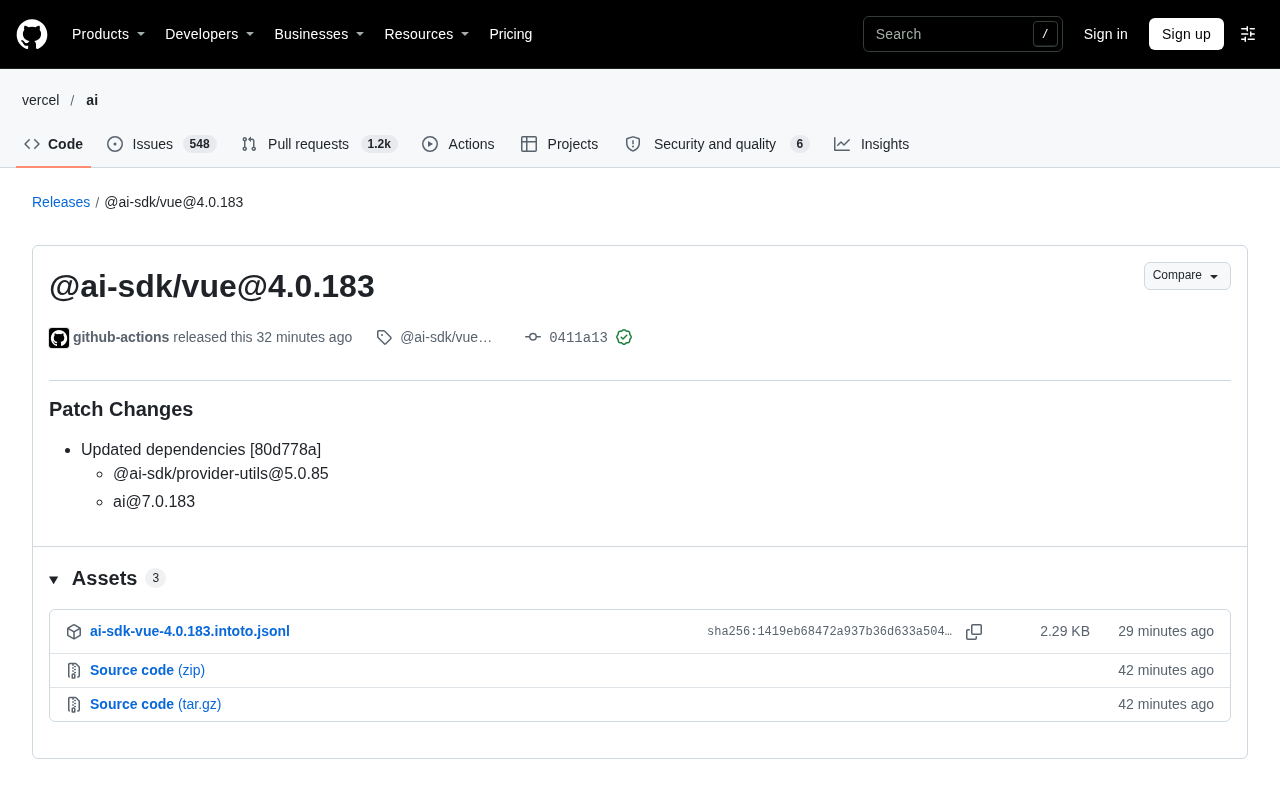
AI SDK's Vue adapter ships a dependency-sync patch, reflecting its automated releases and versioning strategy.
Using the @ai-sdk/vue 4.0.183 patch release as an entry point, the article analyzes the AI SDK's version maintenance cadence. This version was auto-published by the github-actions bot, with the only core change being syncing underlying dependencies @ai-sdk/provider-utils 5.0.85 and main package ai 7.0.183 — the Vue adapter layer itself has no functional or API changes. The article explains the necessity of dependency-propagation releases in a monorepo: the adapter layer directly depends on the main package and provider utility library, so it must follow upstream patches to maintain version consistency. It also notes that automated releases with signature verification provide strong traceability, at the cost of high release frequency and noisy logs. Advice for users: pure dependency-sync patches can be merged in batches, and upgrades should compare all three layers' versions to avoid hidden behavioral inconsistencies.
Vercel's AI SDK has shipped yet another patch update. According to the GitHub Releases page, @ai-sdk/vue@4.0.183 was published by the github-actions bot on 26 Nov — a standard automated patch change. For many developers, release notifications like this look like technical noise, but they happen to be a useful lens into understanding the AI SDK's versioning strategy and maintenance cadence.
What a Patch Release Actually Changes
Change Content: Dependency Chain Propagation
Looking at the changelog, this Patch Change is very restrained: the core is "Updated dependencies," with target commit [80d778a], affecting @ai-sdk/provider-utils@5.0.85 and ai@7.0.183.
In other words, @ai-sdk/vue itself has no functional changes — its update simply syncs the version references of the underlying provider utility library and the main ai package to the latest. This "dependency propagation" release pattern is common in monorepos, aimed at ensuring version consistency across packages within the same release batch.
Why the Vue Package Moves Too
@ai-sdk/vue is the AI SDK's adapter layer for the Vue ecosystem, responsible for wrapping core capabilities like streaming responses and tool calls into a form usable via Vue composables. Since it directly depends on the ai main package and provider-utils, whenever upstream ships a patch, the adapter layer must follow suit — otherwise you risk hidden pitfalls where "the Vue package pins an old provider-utils version and behaves inconsistently with the main package."
This has practical implications for teams using Nuxt or pure Vue projects to integrate AI capabilities: when you upgrade @ai-sdk/vue, you're actually indirectly upgrading the provider abstraction layer. When troubleshooting, you need to look at all three layers' versions together.
Monorepo and Semantic Versioning (SemVer)
A monorepo is a pattern where multiple interdependent packages are managed in the same code repository — AI SDK's ai, @ai-sdk/provider-utils, @ai-sdk/vue and other packages fall into this category. In this structure, after an upstream package ships a patch, downstream packages still referencing the old version would create version inconsistencies within the same repo. Therefore, toolchains (like changesets) trigger "dependency propagation" releases: downstream packages only bump the patch number and update dependency declarations, without any code logic changes.
SemVer defines the meaning of major.minor.patch: major version changes represent breaking API changes, minor versions represent backward-compatible new features, and patch versions represent backward-compatible fixes only. The 183 in 4.0.183 indicates this package has shipped a large number of patches on the 4.x line, a substantial proportion of which are dependency syncs like this rather than standalone fixes.
What Automated Releases Tell Us
Bot Releases and Signature Verification
This release was completed by github-actions, with commits carrying GitHub-verified signatures (GPG key ID identified as B5690EEEBB952194). The automated pipeline handles version bumping, changelog generation, and npm publishing, with human intervention minimized.
The benefit of this model is strong traceability: every version corresponds to a specific signed commit, enabling precise rollback to a particular commit when issues arise. The cost is high release frequency, with many entries in the changelog being "mechanical syncs" — developers need to be able to filter information effectively.
Git Commit Signing and Traceability
Git supports signing commits and tags with GPG or SSH keys, and GitHub verifies signatures and displays a "Verified" badge in the UI. The purpose of signing is to prove that a commit was genuinely produced by the entity holding the corresponding private key (in this case, the bot key configured in the CI pipeline), rather than being forged or tampered with. The GPG key ID mentioned above identifies this key.
In automated release scenarios, signing binds together the "version number — changelog — source commit" triad: any npm version can be traced back to a unique signed commit. This is critical for security audits and failure rollback — when a patch introduces a regression, teams can precisely identify and revert to the last verified commit without relying on the publisher's verbal assurance.
The Maintenance Philosophy Behind Patch Numbers
A patch number like 4.0.183 shows that @ai-sdk/vue has accumulated considerable iterations on major version 4. The AI SDK overall follows a cadence of "major versions carry breaking changes, patch versions handle high-frequency fixes and syncs" — consistent with the reality of today's rapidly evolving AI toolchains and frequently adjusted upstream provider interfaces.
For teams, a pragmatic approach is: don't chase every patch, but watch for behavioral changes in provider-utils or the ai main package; pure dependency-sync updates can be merged in batches to reduce upgrade noise.
Practical Impact on Users
Upgrade Recommendations
If your project pins @ai-sdk/vue, this update alone isn't a must-upgrade — there are no API changes and no new features for the Vue layer. But if your dependency tree already has ai or @ai-sdk/provider-utils at 7.0.183 / 5.0.85, keeping all three consistent avoids duplicate installations and type mismatches caused by version conflicts.
Ecosystem Perspective
The bigger signal from this release is: the AI SDK's Vue adapter layer is still actively maintained and bound to the main package's release cadence. For teams using Vue/Nuxt as their primary stack while integrating multiple model providers, choosing the official adapter means continuously benefiting from upstream fixes — but also accepting a high release frequency.
For content creators and architecture decision-makers, judging whether an AI SDK is worth a long-term bet isn't just about the feature list — it's also about whether it maintains stable cross-framework adapters and predictable release discipline. This seemingly unremarkable patch release is exactly a routine proof of the latter.
Related articles

Nothing CMF Buds 2A Drops to $17.89 on Black Friday: A New Low for ANC Earbuds
Nothing CMF Buds 2A wireless earbuds Black Friday deal: just $17.89 on Amazon, about $11 off retail and a record low. ANC earbuds at an entry-level price.

When AI Creation Gets Accused of "Spitting": Hacker News Heats Up Over the Glaude Controversy
A Hacker News post, "Spitting in the Face of Glaude," sparks debate on AI creation transparency and attribution ethics. This analysis examines the blurred creator identity behind the controversy and offers practical advice for AI content production.

Akai Embraces Custom Firmware: MPC Sample 1.4 Lets Users AI-Program Their Sampler
Akai embraces the modding community with MPC Sample 1.4 firmware, supporting vibe-coded custom firmware and effects. We analyze the impact of this open strategy on music hardware and AI-assisted programming.