AI SDK Vue Releases 4.0.143 Patch: Core Dependencies Synced

@ai-sdk/vue@4.0.143 patch released, only syncing dependencies like ai@7.0.143, no new features.
Vercel's AI SDK ecosystem released the @ai-sdk/vue@4.0.143 patch with no new features or breaking changes, focused on dependency sync: ai updated to 7.0.143, @ai-sdk/provider-utils to 5.0.62, plus related low-level dependencies. Such "dependency-only" releases are common in monorepo-style SDKs, locking in a verified dependency set. The three-digit patch number reflects high-frequency, small-step iteration, and the core package sharing the same patch number suggests coordinated pipeline releases. Vue developers face low upgrade risk, but should upgrade the ai core package alongside @ai-sdk/vue to avoid mismatches or duplicate copies.
Vercel's AI SDK ecosystem has rolled out another minor iteration. @ai-sdk/vue@4.0.143 has been released as a patch update, with the core change centered on dependency synchronization rather than introducing new features or breaking changes.
What This Patch Actually Changed
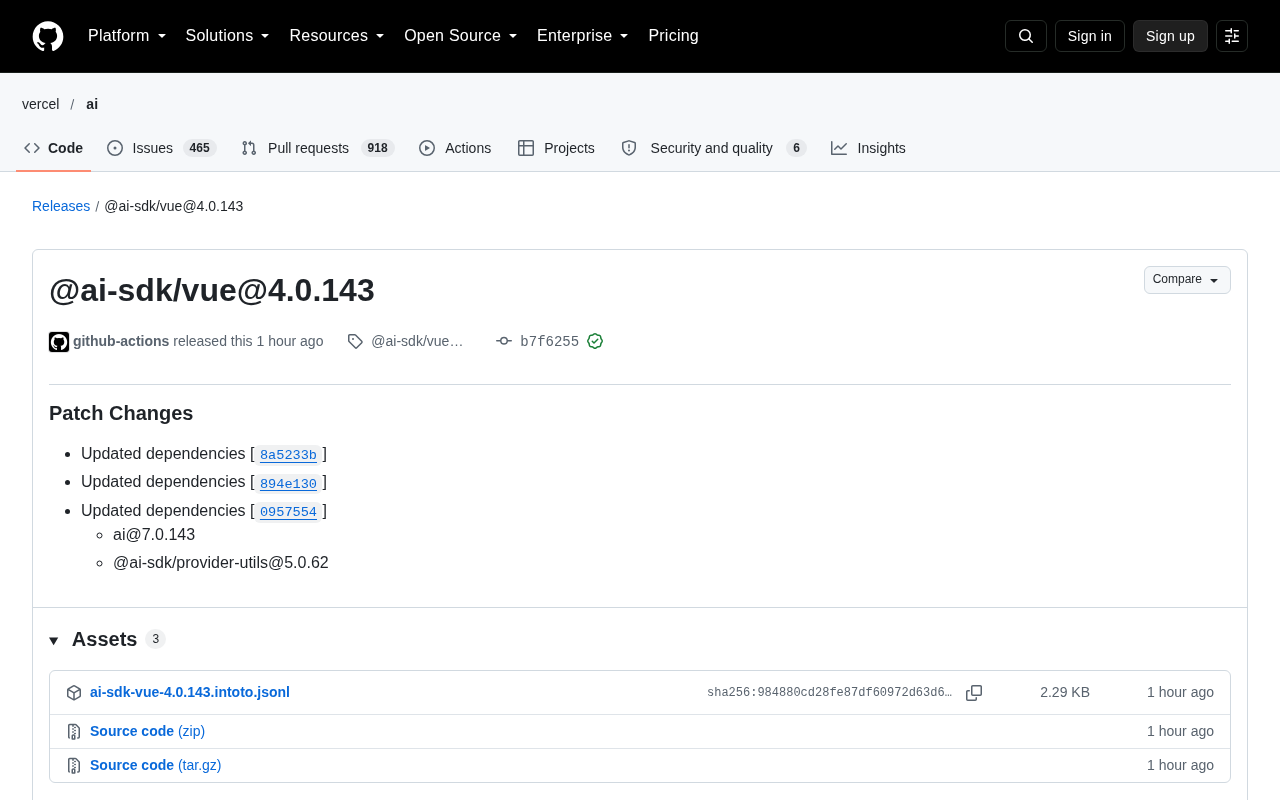
According to the commit records, the change type for @ai-sdk/vue@4.0.143 is marked as Patch Changes, which typically indicates a minor adjustment at the fix or dependency-tracking level. The actual change consists of three dependency updates:
- Updated to
ai@7.0.143 - Updated to
@ai-sdk/provider-utils@5.0.62 - And a group of related low-level dependencies synced alongside
This type of commit is common in monorepo-style SDK repositories. The entire AI SDK is split into the ai core package, framework binding packages (such as @ai-sdk/vue and @ai-sdk/react), and provider utility packages, all locked to each other via exact version numbers. When the core package or utility package releases a patch, the upper-layer framework bindings need to follow suit to ensure that the dependency combinations users install are verified.
Monorepo refers to the engineering practice of managing multiple interrelated software packages within a single code repository. The AI SDK adopts exactly this model: the ai core package, @ai-sdk/vue, @ai-sdk/react, @ai-sdk/provider-utils, and other packages share the same build, test, and release pipeline. The benefit of a monorepo is that cross-package changes can be committed at once and validated uniformly, avoiding the difficulty of synchronizing across multiple repositories; the trade-off is that packages require a strict version coordination mechanism. The AI SDK uses an "exact version locking" strategy, where framework binding packages hard-code the core package version they depend on in package.json (rather than a ^ or ~ range), guaranteeing that the combination users install has been tested by the team. This also explains why a single patch to the core package triggers releases across all upper-layer binding packages.
Why a "Dependency-Only" Version Is Worth Noticing
Looking at @ai-sdk/vue@4.0.143 on its own, it doesn't include any developer-facing new APIs or behavior changes. But this release sends two signals.
First, the AI SDK's release cadence remains high-frequency. A three-digit version number like 4.0.143 indicates that the Vue binding has gone through over a hundred patch iterations, showing the team prefers small, rapid steps and frequent releases rather than accumulating a large batch of changes before shipping a major version.
Second, the core package ai@7.0.143 shares the same patch number as the Vue binding, suggesting that both are advancing in coordination on the same release pipeline. For developers building Vue applications with the AI SDK, this means that when upgrading to the latest version, there won't be a version mismatch between the core logic and the framework layer.
SemVer (Semantic Versioning) dictates that a version number takes the form major.minor.patch, corresponding to incompatible changes, backward-compatible new features, and backward-compatible bug fixes respectively. The patch number 143 in 4.0.143 doesn't represent 143 "release events," but rather a cumulative patch increment counter. In a monorepo, every time the core package releases a patch, the binding packages often need to increment as well, even if the binding package's own code hasn't changed a single line. Therefore, a three-digit patch number reflects more the "number of coordinated releases" rather than the magnitude of changes to the package itself. Understanding this makes the @ai-sdk/vue patch number being as high as 143 unsurprising.
Cross-Reference with Other Framework Bindings
The AI SDK officially maintains multiple framework bindings including React, Svelte, and Vue. These packages typically release patches with the same version number within the same time window. If you're using @ai-sdk/vue, you can cross-reference the corresponding version of @ai-sdk/react in the official repository to confirm you're in a consistent dependency matrix.
For teams integrating the AI SDK into Vue 3 projects, the recommended approach is: don't upgrade @ai-sdk/vue in isolation—include the ai core package in the upgrade plan as well. Because the value of the patch version lies precisely in the compatibility binding between the two.
peerDependencies is a field in npm used to declare "host dependencies," commonly seen in plugins and framework binding packages. It indicates that the package expects a dependency (such as vue or ai) to be provided by the user's own project, rather than installing its own copy. When the peer version range doesn't match the actually installed version, npm 7+ will issue a warning, and pnpm and yarn will also flag it. For @ai-sdk/vue, the ai core package is very likely declared as a peer, which requires developers to proactively upgrade the ai in their project rather than expecting the binding package to bring it in automatically. This is also the technical root cause behind the article's recommendation to "upgrade the core package and the binding package together."
Practical Upgrade Advice for Developers
This update introduces no migration cost. If your project is currently running fine, upgrading to 4.0.143 is a low-risk operation—just run your package manager's update command.
What truly deserves attention is the cleanliness of your dependency tree. Since @ai-sdk/provider-utils has also been synced to 5.0.62, if your project also directly depends on this utility package, make sure its version matches the one referenced internally by the SDK to avoid having multiple copies of the same package.
For teams still on the fence, this kind of pure dependency patch isn't a version you must follow immediately. You can treat 4.0.143 as part of your next routine dependency update batch rather than scheduling a separate release for it.
One-line Summary
@ai-sdk/vue@4.0.143 patch released, only syncing dependencies like ai@7.0.143, no new features.
Paragraph Summary
Vercel's AI SDK ecosystem has released the @ai-sdk/vue@4.0.143 patch version. This update contains no new features or breaking changes; the core action is dependency synchronization: updating ai to 7.0.143, @ai-sdk/provider-utils to 5.0.62, and syncing a group of related low-level dependencies. The article notes that this type of "dependency-only" release is common in monorepo-style SDKs, and its value lies in locking down a verified dependency combination. In terms of release cadence, the three-digit patch number reflects the team's high-frequency, small-step iteration strategy, and the core package and framework binding sharing the same patch number suggests they advance in coordination on the same pipeline. For Vue developers, the upgrade risk is low, but it's recommended to upgrade the ai core package together with @ai-sdk/vue to avoid dependency mismatches or duplicate copies. If the project is running fine, it can also be folded into a routine dependency update batch.
Related articles

Why Does the Tesla Roadster Need to Fly? A Deep Dive into Musk's Wild Demo
Tesla's Roadster launch showed wall-climbing, upside-down driving, and flying stunts—but The Vergecast notes the demo car may lack a battery, the Rocket version is invite-only and not street-legal, and the website terms don't guarantee delivery. After nine years of delays, why does this car still need to exist?

AI Is Not a Replacement: Human-AI Collaboration Through the Lens of Factory Root Cause Analysis
Starting from factory root cause analysis, this article explains how AI accelerates evidence chain construction rather than replacing human experts, exploring the pragmatic implementation logic and business value of 'AI supporting people rather than replacing them.'

AI Agent Decision Auditing: Building an Evidence Chain in Regulated Workflows
Starting from a Reddit discussion, this article analyzes three core issues in AI agent decision auditing within regulated workflows: what fields audit records should contain, how to handle feedback latency for erroneous decisions, and how to continuously calibrate LLM judge consistency with human judgment.