AI SDK Workflow 2.0.110 Patch Release: What the Dependency Chain Update Signals
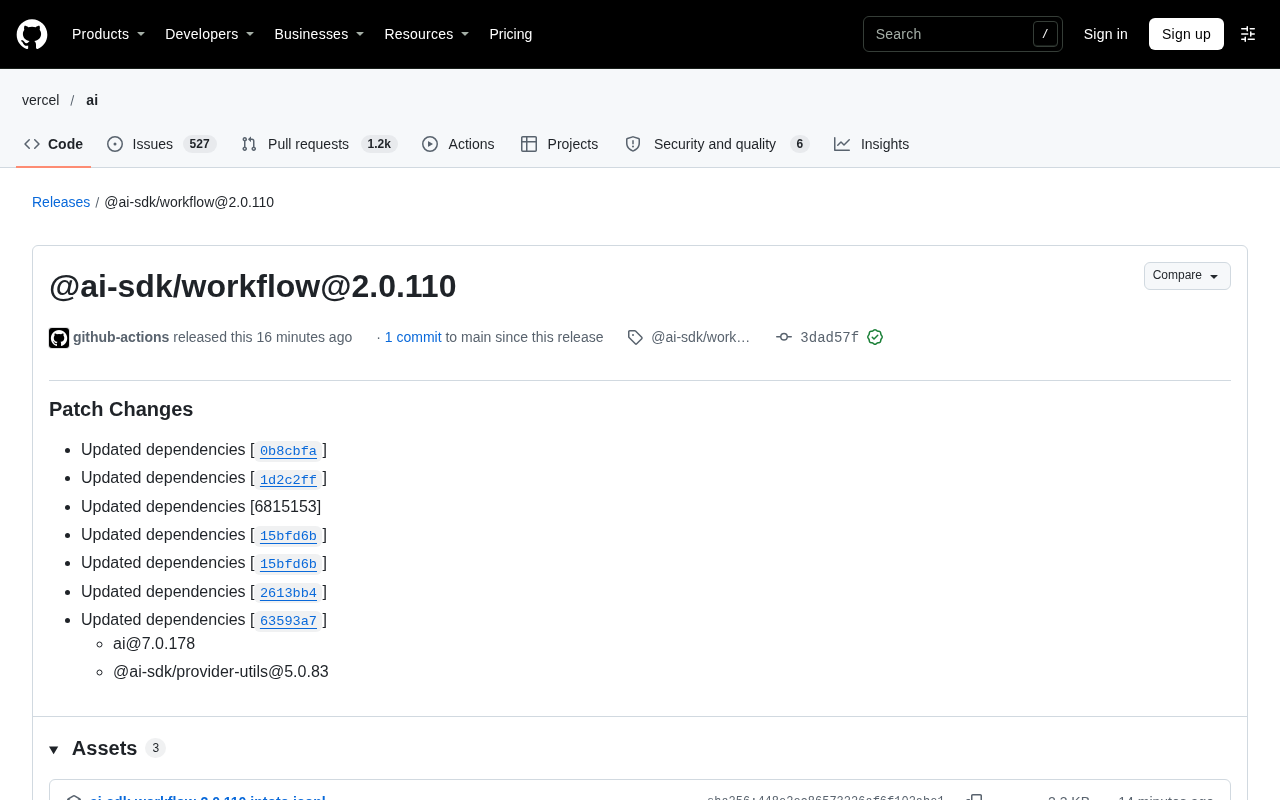
AI SDK's workflow package releases 2.0.110 patch, only synchronizing upstream dependencies with no functional changes.
`@ai-sdk/workflow` in the Vercel AI SDK ecosystem has released version 2.0.110, a patch-level maintenance release. This update introduces no new APIs or breaking changes, with the only change type being "Updated dependencies," primarily synchronizing two upstream packages: `ai@7.0.178` and `@ai-sdk/provider-utils@5.0.83`. The article points out that this reflects the highly coupled evolution rhythm of AI SDK sub-packages: workflow is built on the provider abstraction layer and maintains version synchronization with the core package to avoid interface mismatches. Since the release notes do not disclose specific fix content, developers should check upstream change records before upgrading and verify model invocation and workflow execution paths in a pre-release environment before pushing to production.
Vercel's AI SDK ecosystem has received another routine update. @ai-sdk/workflow has released version 2.0.110 on GitHub, a patch-level maintenance release. Judging from the version number alone, this update introduces no new APIs or breaking changes, but the dependency update chain it connects reveals the highly coupled evolution rhythm among AI SDK sub-packages.
What Exactly Changed in This Update
According to the release notes, the only change type in 2.0.110 is "Patch Changes," with the core content being "Updated dependencies"—that is, synchronizing upstream dependency versions. The release record lists several dependency update commits and explicitly points to two key packages: ai@7.0.178 and @ai-sdk/provider-utils@5.0.83.
This means @ai-sdk/workflow itself has no functional changes. It is more of a "follow-along" release: after the upstream core package ai and the provider utility package are upgraded, the workflow package synchronizes accordingly to ensure consistency of the dependency tree. For SDK ecosystems using monorepos or multi-package collaboration, this release frequency is very common.
Under the Semantic Versioning (SemVer) specification, a version number consists of a major version, a minor version, and a patch version, in the form MAJOR.MINOR.PATCH. An increment in the PATCH position represents backward-compatible bug fixes and should not introduce new APIs or breaking changes; an increment in the MINOR position represents new backward-compatible features; an increment in the MAJOR position may contain incompatible changes. @ai-sdk/workflow releasing 2.0.110 from the 2.0.x series indicates it is still within the 2.0 major version line, so the upgrade expectation for users is low-risk. However, SemVer is only a convention, not a mandate—especially in ecosystems with deep dependency chains, behavioral adjustments in upstream sub-packages can still propagate through indirect dependencies. Therefore, "Patch Changes" is more of a risk indication level than an absolute safety guarantee, and production environments should still combine upstream change records with test verification to make judgments.
The Significance of Dependency Updates: Big Collaboration Behind Small Versions
The Role of provider-utils
@ai-sdk/provider-utils@5.0.83 is the underlying package in AI SDK responsible for provider abstraction and utility functions. Its version advancement typically affects foundational capabilities such as model invocation and streaming response handling. The workflow package depends on it, indicating that workflow orchestration capabilities are built on top of this layer of abstraction.
Provider abstraction is one of the core design patterns of AI SDK. Different model providers (such as OpenAI, Anthropic, Google, etc.) have differences in request formats, authentication methods, and streaming protocols. AI SDK shields these differences at the bottom layer through a unified provider interface, allowing upper-layer code to invoke models in a consistent manner. @ai-sdk/provider-utils is the utility package that carries this layer of abstraction, typically including common logic such as request construction, response parsing, streaming data chunk processing, and error mapping. When this layer undergoes version advancement, the impact is often not limited to a single model but affects all upper-layer modules built on this abstraction. The workflow package depends on it, meaning that model invocation, streaming output, and interruption handling in workflows all reuse this layer of implementation, and its stability directly determines the reliability of orchestration logic.
Linkage with the ai Core Package
ai@7.0.178 is the main package of AI SDK. Keeping workflow synchronized with it avoids provider interface mismatches between different sub-packages. For developers, upgrading workflow also brings the latest fixes from the core package, reducing the cost of manual version alignment.
It should be noted that this release note does not provide specific bug fix content or behavioral change descriptions, only listing commit references for dependency updates. Therefore, it is impossible to determine whether these dependency updates contain changes that have actual impact on workflow usage scenarios.
Monorepo (managing multiple packages in a single code repository) is a common organizational approach in current SDK ecosystems, and multiple sub-packages of AI SDK are typically developed collaboratively within the same repository. In this mode, packages reference each other through the workspace protocol, and releases often adopt a "follow-along" strategy: after the core package is upgraded, sub-packages that depend on it synchronously increase their version numbers and update dependency declarations. The advantage of this approach is that the dependency tree always converges to a consistent state, avoiding "dependency hell"—where different sub-packages lock incompatible provider interface versions, causing type mismatches or missing methods at runtime. The cost is that sub-package release records frequently show seemingly meaningless PATCH increments. Understanding this mechanism makes it clear that the version number advancement of @ai-sdk/workflow reflects more the ecosystem synchronization rhythm rather than the functional evolution trajectory of the package itself.
How Developers Should Treat Such Patches
For teams that lock versions, patch-level updates usually mean low risk. However, the AI SDK ecosystem iterates quickly, and small version changes in the dependency chain can sometimes bring indirect behavioral differences. It is recommended to check the change records of the corresponding versions of ai and @ai-sdk/provider-utils before upgrading to confirm whether there are fixes that affect your own usage.
If the project uses a lockfile to manage dependencies, directly updating the workflow package will typically pull in new dependency versions as well. For production environments with high stability requirements, you can first verify model invocation and workflow execution paths in a pre-release environment before pushing to production.
A lockfile (such as package-lock.json, pnpm-lock.yaml, yarn.lock) records the exact version and resolution address of each package in the dependency tree and is key to ensuring reproducible builds. When a project performs dependency updates, the package manager decides whether to pull new versions based on the lockfile: if @ai-sdk/workflow is directly upgraded, its declared dependency range may allow ai and @ai-sdk/provider-utils to resolve to new PATCH versions, thereby updating the entire dependency chain. For teams pursuing stability, a "review before upgrade" process can be adopted: perform updates in a separate branch, check the actually resolved versions through npm ls or pnpm why, and then combine upstream changelogs with integration tests to confirm no behavioral regression before merging. This way, you can enjoy upstream fixes while keeping the uncertainty brought by indirect changes within an acceptable range.
Summary
@ai-sdk/workflow@2.0.110 is a typical ecosystem-coordinated patch release. It has no new features of its own; its value lies in maintaining dependency chain consistency. Developers following AI SDK can treat such releases as a signal of version health without expecting functional surprises.
One-line Summary
AI SDK's workflow package releases 2.0.110 patch, only synchronizing upstream dependencies with no functional changes.
Paragraph Summary
@ai-sdk/workflow in the Vercel AI SDK ecosystem has released version 2.0.110, a patch-level maintenance release. This update introduces no new APIs or breaking changes, with the only change type being "Updated dependencies," primarily synchronizing two upstream packages: ai@7.0.178 and @ai-sdk/provider-utils@5.0.83. The article points out that this reflects the highly coupled evolution rhythm of AI SDK sub-packages: workflow is built on the provider abstraction layer and maintains version synchronization with the core package to avoid interface mismatches. Since the release notes do not disclose specific fix content, developers should check upstream change records before upgrading and verify model invocation and workflow execution paths in a pre-release environment before pushing to production.
Related articles
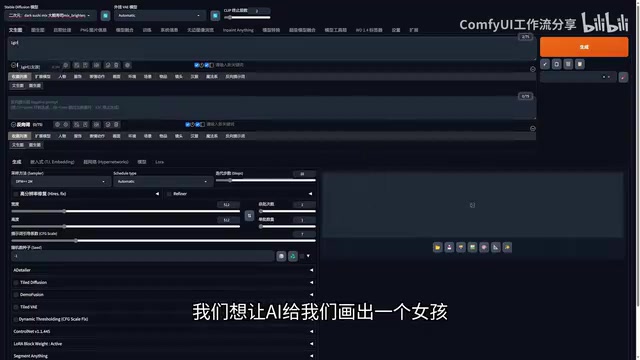
Akio SD Bundle 2026 Edition: One-Click Install & Zero-Basics Image Generation Tutorial
Akio Stable Diffusion bundle 2026 one-click install tutorial: text-to-image prompts, checkpoint and VAE selection, sampling parameters, seed reproduction, and ControlNet line-art repainting—generate images from zero basics.
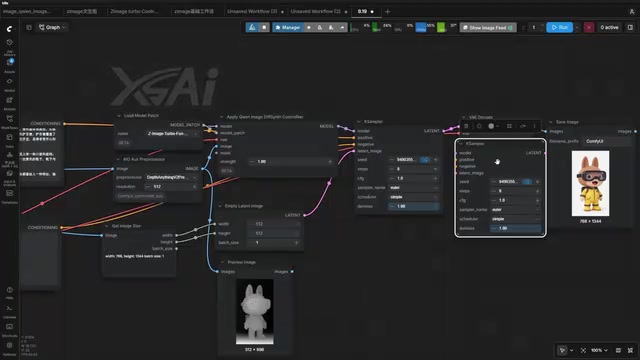
ComfyUI Two-Stage Sampling in Practice: A Guide to Choosing ControlNet Preprocessors
ComfyUI two-stage sampling tutorial: ControlNet controls structure in stage one; stage two drops ControlNet to boost quality with Denoise at 0.75. Covers OpenPose, Canny, Soft Edge, and Depth preprocessors.

2026's Most Mind-Bending Animated Series 'Infinite Flow': The Ultimate Fusion of Mystery, Deduction, and Survival Challenges
An in-depth analysis of Bilibili's animated series *Infinite Flow*: its infinite-flow worldview, mystery-deduction and survival challenges, Lin Qian's growth, ensemble portrayal, and narrative ambition.