@ai-sdk/workflow 2.0.115 Patch Update: Dependency Chain Evolution and Ecosystem Cadence

@ai-sdk/workflow 2.0.115 is a dependency-driven patch reflecting version linkage and automated releases in the AI SDK ecosystem.
@ai-sdk/workflow releases patch 2.0.115 with no feature changes of its own, mainly syncing dependencies on @ai-sdk/provider-utils 5.0.85 and ai 7.0.183. This dependency-following pattern is common in monorepo-managed SDK ecosystems and is automatically published by GitHub Actions with signature verification. The high-frequency, small-step release strategy reduces the risk of each change but also requires integrators to track release notes more proactively. When upgrading, developers should pay attention to dependency locking strategy, focus on validating interactions with model providers, and establish a routine dependency version inspection mechanism.
The Engineering Signal Behind a Version Number
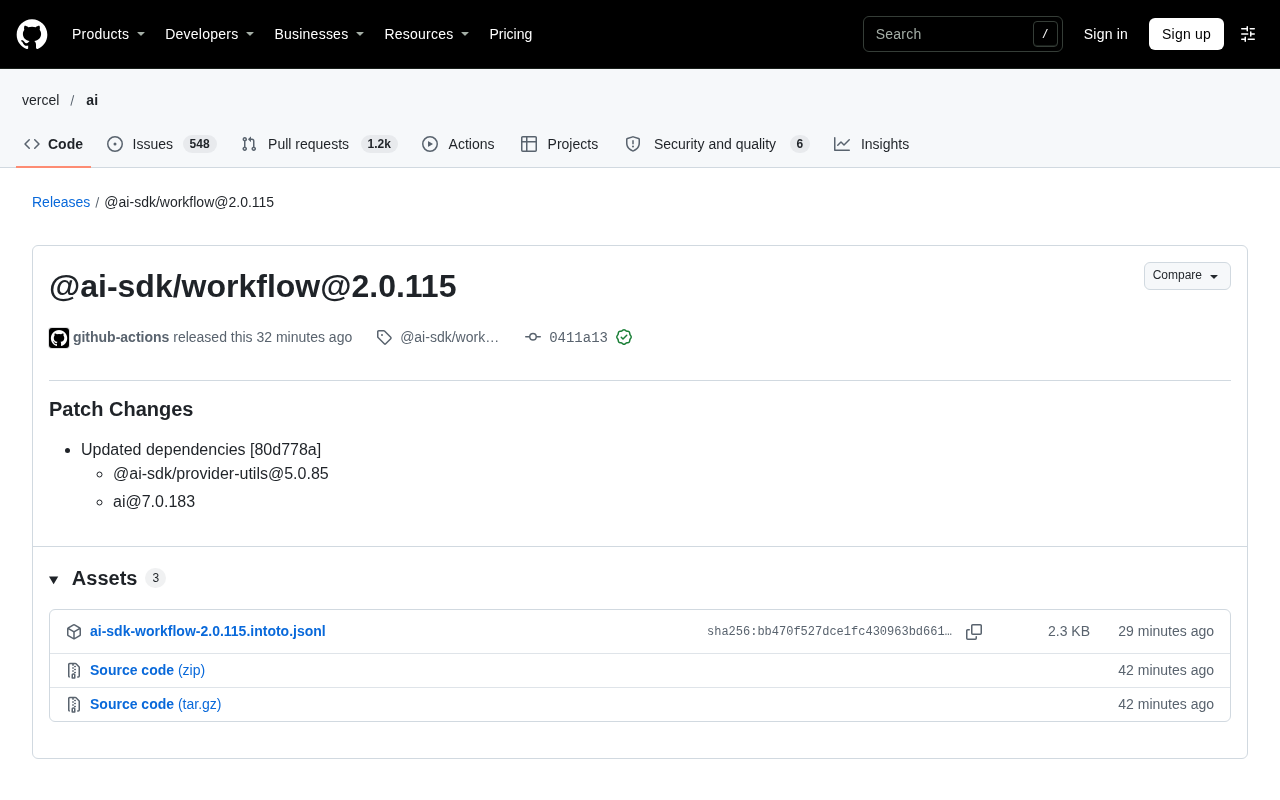
@ai-sdk/workflow has released version 2.0.115. This patch update contains no feature-level changes itself; its core information centers on synchronized dependencies: @ai-sdk/provider-utils was updated to 5.0.85, and the ai package was updated to 7.0.183. For developers familiar with the AI SDK ecosystem, this feels more like a "maintenance release," but it precisely reflects how this toolchain organizes version management.
What the Patch Update Actually Contains
According to the release record, this change is categorized as Patch Changes, triggered by Updated dependencies and referencing commit 80d778a. This means the workflow package itself adds no new APIs and fixes no independent defects; instead, it passively follows the upstream versions of provider-utils and the ai package.
This pattern is quite common in SDK ecosystems managed by monorepos: lower-level toolkit packages iterate first, and upper-level wrapper packages stay version-aligned on the premise of decoupled dependencies. For users, the direct impact of upgrading to 2.0.115 is usually limited to how transitive dependencies resolve, rather than requiring changes to application code.
Why Dependency Synchronization Deserves Attention
AI SDK's provider-utils handles the common logic for connecting to different model providers, while the ai package carries the core abstractions. When both advance their version numbers at the same time, it often means several upstream detail adjustments are accumulating. Although this release does not disclose specific changes, every step forward in the dependency chain paves the way for future features and reminds users to pay attention to the health of their dependency trees.
Monorepos and Dependency Alignment
A monorepo (single code repository) is an engineering practice that manages multiple related packages in one version-controlled repository. In the AI SDK ecosystem, packages such as @ai-sdk/workflow, @ai-sdk/provider-utils, and ai are very likely part of the same monorepo. Under this structure, packages reference each other through the workspace protocol, and releases are usually coordinated by tools such as changesets: when a lower-level package publishes a new version, upper-level packages automatically receive dependency updates, thereby maintaining version alignment. This explains why a patch may contain only dependency changes—it is a natural product of the monorepo's automated release process. For users, understanding this helps judge the actual scope of impact behind version number changes.
Resolution of Downstream Dependencies and Lockfiles
In the Node.js ecosystem, dependency resolution is controlled by lockfiles such as package-lock.json, yarn.lock, and pnpm-lock.yaml. Lockfiles pin the exact version of each dependency to ensure consistent installs across environments. When @ai-sdk/workflow is upgraded to 2.0.115, the dependency range it declares (for example, ^5.0.85) may allow provider-utils updates, but the actually installed version is still determined by the lockfile. If the project does not update the lockfile, transitive dependencies will not change; if it does, pay attention to provider-utils' Semantic Versioning (SemVer) compatibility. Therefore, when upgrading a patch package, checking lockfile changes is more practical than focusing on the version number itself.
Maintenance Strategy Through Release Cadence
The patch number 2.0.115 itself conveys information: the workflow package has already gone through many small iterative steps. High-frequency patches combined with dependency following indicate that the team prefers frequent small releases to reduce the risk of each change, rather than saving up a major version and upgrading everything at once.
For integrators, the benefit of this cadence is finer-grained issue localization; the cost is the need to track release notes more proactively, especially when provider-utils versions jump significantly, since configuration or invocation patterns may differ subtly.
Validation and Release Pipeline
This commit was automatically published by GitHub Actions and carries a GitHub verified signature with signing key ID B5690EEEBB952194. The combination of automated publishing and signature verification indicates that the project's release process has been standardized, with little manual intervention. This also explains why patch updates can maintain a relatively high frequency—the pipeline handles most of the repetitive work.
Semantic Versioning and the Meaning of Patch Numbers
Semantic Versioning (SemVer) specifies the version format major.minor.patch, corresponding respectively to incompatible API changes, backward-compatible feature additions, and backward-compatible bug fixes. The 115 in 2.0.115 indicates that the package has published a large number of patches since 2.0.0, usually meaning active maintenance and frequent iteration. An increasing patch number does not guarantee zero risk by itself, especially when a patch involves dependency updates, since transitive dependency changes may introduce behavioral differences. Therefore, for production environments, it is advisable to evaluate the impact of patch upgrades in combination with changelogs and integration tests, rather than judging stability solely by version numbers.
What Developers Should Do
Faced with this kind of patch release, a pragmatic approach is to first confirm the project's dependency locking strategy. If lockfiles are used, the cost of upgrading directly is very low; if dependency ranges are written broadly, it is advisable to run integration tests after upgrading, focusing on validating the parts that interact with model providers, because changes in provider-utils usually occur at this layer.
At the same time, pay attention to the compare view and tag list on the release page. Although the automatically generated change description this time is fairly brief, the referenced commit number can still be used to trace specific changes. For teams using workflow in production, establishing routine dependency version inspections is more valuable than chasing every patch number.
Summary
@ai-sdk/workflow 2.0.115 is a typical dependency-driven patch: it has no new features, yet clearly demonstrates the version linkage mechanism and automated release capabilities of the AI SDK ecosystem. Understanding this kind of update is more important than memorizing version numbers.
Related articles

Nothing CMF Buds 2A Drops to $17.89 on Black Friday: A New Low for ANC Earbuds
Nothing CMF Buds 2A wireless earbuds Black Friday deal: just $17.89 on Amazon, about $11 off retail and a record low. ANC earbuds at an entry-level price.

When AI Creation Gets Accused of "Spitting": Hacker News Heats Up Over the Glaude Controversy
A Hacker News post, "Spitting in the Face of Glaude," sparks debate on AI creation transparency and attribution ethics. This analysis examines the blurred creator identity behind the controversy and offers practical advice for AI content production.

Akai Embraces Custom Firmware: MPC Sample 1.4 Lets Users AI-Program Their Sampler
Akai embraces the modding community with MPC Sample 1.4 firmware, supporting vibe-coded custom firmware and effects. We analyze the impact of this open strategy on music hardware and AI-assisted programming.