@ai-sdk/workflow 2.0.97 Released: Dependency Updates and Ecosystem Coordination

@ai-sdk/workflow 2.0.97 patch update synchronizes three underlying dependencies.
@ai-sdk/workflow released patch version 2.0.97, automatically published by github-actions with GPG signature verification. This update contains no feature changes; its core is synchronizing underlying dependencies: @ai-sdk/provider-utils to 5.0.76, ai to 7.0.165, and @ai-sdk/provider to 4.0.37. workflow remains on the 2.x version line, evolving independently from the ai package's 7.x series. The article advises developers to check whether project dependency versions align before upgrading, especially in scenarios with custom provider implementations where the interface layer should be checked for breaking changes; it also recommends combining lockfiles with CI automated tests to establish a pragmatic dependency update strategy.
The AI SDK ecosystem has received a routine but noteworthy maintenance update. According to the RSS source, @ai-sdk/workflow has released version 2.0.97. This update is a patch-level change (Patch Changes), with the core content being synchronized upgrades of dependencies.
Release Overview
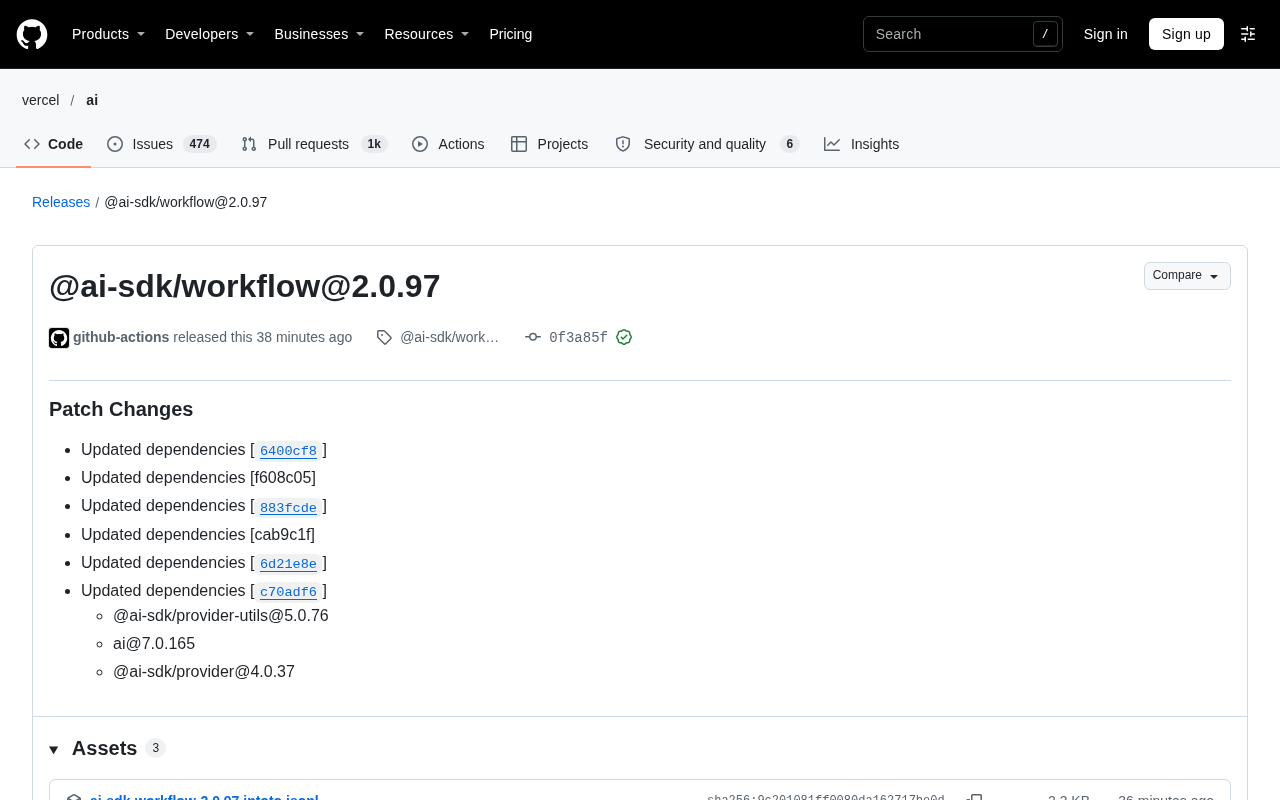
Looking at the GitHub release records, @ai-sdk/workflow@2.0.97 was published by the automated workflow github-actions on November 7, with commit ID 0f3a85f and a GitHub verified signature. The release notes are very concise, listing only several dependency update entries corresponding to different commit hashes (6400cf8, f608c05, 883fcde, cab9c1f, 6d21e8e, c70adf6).
This release pattern is not uncommon in the AI SDK's iteration rhythm: the workflow package itself introduces no new features but instead locks in the latest versions of underlying dependencies to ensure compatibility and stability across the entire toolchain.
Dependency Chain Sync: What Was Updated
This update involves specific version numbers for three key packages:
@ai-sdk/provider-utilsupgraded to5.0.76aiupgraded to7.0.165@ai-sdk/providerupgraded to4.0.37
These three packages form the infrastructure layer of the AI SDK. @ai-sdk/provider handles the abstraction interface for model providers, @ai-sdk/provider-utils provides shared utility functions, and the ai package is the core entry point that developers call directly. As an upper-layer orchestration module, workflow depends on the stable behavior of these underlying packages.
Why Patch Updates Are Worth Noting
For developers using @ai-sdk/workflow, a patch version typically means you can get underlying fixes without modifying business code. But this also carries an implicit requirement: the version numbers in the dependency chain must match what is actually installed in the project, otherwise type mismatches or runtime behavior differences may occur. This update explicitly lists the upgraded dependencies and their versions, providing a clear basis for locking dependencies.
Semantic Versioning (SemVer) is the background for understanding the value of patch updates. SemVer defines version numbers as major.minor.patch: a major version change indicates incompatible API breaking changes, a minor version indicates backward-compatible feature additions, and a patch number indicates only backward-compatible bug fixes. Therefore, when you see a version number like 2.0.97, you can reasonably infer that it contains no API changes and carries low upgrade risk.
However, a patch update of a dependency package does not mean the entire dependency chain contains only patch-level changes. This update bumps ai to 7.0.165 and @ai-sdk/provider to 4.0.37. Judging from the version numbers, these still fall within their respective patch ranges, but this only guarantees the semantics of the respective packages themselves; when multiple packages are upgraded simultaneously, the interface alignment between them still needs to be resolved by the package manager. Developers should confirm the final installed version combination using the lockfile rather than inferring compatibility solely from version numbers.
Practical Impact on Developers
If you are using @ai-sdk/workflow to build AI workflows, the direct benefit of upgrading to 2.0.97 is getting the latest state of underlying dependencies. From the ai package version 7.0.165, the AI SDK is already in a fairly mature 7.x series, while the workflow package remains on its independent 2.x version line. This version number difference reflects the strategy of independent evolution for each AI SDK module.
In practice, it is recommended to check whether the versions of ai and @ai-sdk/provider in your project align with this release before upgrading. If the project uses a dependency lockfile, simply run the package manager update; if there are custom provider implementations, you need to confirm whether the interface layer (@ai-sdk/provider 4.0.37) introduces any breaking changes—given the patch level, this is unlikely.
Lockfiles are the mechanism involved here. npm's package-lock.json, pnpm's pnpm-lock.yaml, and Yarn's yarn.lock precisely record the resolved versions and integrity checksums of each dependency and its transitive dependencies, ensuring that different machines and CI environments install exactly the same dependency tree.
This means that even if the dependency range in @ai-sdk/workflow's package.json allows 2.0.97, the project may still actually install the older version recorded in the lockfile until npm update is run or the lockfile is deleted and reinstalled. Conversely, the lockfile also prevents unexpected changes from automatic patch version drift. In CI, npm ci is typically used to install according to the lockfile, so when upgrading dependencies you need to commit the updated lockfile as well; otherwise, local and pipeline environments will have inconsistent versions.
Automation Signals in the Release Ecosystem
Another noteworthy detail in the release record is signature verification. The commit carries a GitHub verified signature (GPG key ID: B5690EEEBB952194), and the release was completed by the github-actions bot. This indicates that the AI SDK release process is fully automated, with a standardized, traceable path from code merge to version release.
For enterprise projects that depend on the AI SDK, this automated release rhythm means establishing a corresponding dependency update strategy. When patch versions are released frequently, blindly following them may introduce unnecessary changes; but prolonged stagnation may miss critical fixes. A pragmatic approach is to pay attention to the commit hashes of dependency updates and merge version upgrades only after configuring automated tests in CI.
GPG signature verification is the foundation for judging the trustworthiness of a release source. Git allows commits and tags to be signed with GPG or SSH keys. GitHub verifies the signature and displays a "Verified" badge, along with the ID of the key used for signing. A commit signature proves that the commit was indeed created by the party holding the corresponding private key and that the content has not been tampered with since signing.
Combined with the github-actions bot identity, it can be inferred that the release was automatically completed by the CI pipeline, with the signing key stored in the repository's secrets. For enterprise projects, this means supply chain trust can be established by verifying signatures and sources: only accept versions from the official repository, with valid signatures, and produced by the expected automated identity, thereby reducing the risk of dependency tampering or poisoning.
Summary
@ai-sdk/workflow@2.0.97 is a typical ecosystem coordination update. It has no feature changes itself, but by synchronizing the versions of @ai-sdk/provider-utils, ai, and @ai-sdk/provider, it maintains the consistency of the AI SDK toolchain. For developers, understanding the dependency relationships behind this kind of patch release is more valuable than focusing on the version number itself.
Related articles
 Tech Frontiers
Pushing the Limits of Extreme Sudoku on a 16GB GPU: Insights from Depth and Flow Matching
A researcher trained a 16.54M-parameter model on a 16GB GPU to solve extreme Sudoku, finding effective depth breaks the 60% plateau and flow matching with improved sampling pushes accuracy past 99% with ~50× lower layer-evaluation budget.
 Tech Frontiers
AI Agent Approval Workflows: Why Human Confirmations Always Get Mindlessly Clicked
Why do AI agent approval workflows always get mindlessly clicked? A Reddit discussion shows that separating rules from keys, low-frequency high-risk approvals, and GitHub Environments-style gates are the keys to effective approvals.
 Tech Frontiers
MuJoCo: An Analysis of DeepMind's Open-Source General-Purpose Physics Simulator
An in-depth analysis of Google DeepMind's open-source physics simulator MuJoCo: high-performance C++ kernel, MJCF modeling format, contact solving principles, MJX GPU acceleration, and robot reinforcement learning use cases.