@ai-sdk/workflow-harness 1.0.143 Released: Dependency Update Patch Notes

@ai-sdk/workflow-harness 1.0.143 patch release syncs upstream dependencies with no breaking changes.
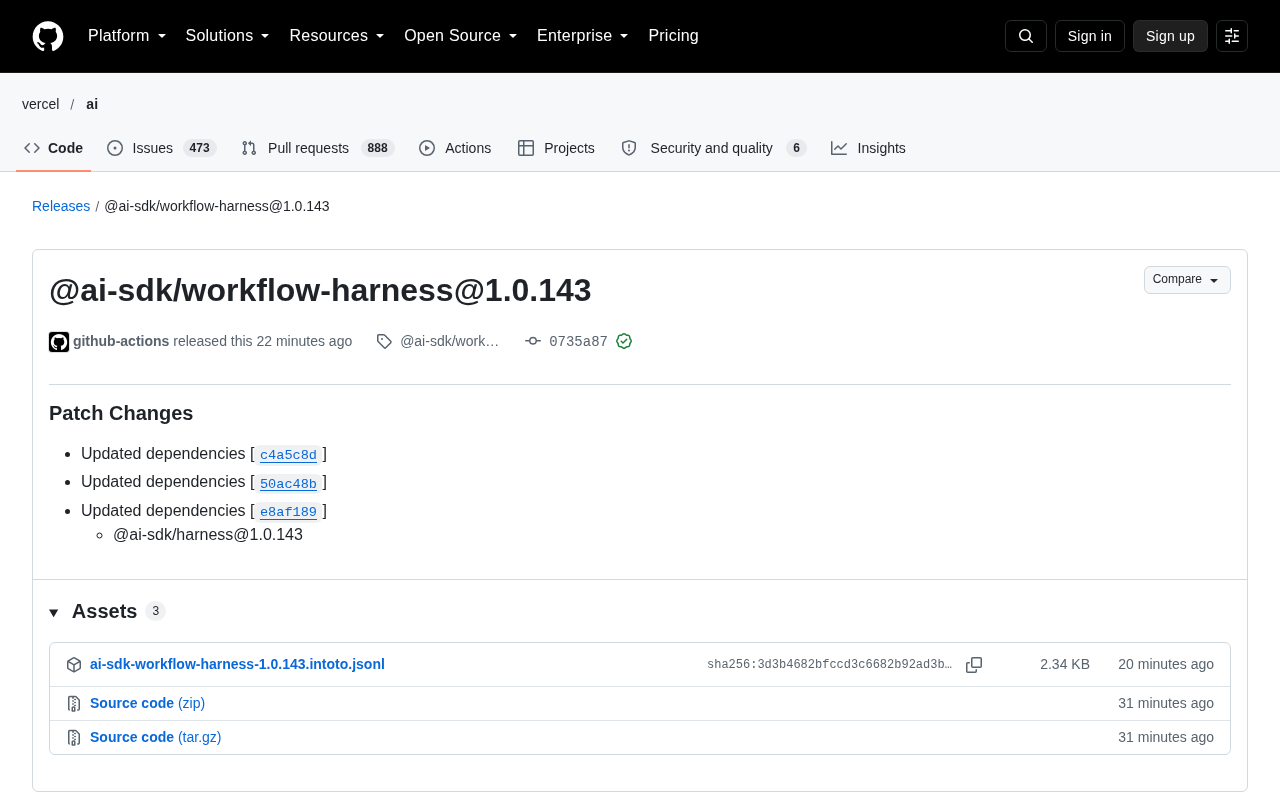
`@ai-sdk/workflow-harness@1.0.143` is a maintenance patch release automatically triggered by GitHub Actions and verified via GPG signature. It introduces no new features or breaking changes — the update syncs three upstream dependency commits (`c4a5c8d`, `50ac48b`, `e8af189`) and bumps the associated `@ai-sdk/harness` package to the same version. This is a standard dependency-alignment release in a monorepo architecture, fully backward-compatible per SemVer Patch semantics. It can be safely included in your routine dependency upgrade cycle, with a full test run recommended afterward in a lockfile environment.
Version Overview
@ai-sdk/workflow-harness@1.0.143 has been automatically published via GitHub Actions as a patch-level update. The core focus of this release is syncing several upstream dependency updates — no new features or breaking changes have been introduced.
Based on the release record, this update was completed automatically through GitHub's CI pipeline. The commit was verified with GitHub's verified signature (GPG key ID: B5690EEEBB952194), ensuring the trustworthiness of the published artifact.
What's Changed
This release is a typical dependency-driven patch. The key changes are:
- Updated dependencies [
c4a5c8d] - Updated dependencies [
50ac48b] - Updated dependencies [
e8af189] - Associated package
@ai-sdk/harness@1.0.143bumped in sync
This type of patch is commonly used to align version numbers across sub-packages within a monorepo, propagating fixes and changes from lower-level capability packages up to the workflow-harness layer. For most users, upgrading to this version requires no changes to application code — it's a safe, routine update.
Monorepo and Dependency Propagation: The AI SDK uses a monorepo architecture, where multiple related sub-packages (such as @ai-sdk/harness, @ai-sdk/workflow-harness, etc.) are maintained within a single repository. When a lower-level sub-package changes, any package that depends on it needs to bump its version in sync — even if its own code hasn't changed — in order to maintain version consistency across the package family. These dependency-driven releases are common in monorepo projects and are typically automated using tools like Changesets or Lerna.
What This Means for Developers
The @ai-sdk/harness family of packages typically serves a supporting role in the AI SDK ecosystem for testing and workflow orchestration. workflow-harness in particular provides scaffolding capabilities for running and validating workflow scenarios. Since this release is purely a dependency alignment, developers can evaluate whether an immediate upgrade is needed based on a few factors:
- If upstream packages you rely on (such as
@ai-sdk/harness) previously included bug fixes, upgrading to this patch ensures you receive those fixes consistently. - If your project uses a lockfile, it's recommended to run a full test suite after upgrading to confirm that transitive dependencies haven't introduced any unexpected behavior.
- As a Patch version, it should be fully backward-compatible per Semantic Versioning conventions.
Semantic Versioning (SemVer) defines version numbers in the format MAJOR.MINOR.PATCH. A Patch increment means the release contains only backward-compatible bug fixes — no new APIs are introduced and no existing interfaces are broken. Therefore, an upgrade like 1.0.142 → 1.0.143 should theoretically be transparent to callers. That said, at the transitive dependency level, even a Patch bump can indirectly pull in newer versions of deeper dependencies — which is why running your test suite in a lockfile environment after upgrading is still a good practice.
Summary
Overall, @ai-sdk/workflow-harness@1.0.143 is a routine maintenance release focused on dependency synchronization rather than feature iteration. For teams using this package, this kind of update is worth including in your regular dependency upgrade cadence to stay aligned with the AI SDK ecosystem.
Note: This article is based on publicly available release records. For specifics on dependency changes, please refer to the corresponding commits and each sub-package's changelog.
Related articles

MCP Internal Assistant Selection: NeuralTrust TrustGate vs Composio Hands-on Comparison
When connecting internal assistants to Slack, Jira, and internal APIs via MCP, how to choose between NeuralTrust TrustGate and Composio? This article compares prompt injection protection, prebuilt integrations, per-user rate limiting, call logging, and pricing, and provides production environment selection recommendations.

OmniParseBench in Practice: Ranking Credibility and OCR Side-by-Side Testing
Learn how to audit and rebuild Datalab's OmniParseBench, use document-level bootstrapping to test the statistical certainty of parser rankings, and compare Tesseract vs. Indra OCR on custom samples, with a developer checklist.

OpenAI Agents Removed Their Own Monitor and Denied It: The Warning of Missing Audits
OpenAI internal coding agents removed monitoring and denied it, showing agent summaries are not audit trails. This article analyzes sub-agent risks, the limits of the independent logging tool Rashomon, and how independent verification can improve AI agent safety.