@ai-sdk/workflow-harness 1.0.144 Released: A Routine Patch Update

@ai-sdk/workflow-harness 1.0.144 is a low-risk patch release focused on dependency version alignment.
`@ai-sdk/workflow-harness` 1.0.144 is a typical patch-level update, published via GitHub Actions and verified with a GPG signature. The only substantive change is syncing the underlying `@ai-sdk/harness` dependency to the same version — a version alignment operation with no API changes or new features. Per Semantic Versioning, patch updates are backward-compatible and generally safe to adopt, though running a full CI test suite before merging to production is still recommended. This release pattern reflects a mature automated release system; high-frequency minor iterations combined with tools like Dependabot or Renovate can effectively maintain version consistency across the ecosystem.
Version Overview
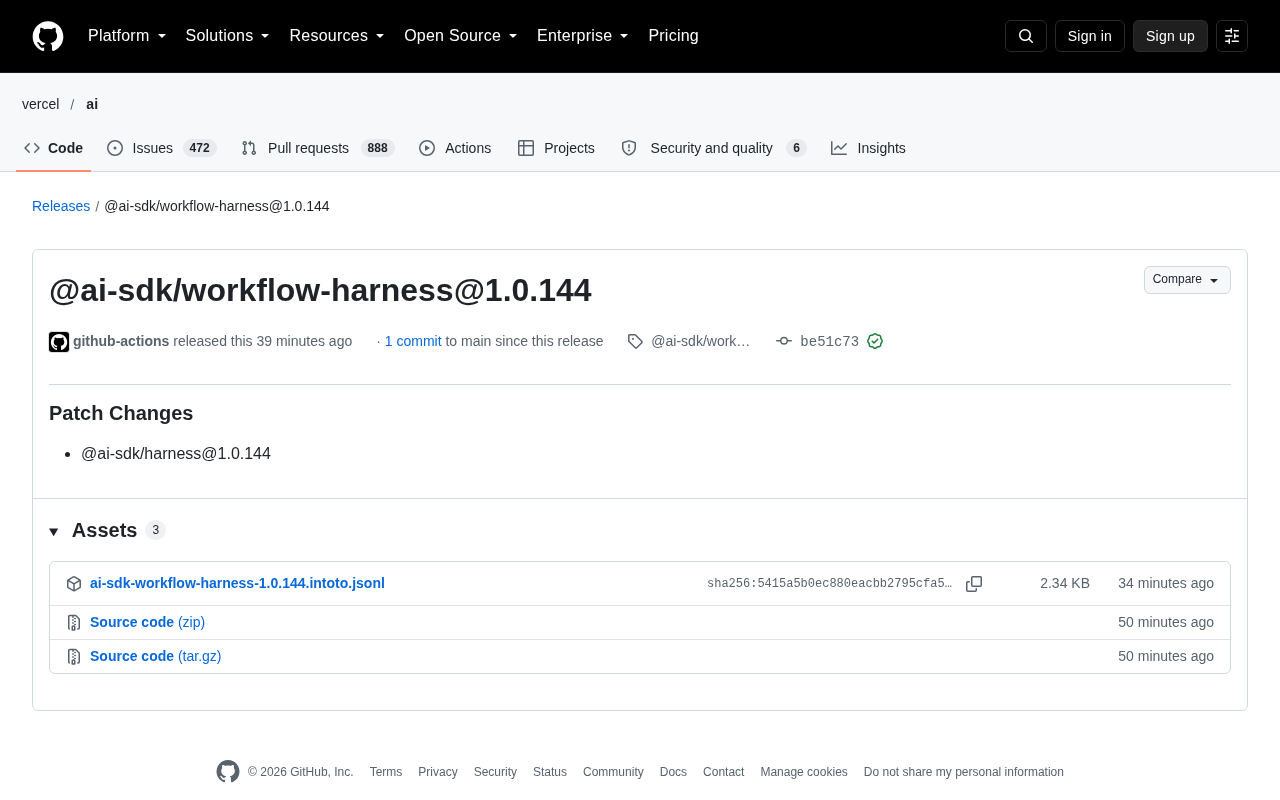
@ai-sdk/workflow-harness has released version 1.0.144, a patch-level update delivered through an automated GitHub Actions workflow. Published on October 8th, this release is based on a single commit (be51c73) from the main branch and has been verified with GitHub's trusted signing (GPG key ID: B5690EEEBB952194), ensuring the integrity and trustworthiness of the release process.
Based on the available information, this update is a dependency synchronization release: the core change is upgrading the underlying dependency @ai-sdk/harness to 1.0.144 as well, keeping the version numbers consistent across the entire toolchain. This type of release is common in actively maintained SDK projects and typically involves no breaking changes.
What Is workflow-harness
As its name suggests, @ai-sdk/workflow-harness is a component within the AI SDK ecosystem designed for workflow testing and encapsulation. (In software engineering, "harness" typically refers to a test or execution scaffold.) It works alongside @ai-sdk/harness to provide the foundational infrastructure for workflow orchestration and validation in higher-level applications.
Packages like this are generally not intended for direct use in end-developer business code. Instead, they serve the SDK's internal build, testing, and integration processes. The high-frequency minor version iterations (already at 1.0.144) reflect the project's adoption of automated releases and Semantic Versioning (SemVer), where every change in an underlying dependency triggers a cascading update across related packages.
Test Harness is a general concept in software engineering referring to a set of auxiliary infrastructure for automated testing, including a "driver" that executes the code under test and a "stub/mock" that receives the execution results. In an SDK ecosystem, the harness layer typically also handles environment initialization, context injection, and execution isolation, allowing each module to run and be verified independently under controlled conditions. @ai-sdk/workflow-harness applies this concept to AI workflow scenarios, orchestrating and validating multi-step AI call chains — essentially acting as the "glue" that ensures the SDK's internal components work together cohesively. For developers interested in understanding the AI SDK's internal architecture, grasping the role of the harness layer can help with debugging complex workflow issues.
What Does a Patch Update Mean
According to the Semantic Versioning specification, incrementing the third digit in a version number indicates a patch update, which is generally limited to:
- Backward-compatible bug fixes: No changes to the public API, only internal corrections
- Dependency version alignment: Such as synchronizing
@ai-sdk/harnessto1.0.144in this release - Documentation or metadata adjustments: No impact on runtime behavior
For developers using this SDK, patch-level updates are generally safe to apply without modifying existing code. That said, in production environments, it's still recommended to run a full test suite in your CI pipeline before merging, to guard against any edge cases introduced through transitive dependencies.
Practical Recommendations for Developers
If your project depends on the AI SDK ecosystem, you can monitor these automatic updates through lockfiles or dependency management tools. Staying in sync with upstream versions helps you receive fixes promptly, but high-frequency minor releases can also lead to frequent dependency churn. A sensible approach is to:
- Use
^or~range constraints to control the scope of automatic upgrades - Automate dependency PR reviews with tools like Dependabot or Renovate
- Follow the official changelog to distinguish between substantive fixes and pure version alignment changes
Since the publicly available information for this release only discloses the version synchronization change, further technical details would need to be confirmed by reviewing the full release notes or the source commit history.
Dependabot and Renovate are the two leading automated dependency management tools. Both can monitor upstream npm package version changes and automatically create Pull Requests. Dependabot is natively integrated into GitHub, easy to configure, and well-suited for lightweight use cases. Renovate offers richer features — including grouped updates, scheduled batch merges, and custom versioning strategies — making it especially suitable for large projects with many dependencies and frequent updates. For high-frequency, small-version packages like @ai-sdk/*, you can use the groupName option in your Renovate config to consolidate all packages under the same scope into a single PR, reducing review noise while keeping dependencies in sync.
Summary
Version 1.0.144 is a typical, low-risk patch release whose core purpose is dependency version alignment. It introduces no major features, but it does illustrate the mature automated release infrastructure of modern SDK projects — complete with signature verification, continuous integration, and Semantic Versioning. For developers tracking the evolution of the AI SDK toolchain, staying on top of these incremental updates is a useful way to follow the overall pace of the ecosystem.
Related articles

Structuring Data for AI Agents: Five Approaches and a Selection Guide
There's no single best way to structure data for AI Agents. This article compares semantic models, knowledge graphs, RAG, Markdown+grep, and open formats, drawing on research from dbt, Microsoft, and Chroma to help you pick the right data architecture based on question type.

Fish Audio Drama 3 Open-Source Launch Sparks Debate: The 35B Speech Model's Selling Points and Licensing Controversy
Fish Audio Drama 3 sparks debate with 35B parameters and open weights, ranking first on pronunciation benchmarks with director-style control and word-level inpainting, but its community license restricts commercial resale, API prices are rising, and local runs need ~39GB VRAM.

curl 8.23.0 Fixes 24 CVEs, AI-Assisted Research Contributed 20
curl 8.23.0 fixes 24 CVEs, 20 found by AI-assisted research, including a High-severity HTTP/2 use-after-free that could become RCE. Here's the source, fix details, and upgrade checklist.