@ai-sdk/workflow-harness 1.0.160 Patch Release: Dependency Update Analysis

AI SDK's workflow-harness releases patch 1.0.160, synchronously upgrading the underlying harness dependency.
The article introduces the release of @ai-sdk/workflow-harness 1.0.160. This Patch Changes release's core change is only synchronously updating the dependency @ai-sdk/harness to the same version number, with no new features or breaking changes. It explains the significance of such linked updates in a tightly coupled SDK ecosystem: propagating underlying bug fixes, maintaining version consistency, and reducing troubleshooting costs from mismatched version combinations. Developers are advised to upgrade via the normal patch process, first verifying workflow orchestration logic in a test environment, and to follow the underlying package's changelog to judge change relevance. The release was automatically completed by github-actions with GPG signatures, reflecting a verifiable automated supply chain process.
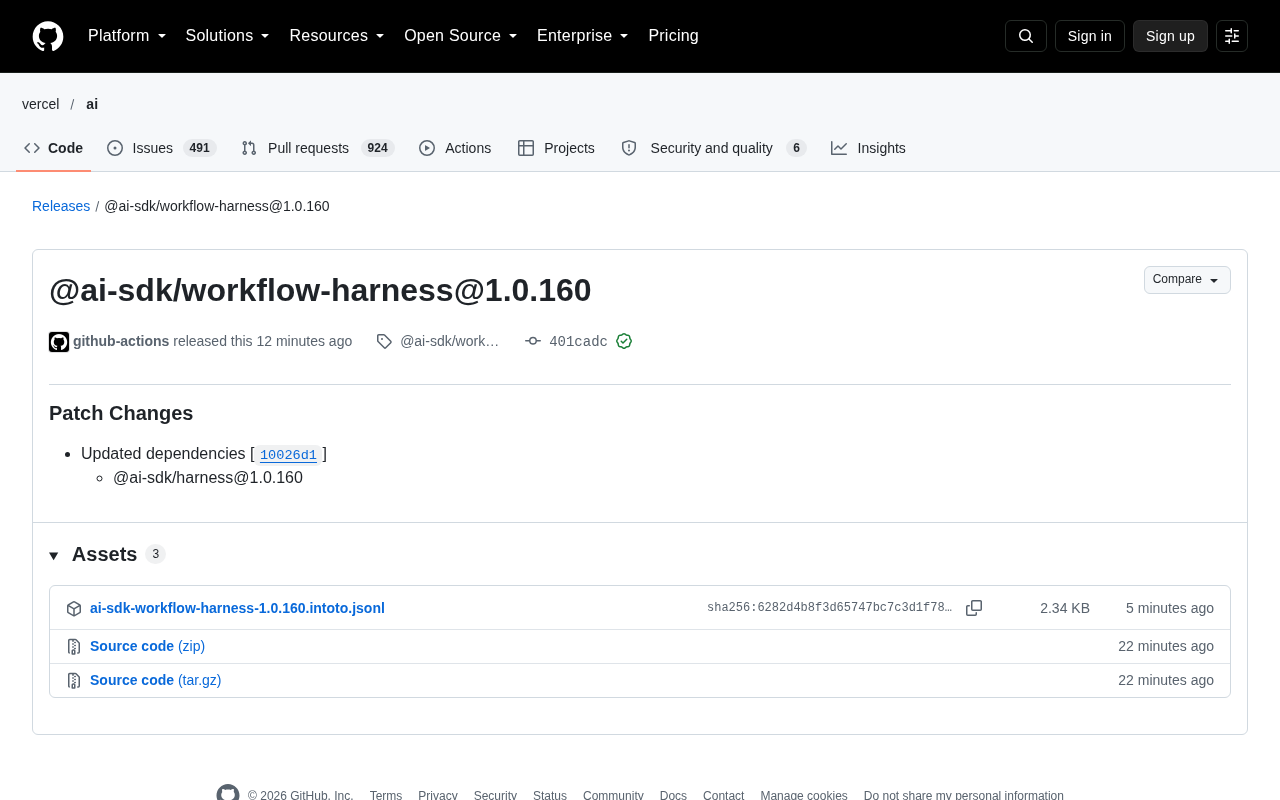
The @ai-sdk/workflow-harness package in the AI SDK ecosystem has released version 1.0.160. This is a typical patch version update, with the core change focused on synchronizing a dependency upgrade. For developers using this toolchain to build AI workflows, understanding the significance and impact of these small version updates helps with better project dependency management.
Overview of Version Update Contents
According to the release record on GitHub, @ai-sdk/workflow-harness@1.0.160 is classified as a Patch Changes type. The release notes explicitly state: updated dependency @ai-sdk/harness@1.0.160. This means the release introduces no new features or breaking changes; instead, it follows the version cadence of the upstream core package @ai-sdk/harness, keeping both version numbers in sync.
This kind of dependency linkage is common in monorepos or tightly coupled SDK ecosystems. workflow-harness, as a wrapper layer oriented toward workflow scenarios, depends directly on the implementation of the underlying harness. When the underlying package releases a patch, the upper-layer package updates its dependency in sync to ensure users install a verified combination of versions.
SemVer and Patch Versions: Semantic Versioning (SemVer) defines the version number format as MAJOR.MINOR.PATCH. An increment in the PATCH position indicates a backward-compatible bug fix and should not contain new features or breaking API changes; an increment in the MINOR position indicates a backward-compatible feature addition; a MAJOR increment indicates incompatible changes. Therefore, a PATCH-level release like 1.0.160 is, by convention, safe for consumers, and upgrading requires no changes to calling code. However, SemVer is only a community convention rather than a mandatory standard; whether it is actually compatible still needs to be verified against release notes and testing, especially for packages in the 0.x stage or with deep internal coupling.
What the Dependency Update Means
For end developers, the practical impact of such patch updates usually manifests in several aspects. First is propagation of bug fixes: if @ai-sdk/harness@1.0.160 includes certain bug fixes or edge-case handling, then once workflow-harness depends on it in sync, users can obtain these improvements by upgrading. Second is version consistency: aligning the version numbers of both packages to 1.0.160 reduces the troubleshooting cost caused by mismatched version combinations.
It is worth noting that the release notes do not list the specific change entries of @ai-sdk/harness 1.0.160 in detail. Judging only from the release record, this is a routine maintenance release with no breaking change marked.
Monorepo and Linked Releases: A monorepo refers to an engineering pattern that manages multiple interrelated packages in the same code repository. Such repositories usually use tools like Changesets or Lerna to manage versions uniformly; when the underlying package changes, they can automatically trigger the upper-layer package to synchronize its dependency upgrade and publish, ensuring that the version combinations of all packages in the ecosystem are always verified. The cost is that upper-layer packages generate a large number of patch versions that appear to have "no content", with release records only reflecting dependency upgrades. Understanding this helps developers distinguish "real code changes" from "version alignment noise" and avoid being misled by dense version numbers during dependency audits.
Recommendations for AI Workflow Developers
If your project directly depends on @ai-sdk/workflow-harness, upgrading to 1.0.160 carries low risk. As a patch version, it should not contain incompatible API changes under SemVer rules. It is recommended to first verify in a test environment whether the workflow orchestration logic and node behavior work properly, then merge to the main branch.
At the same time, you can follow the changelog of @ai-sdk/harness to learn the specifics of the underlying fixes and judge whether these changes are relevant to your current workflow scenarios. For projects that lock dependency versions, whether it is necessary to follow this patch depends on your requirements for the stability of this dependency chain.
Engineering Signals from the Release Process
From the release record, it can be seen that this version was automatically published by github-actions, the commit carries a GitHub verified signature, and the GPG key ID is B5690EEEBB952194. This indicates that the project's release process is highly automated and that the commit source is verifiable. For teams concerned about supply chain security, such signatures and automated release records are reference information for evaluating dependency trustworthiness.
Overall, @ai-sdk/workflow-harness@1.0.160 is a typical ecosystem synchronization update that introduces no new features; its core value lies in maintaining the consistency and maintainability of the dependency chain. Developers can handle it through the normal patch upgrade process.
GPG Signatures and Supply Chain Security: GPG (GNU Privacy Guard) is an encryption signing tool based on the OpenPGP standard. When GPG signing is used in Git commits, the committer can generate a cryptographic signature over the commit content, and verifiers can use the corresponding public key to confirm that the commit indeed comes from the claimed author and that the content has not been tampered with. GitHub displays a Verified badge next to the commit. Combined with a release process automatically executed by CI (such as github-actions), it enables traceability of the entire chain from code commit to npm package publishing, reducing the risk of dependency poisoning and malicious publishing after account compromise, and is a common check item in software supply chain security assessments.
One-line Summary
AI SDK's workflow-harness releases patch 1.0.160, synchronously upgrading the underlying harness dependency.
Paragraph Summary
The article introduces the release of @ai-sdk/workflow-harness version 1.0.160. This version is a Patch Changes release, with the core change being only the synchronized update of the dependency @ai-sdk/harness to the same version number, introducing no new features or breaking changes. The article explains the significance of such linked updates in a tightly coupled SDK ecosystem: propagating underlying bug fixes, maintaining version consistency, and reducing the troubleshooting cost of mismatched version combinations. The recommendation for developers is to upgrade via the normal patch process, first verifying workflow orchestration logic in a test environment, and to follow the underlying package's changelog to judge the relevance of changes. The article also notes that the release was automatically completed by github-actions with GPG signatures, reflecting a verifiable automated supply chain process.
Related articles

Gemini 4 Argon Hands-On: AI Builds Board Games, Constructs Temples, and Trains Robots Autonomously
Gemini 4 Argon hands-on roundup: AI autonomously builds a desk racetrack and temple in Blender, writes a ray tracing engine, trains a humanoid robot to sink 7 shots, plus API pricing and developer access.

The Magic Octagonal Coin: Why Only 9% of People Can Predict Its Flip?
Only 9% of people can correctly predict the Magic Octagon coin flip. This article explains its spatial rotation mechanism, common cognitive pitfalls, and a new hypothesis based on Relevance Theory, exploring the limits of human spatial reasoning.

Sam Altman: AI Is Entering the Era of Scientific Discovery — Math Breakthroughs Will Replicate in Biology and Energy
Sam Altman says AI is entering the era of scientific discovery — math breakthroughs will replicate in biology, materials science, and energy to help develop new drugs and energy sources.