@ai-sdk/workflow-harness 1.0.188 Patch Release: Dependency Synced and Upgraded

@ai-sdk/workflow-harness 1.0.188 released as a dependency-sync-only patch with no functional changes.
Vercel AI SDK ecosystem's @ai-sdk/workflow-harness released version 1.0.188, a standard Patch Changes update. The core change synchronously upgrades the dependency @ai-sdk/harness to 1.0.188 (commit hash 679b5b5); workflow-harness itself introduces no new APIs or behavioral changes—the version bump keeps consistency with the upstream package and prevents downstream users from installing mismatched combinations. The release was automatically completed by the github-actions bot with GPG signature verification. Users need not modify code—just confirm that dependency versions in the lockfile are aligned. The article also discusses the risks of version drift, characteristics of automated release pipelines, and the need to establish your own upgrade cadence when facing high-frequency minor versions.
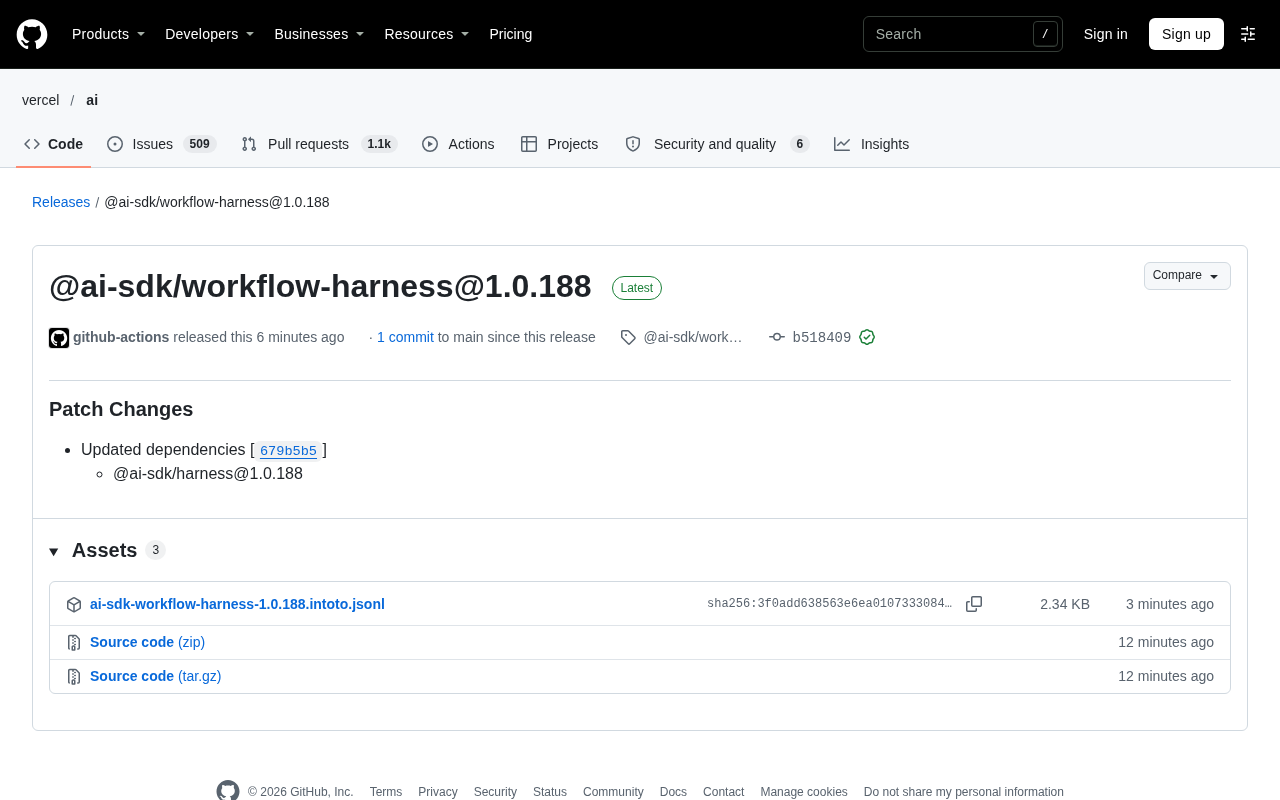
In Vercel's AI SDK ecosystem, @ai-sdk/workflow-harness is a relatively low-key but critical package—it consolidates the orchestration logic of AI workflows into a reusable harness. Version 1.0.188 has been released, and this is a standard patch update.
What Changed in This Update
According to the GitHub Release page, 1.0.188 performed a Patch Changes: the dependency @ai-sdk/harness was synchronously upgraded to 1.0.188, with corresponding commit hash 679b5b5.
In other words, workflow-harness itself introduces no new APIs or behavioral changes; its version number was bumped to stay consistent with the upstream harness package. This "locked version" release cadence is common in monorepo-managed SDKs, aiming to prevent downstream users from installing mismatched version combinations.
The Significance of Dependency Synchronization
When a package is just a shell layer with the real logic living in its dependencies, version drift can cause subtle problems: users might install workflow-harness 1.0.187 alongside harness 1.0.188, triggering hard-to-diagnose runtime errors. Pinning the dependency to the same version effectively closes this gap through the release process.
Version drift refers to interrelated packages within the same monorepo being installed at different versions, resulting in inconsistent API expectations. In the npm ecosystem, each package independently declares version constraints, and package managers resolve dependency trees according to Semantic Versioning (SemVer) rules—making it easy for package A to depend on B@1.0.187 while the user has explicitly installed B@1.0.188. If B's internal implementation or export structure has subtle adjustments between minor versions, A might read nonexistent fields or incorrect method signatures, manifesting as hard-to-reproduce runtime exceptions. Binding the version numbers of the shell package and the real logic package to the same number (i.e., locked versions) is a way to replace runtime protection with the release process: as long as a user installs workflow-harness 1.0.188, the resolved harness will necessarily be 1.0.188 as well.
What the Release Metadata Tells Us
This release was completed by the github-actions bot, with the commit carrying a GitHub verified signature, GPG key ID B5690EEEBB952194, and marked as Verified.
From an engineering perspective, this indicates the release pipeline is fully automated: after merging to the main branch, CI directly produces the tag and release note, with no manual intervention in writing version numbers or change logs. The higher the degree of automation, the more predictable patch releases become—and it also means such minor versions will appear at a relatively high frequency. For dependents, it's worth configuring automatic updates or periodic checks rather than manually tracking each one.
The Release page provides Latest / Compare / filter-by-tag views for easy comparison of adjacent version differences. However, an exception prompt appeared while loading resources on the page, and some interactive elements required a refresh to display properly—this does not affect the content of the version itself.
GPG signature verification is an integrity check GitHub performs on commit origins. Developers sign the commit object with their local private key, and GitHub verifies whether the signature matches using their public key; if it matches, it is marked as Verified and the key ID is displayed. This proves the commit indeed came from the person or automation account holding that private key and was not tampered with during transmission. In scenarios where releases are made by the github-actions bot, signing is typically done with keys injected into the CI environment, so the Verified mark is also circumstantial evidence for judging whether the release pipeline is fully automated and bypasses manual intervention. Note that Verified only guarantees origin and integrity—it does not mean the code has undergone a security audit.
Practical Impact on Users
If your project directly depends on @ai-sdk/workflow-harness, this upgrade requires no code changes. The only recommended action: confirm that @ai-sdk/harness in your lockfile is aligned to the same version as workflow-harness, avoiding mixed old dependencies.
For teams using the AI SDK for workflow orchestration, the value of such patches lies not in new features but in keeping the dependency graph clean. What truly deserves attention is behavioral changes in the upstream harness—that's the real signal source at the feature level.
How to View High-Frequency Minor Versions
AI SDK-related packages are currently in a period of rapid iteration, and dense patch releases are the norm. Rather than chasing every tag, it's better to establish your own upgrade cadence: lock major versions, pull patches as needed, and verify dependency consistency in CI. The content of this 1.0.188 update is simple, but it serves as a good opportunity to review your dependency management strategy.
Summary
1.0.188 is a pure dependency synchronization patch, with the core change being the upgrade of @ai-sdk/harness to the same version. The release was completed automatically by CI with signature verification, with no feature-level changes. Users need not modify code—just pay attention to dependency version alignment.
Related articles

Nvidia CEO Removal Saga: Trump Intervenes Over the Weekend, Jensen Huang Reinstated Monday
Vergecast podcast reveals Nvidia CEO drama: earnings call said he wouldn't return and a new CEO was being sought; Trump intervened over the weekend, with J.D. Vance brokering a security guarantee to the board; Jensen Huang reinstated at 9 a.m. Monday.
Semantic Caching Explained: Reusing the Same Answer for Similar Questions
Semantic caching uses embeddings to judge whether queries are similar in meaning and reuses cached results for similar prompts. This article explains how it works, the difficulty of threshold tuning (such as the risk of misjudging negations), and its applicable boundaries.

How Did Trump Personally Turn Nvidia into the "Twelfth Board Member"?
A YouTube political commentary offers a sharp view: behind Nvidia's market cap milestone, Trump's deep involvement earns him the title of "twelfth board member." The article breaks down the commentator's logic on stock market achievements, the break from small-government tradition, and power display.