@ai-sdk/workflow-harness Releases 1.0.181 Patch Update

@ai-sdk/workflow-harness releases patch 1.0.181, auto-published by CI with signature verification.
The `@ai-sdk/workflow-harness` package in the AI SDK ecosystem has released patch version 1.0.181, with changes linked to the same version of `@ai-sdk/harness`, keeping both versions in sync. As a Patch Changes update, it is a backward-compatible bug fix or minor adjustment, and dependents typically need not modify existing workflow code. The package handles workflow orchestration and runtime decoupling in the AI SDK, and being standalone allows it to iterate independently of the core SDK. This release was automated by the GitHub Actions bot with a GPG verified signature, indicating CI integration with stronger traceability and a more stable cadence. Since release notes lack specific fix details and the page shows resource loading errors, production projects are advised to perform canary upgrades per existing strategy and prioritize checking harness version consistency when workflows are abnormal.
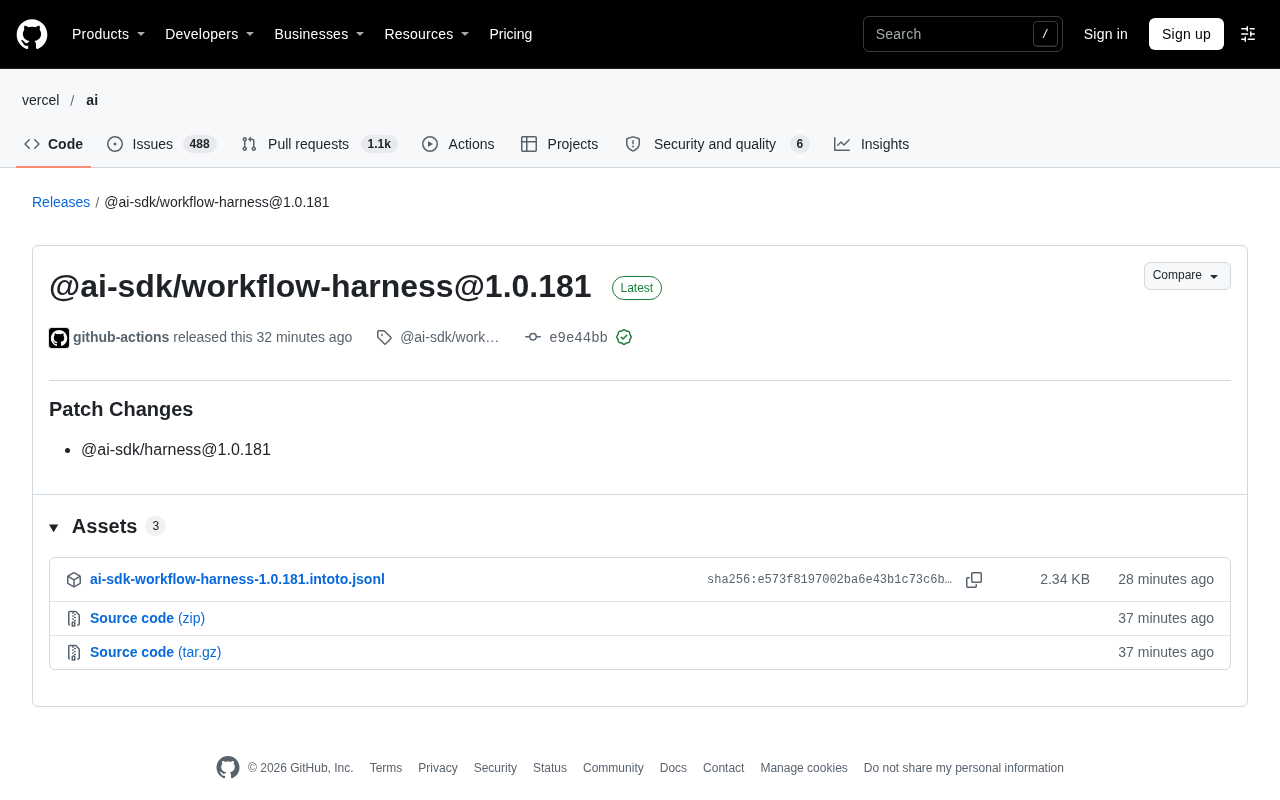
The @ai-sdk/workflow-harness package in the AI SDK ecosystem has released version 1.0.181. This is a patch update, automatically published by GitHub Actions, with a commit bearing a GitHub verified signature.
Patch Contents and Scope of Impact
According to the release notes, this update is a Patch Changes type, i.e., a backward-compatible bug fix or minor adjustment. The change is linked to @ai-sdk/harness@1.0.181, indicating that workflow-harness stays in sync with the underlying harness package version. For projects that depend on this package, upgrading typically requires no changes to existing workflow code.
Under Semantic Versioning (SemVer), the version number major.minor.patch corresponds to incompatible changes, backward-compatible feature additions, and backward-compatible bug fixes, respectively. 1.0.181 increments the third segment, so by convention it should not contain breaking changes—this is also the basis for the statement that "upgrading typically requires no changes to existing workflow code." Notably, the patch number has accumulated to 181, indicating that the package adopts a high-frequency, small-step release strategy, where each change is small in scope and cheap to roll back. However, SemVer is only a convention, not a guarantee; before actually upgrading, you should still check the tag diff to confirm there are no unexpected behavioral changes, especially for fixes involving workflow execution order or error-handling logic.
The Role of workflow-harness in the AI SDK
workflow-harness is the tooling layer in the AI SDK ecosystem used to organize and drive workflows. It decouples model calls, step orchestration, and the runtime harness, enabling developers to define multi-step AI tasks in a more structured way. Abstracting workflows into a standalone package also means it can iterate independently of the core SDK, reducing overall coupling.
The AI SDK itself is a TypeScript toolkit for building large-model applications. Its core packages include ai (a unified model invocation interface), provider packages for various model vendors, and foundational layers such as @ai-sdk/core. Its design philosophy separates "which model to call" from "how to organize the invocation flow": developers switch models via providers and build applications using capabilities such as tool calling, streaming, and generative UI. @ai-sdk/workflow-harness is an upper-layer orchestration component in this system. Being versioned and released separately from the core SDK is precisely to ensure that the iteration cadence of workflow capabilities is not constrained by the core package's release schedule, and to make it easy to include on demand only in projects that need multi-step orchestration, avoiding adding dependency burden to lightweight applications.
Automation Signals in the Release Process
This release was completed by the github-actions bot, and the commit carries a GPG verified signature. This pattern is common in mature open-source projects and indicates that version releases have been integrated into CI: tagging, building, and publishing are all done by the pipeline, with few manual steps and stronger traceability. For users, this means a more stable release cadence and more trustworthy release records.
GPG signature verification is an integrity mechanism in Git: the committer generates a signature over the commit content using a private key, and platforms such as GitHub verify it with the corresponding public key. Once verification passes, the commit displays a "Verified" badge. It proves that the commit indeed comes from the claimed account and that the content has not been tampered with since signing. In automated release scenarios, CI bots (such as github-actions) hold dedicated signing keys, and the release pipeline automatically completes signing when tagging, building, and pushing, so that every released version can be traced to a specific pipeline run record. This has practical value for dependents: it allows them to determine whether a given version went through the proper release channel rather than being an accidental manual release or a tampered artifact, improving supply chain security.
How to View This Update
The patch version itself does not disclose specific fix details, and the release page also shows error prompts for filtering and resource loading. For production projects, such minor versions can be followed according to the usual dependency strategy; if recent workflow runs encounter anomalies, priority should be given to checking whether they are related to a harness version mismatch.
FAQ
Does this update require code changes? Patch versions usually do not. It is recommended to first check the dependency lock file to confirm that the workflow-harness and harness versions are consistent.
Where can I view the changes? The GitHub Releases page provides a tag comparison entry, allowing you to compare 1.0.181 with the previous version to view commit differences.
Is it suitable to upgrade directly to production? You can perform a canary upgrade according to the project's existing strategy, and then roll out fully after observing workflow execution logs.
One-line Summary
@ai-sdk/workflow-harness releases patch version 1.0.181, automatically published by CI with signature verification.
Paragraph Summary
The @ai-sdk/workflow-harness package in the AI SDK ecosystem has released patch version 1.0.181, with changes linked to the same version of @ai-sdk/harness, keeping both versions in sync. As a Patch Changes type update, it is a backward-compatible bug fix or minor adjustment, and dependents typically do not need to modify existing workflow code. In the AI SDK, this package plays the role of workflow orchestration and runtime decoupling; being a standalone package allows it to iterate separately from the core SDK. This release was automatically completed by the GitHub Actions bot, and the commit carries a GPG verified signature, indicating that version releases have been integrated into the CI pipeline, with stronger traceability and a more stable cadence. Since the release notes do not disclose specific fix details and the page shows resource loading errors, it is recommended that production projects perform canary upgrades according to their existing strategy and prioritize checking whether the harness version is consistent when workflows are abnormal.
Related articles

Nothing CMF Buds 2A Drops to $17.89 on Black Friday: A New Low for ANC Earbuds
Nothing CMF Buds 2A wireless earbuds Black Friday deal: just $17.89 on Amazon, about $11 off retail and a record low. ANC earbuds at an entry-level price.

When AI Creation Gets Accused of "Spitting": Hacker News Heats Up Over the Glaude Controversy
A Hacker News post, "Spitting in the Face of Glaude," sparks debate on AI creation transparency and attribution ethics. This analysis examines the blurred creator identity behind the controversy and offers practical advice for AI content production.

Akai Embraces Custom Firmware: MPC Sample 1.4 Lets Users AI-Program Their Sampler
Akai embraces the modding community with MPC Sample 1.4 firmware, supporting vibe-coded custom firmware and effects. We analyze the impact of this open strategy on music hardware and AI-assisted programming.