AI SDK Workflow Toolkit Releases 1.0.182 Patch Update
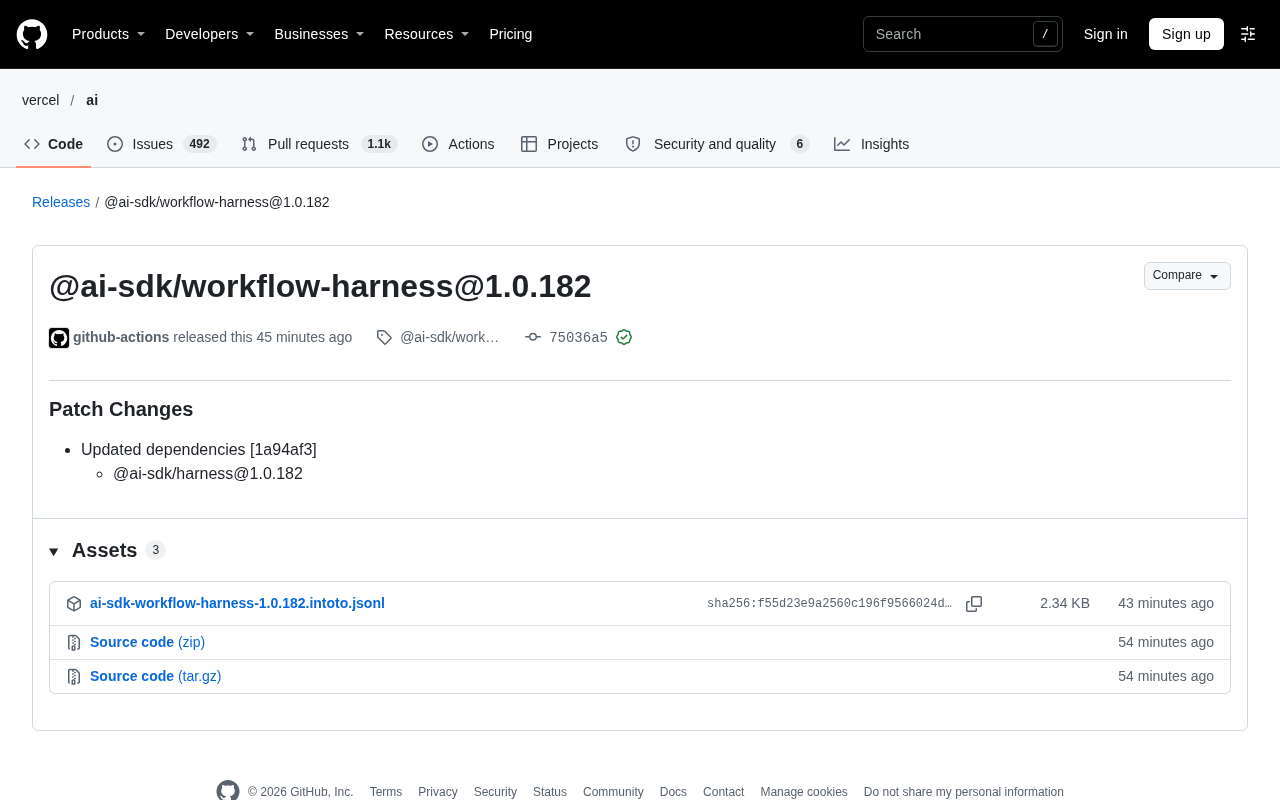
@ai-sdk/workflow-harness releases 1.0.182 patch, primarily syncing the underlying harness dependency.
The @ai-sdk/workflow-harness package in the AI SDK ecosystem releases version 1.0.182, with its version number fully aligned with the underlying @ai-sdk/harness. Marked as Patch Changes, the release notes show the core change is simply updating the dependency to harness commit 1a94af3, with the workflow toolkit itself likely having no code logic changes. Maintainers intentionally keep upper and lower layer versions in sync to avoid interface incompatibilities from dependency mismatches. The version is auto-released by GitHub Actions with GPG-signed commits, reflecting CI/CD practices and a high release frequency. The article considers this a low-risk routine maintenance release and recommends developers verify in a test environment and upgrade promptly, while following the harness changelog for specific fix details.
The workflow-harness package in the AI SDK ecosystem recently released version 1.0.182. This version number is in sync with the companion @ai-sdk/harness package, with both updated to 1.0.182, demonstrating the SDK family's coordinated approach to version management.
Nature of the Patch Update
According to the GitHub release notes, this update is marked as Patch Changes. This means it is not a major version iteration introducing new features, but rather a fix or dependency adjustment for existing functionality. For developers building workflows with the AI SDK, patch updates typically mean improved stability and compatibility rather than breaking changes.
The release notes explicitly list the change: updating the dependency to version 1a94af3 of @ai-sdk/harness. This dependency update is the core of the patch, indicating that the workflow-harness package itself likely has no code logic changes, but instead inherits fixes or improvements by syncing the underlying harness package.
Significance of Dependency Synchronization
In a modular SDK architecture, workflow-harness serves as an upper-layer wrapper that depends on the underlying @ai-sdk/harness for foundational capabilities. The fact that both share the same version number (1.0.182) is no coincidence—maintainers intentionally keep versions aligned so developers can track compatibility. When the underlying harness is updated, the upper-layer workflow toolkit syncs its dependency accordingly, ensuring that developers using the latest version won't encounter interface incompatibilities caused by version mismatches.
The commit 1a94af3 referenced by this dependency update is not detailed in the release notes, but given the nature of patch changes, it can be inferred that the commit contains fix-type modifications. For production users, upgrading to 1.0.182 promptly helps obtain these fixes.
In the Node.js/TypeScript ecosystem, packages like @ai-sdk/harness are typically referenced through npm's semantic versioning (SemVer) and lock file mechanisms. Upper-layer packages declare dependency ranges (e.g., ^1.0.0) in package.json, while the actual installed version at release time is locked by package-lock.json or pnpm-lock.yaml. When maintainers "update the dependency to version 1a94af3," it often means re-resolving the dependency from a workspace package in the repository or a specific commit and writing it to the lock file. Strict version alignment (both at 1.0.182) prevents npm from resolving multiple copies of harness during installation, thereby avoiding singleton state fragmentation or type incompatibility issues caused by "multiple instances of the same package."
It's important to distinguish that the commit hash 1a94af3 is a Git-level identifier, while 1.0.182 is an npm release-level version number. The release notes place them side by side to express "this release corresponds to that commit in the source tree," making it easy for developers to trace code differences.
Release Process and Trustworthiness
This version was automatically released by github-actions at 12 Nov 20:23. The commit has a GitHub-verified signature (GPG key ID: B5690EEEBB952194), indicating that the release process has a certain level of trustworthiness assurance. The automated release process also shows that the project adopts continuous integration/continuous delivery (CI/CD) practices, and the release frequency may be relatively high—developers can expect similar patch updates in the future.
The GPG signature verification (GPG key ID: B5690EEEBB952194) corresponds to the "Verified" badge on GitHub, indicating that the signing key for this commit has been registered by GitHub under an account, proving that the commit genuinely came from that account and was not forged. However, it only guarantees source identity and content integrity—it is not equivalent to a security audit of the code.
Automatic release by github-actions means the release process is likely driven by tools such as changesets or semantic-release: automatically calculating version numbers, generating CHANGELOGs, and executing npm publish when PRs are merged. Such processes typically work with npm's provenance feature to bind build pipeline metadata to release artifacts, allowing downstream users to verify that "this package was indeed built by that repository's CI." For high-frequency patch projects, automated releases significantly reduce human error, but they also require developers to trust the CI configuration and branch protection rules.
Recommendations for Developers
For developers currently using @ai-sdk/workflow-harness, this 1.0.182 patch update is a low-risk upgrade. As a patch version, the upgrade cost is low—it's recommended to verify in a test environment and apply as soon as possible to maintain consistency with other packages in the dependency chain. At the same time, following the @ai-sdk/harness changelog can help better understand the specific improvements brought by this dependency update.
For developers who have not yet used this toolkit, this update reveals that the AI SDK provides a dedicated harness tool for workflow orchestration, which is worth including in technology selection evaluations when building AI workflows.
Maintenance Cadence Behind the Version Number
From version number 1.0.182, it's evident that the project has iterated through quite a few patch versions in the 1.0.x series. This high-frequency patch release pattern is common in actively maintained open-source projects, reflecting the maintainers' quick response to issue fixes. For users, this means the project is in an actively maintained state, and issues are more likely to receive timely fixes.
Overall, @ai-sdk/workflow-harness 1.0.182 is a routine maintenance release, with dependency synchronization at its core. It does not change how the workflow toolkit is used, but by keeping the dependency chain up to date, it provides developers with a more stable foundation.
Related articles

Gordon Ramsay vs. the Michelin Father-Son Duo: A Galician Culinary Quest
Gordon Ramsay heads to Galicia, Spain, for a culinary showdown with two-Michelin-star chef Pepe Vieira. From Coast of Death goose barnacles to traditional stone-oven bread, explore Galicia's unique food culture and ingredient stories.

The 15-Year Programmer Who's Been Unemployed for Two Years: The Tech Worker's Dilemma in the AI Era
A US senior software engineer with 15 years of experience has been unemployed for two years, exhausted his savings, and sought help on Hacker News. This article analyzes the structural causes of long-term unemployment among tech workers, strategies for addressing resume gaps, and the redefinition of experience value in the AI era.

Soundcore Liberty 5 Pro Drops to All-Time Low: The Go-To True Wireless Earbuds for Commutes and Calls
Soundcore Liberty 5 Pro drops to an all-time low of $129.99 (from $169.99). These Anker true wireless earbuds excel at call quality and are on sale at Amazon, Best Buy, and Walmart in four colors—ideal for commutes and online meetings.