@ai-sdk/xai 2.0.101 Patch Release: The Maintenance Signal Behind a Dependency Chain Update
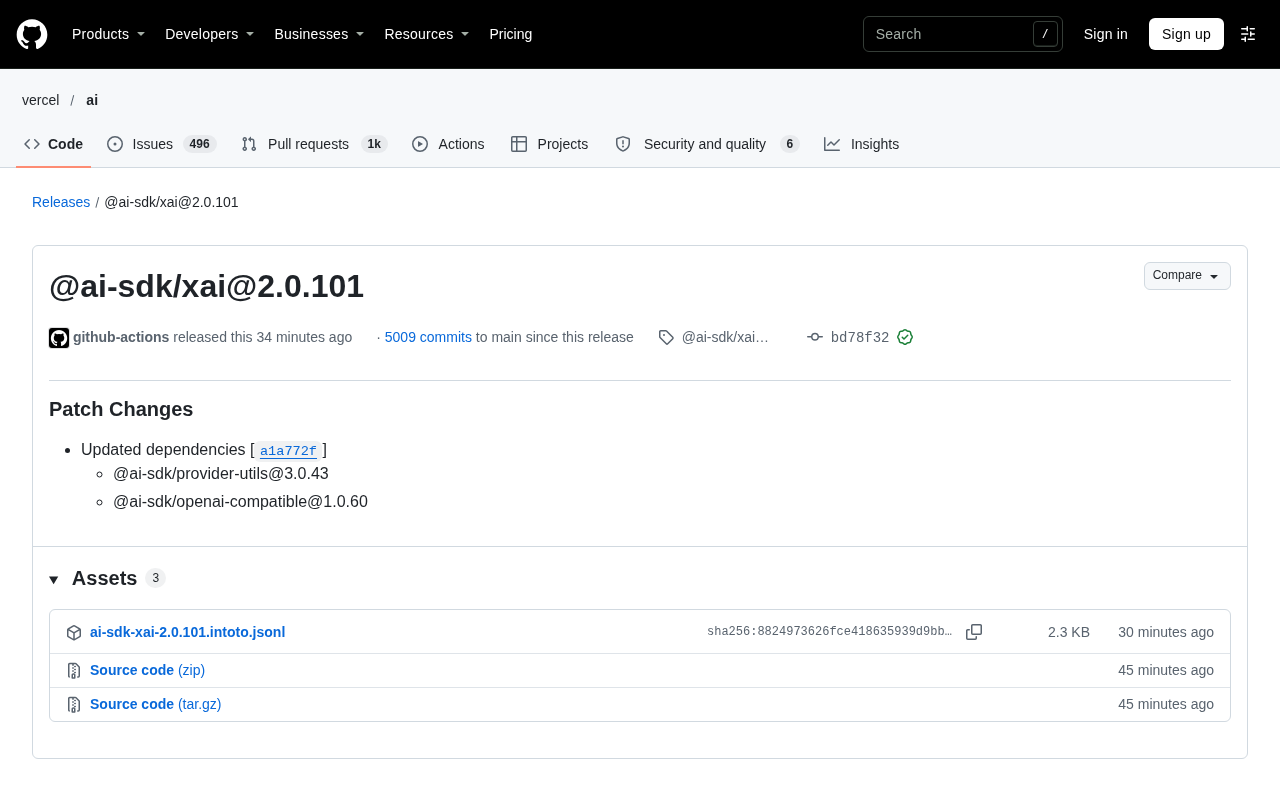
@ai-sdk/xai 2.0.101 only updates underlying dependencies, reflecting the AI SDK ecosystem's automated maintenance rhythm.
Vercel AI SDK released @ai-sdk/xai@2.0.101, a patch version that only updates dependencies on @ai-sdk/provider-utils and @ai-sdk/openai-compatible, with no breaking API changes. The article breaks down the technical details, noting that the xai provider is built on openai-compatible and its behavior is affected by two dependency chains. The release was triggered by an automated github-actions pipeline with a GPG verified signature, indicating a highly mature release process. The article emphasizes that the core value of a patch release is not new features but preventing version drift between provider packages and shared utility libraries. For teams using 2.0.x, the upgrade risk is low; it is recommended to verify streaming output and error callbacks in a test environment before deploying to production.
A Seemingly Routine Patch That Reveals the Maintenance Rhythm of the Vercel AI SDK Ecosystem
On GitHub, @ai-sdk/xai@2.0.101 appeared on the release page as a standard patch release. Only the last digit of the version number changed, and the changelog contained a single line: updated dependencies to bring in @ai-sdk/provider-utils@3.0.43 and @ai-sdk/openai-compatible@1.0.60. For users who don't track SDK versions, this release is almost invisible; but for teams that have integrated xAI's Grok models into production, it carries a more noteworthy signal—Vercel's AI SDK is using a unified provider abstraction layer to converge various model services under a single interface.
Breaking Down the Change: What the Patch Version Modified
Only Dependencies, Not the API
The only technical action in the release notes is Updated dependencies [a1a772f], affecting two packages: @ai-sdk/provider-utils and @ai-sdk/openai-compatible. This aligns with the definition of a patch in semantic versioning: no new features, no breaking changes to existing usage, only fixes and underlying synchronization. The commit record shows the change is on the main branch and carries a GitHub verified signature, indicating it went through an automated release pipeline (github-actions) rather than a manual push.
Semantic Versioning (SemVer) is a common convention for software version management, with the format major.minor.patch (e.g., 2.0.101). A major version change indicates incompatible API modifications, a minor version change indicates backward-compatible feature additions, and a patch change indicates backward-compatible bug fixes. Each provider package in the Vercel AI SDK strictly follows this specification, so when you see a patch version bump, you can safely assume no changes are needed to existing calling code. This is why the article emphasizes that 2.0.101 is merely a maintenance release—its scope is strictly limited to fixes under SemVer.
The Role of provider-utils
@ai-sdk/provider-utils is the package in the AI SDK responsible for common provider capabilities, including request construction, streaming response parsing, error handling, and other cross-provider reusable logic. A minor version bump usually means fixes to these underlying utility functions. Since the xai provider depends on it, such updates are passively propagated to the xai package—which is why many SDK patch releases appear to "change nothing" but may actually fix edge cases in streaming or retry paths.
Streaming response parsing is a critical path in the AI SDK. When interacting with large language models, responses are typically returned incrementally via Server-Sent Events (SSE) or chunked transfer, and the SDK needs to parse these chunks into a unified streaming interface (such as the async iterator returned by streamText). This process involves chunk boundary handling, JSON fragment concatenation, end-of-stream marker detection, and other details; any mishandling of an edge case can cause stream interruption or data loss. @ai-sdk/provider-utils is precisely the package that encapsulates these cross-provider common logic, and its fixes often directly improve streaming output stability—which is why patch updates are worth paying attention to.
Why the xai Provider Deserves Special Attention
Migration Costs Brought by Unified Abstraction
The core design of the Vercel AI SDK is to unify model calls from different vendors into a similar API, so developers only need to replace a small amount of code when switching providers. The xai provider follows this pattern and is implemented based on the openai-compatible package—because xAI's API is highly similar to OpenAI's compatibility layer. This reuse keeps integration costs low, but it also means the xai package's behavior is affected by two dependency lines: provider-utils and openai-compatible. A single dependency update actually synchronizes fixes across both chains.
The OpenAI-compatible layer (OpenAI-compatible API) refers to other model providers mimicking OpenAI's interface specification (such as the /v1/chat/completions endpoint and the same request/response structures), allowing developers to use the same client code to call models from different vendors. xAI's Grok API adopts this pattern, so @ai-sdk/xai can reuse the request construction and response parsing logic from the @ai-sdk/openai-compatible package without implementing them from scratch. This reuse greatly reduces integration costs but also introduces coupling: fixes in the openai-compatible package affect all providers built on it, including xai.
Practical Impact on Users
For projects directly calling @ai-sdk/xai, upgrading to 2.0.101 carries very low risk: there are no breaking API changes, and the main benefit comes from fixes in underlying dependencies. It is recommended to verify streaming output and error callback paths in a test environment before deploying to production. For teams not yet integrated, this version can serve as a stable reference point within the current minor line (2.0.x).
Ecosystem Maturity as Seen from Release Cadence
Traces of an Automated Pipeline
The release was triggered by github-actions, carries a GPG verified signature, and has an auto-generated changelog—these details indicate that the AI SDK's release process is highly automated. For engineering teams depending on the SDK, this means version releases are highly predictable and rollback paths are clear.
The Value of a Patch Release Is Not in Features
Frequent patch releases can easily be misunderstood as "nothing substantial." But in infrastructure like the provider abstraction layer, continuous dependency synchronization is itself valuable: it ensures no version drift between provider packages and shared utility libraries, reducing chain issues like "upgrading A requires upgrading B at the same time." From this perspective, @ai-sdk/xai@2.0.101 is a necessary maintenance action rather than a milestone worth extensive coverage.
Recommendations for Developers
If your project is locked to 2.0.x, you can directly follow this patch; if you are evaluating whether to integrate Grok into your existing AI SDK workflow, pay attention first to the version compatibility matrix of provider-utils and openai-compatible, then decide on your upgrade cadence. Watching the dependency change notes on the release page is more useful than watching the version number itself to determine whether a patch is relevant to your use case.
One-line Summary
@ai-sdk/xai 2.0.101 only updates underlying dependencies, reflecting the automated maintenance rhythm of the AI SDK ecosystem.
Paragraph Summary
Vercel AI SDK released @ai-sdk/xai@2.0.101, a patch version that only updates dependencies on @ai-sdk/provider-utils and @ai-sdk/openai-compatible, with no breaking API changes. The article breaks down the technical details of this change, noting that the xai provider is built on openai-compatible and its behavior is affected by two dependency chains. The release was triggered by an automated github-actions pipeline with a GPG verified signature, indicating a highly mature release process. The article emphasizes that the core value of a patch release is not new features but preventing version drift between provider packages and shared utility libraries. For teams using 2.0.x, the upgrade risk is low; it is recommended to verify streaming output and error callbacks in a test environment before deploying to production.
Related articles

Surface RTX Spark Dev Box Runs 120B Model Fully Offline: An Intelligent Terminal Hands-On
Microsoft Surface RTX Spark Dev Box demo: running a 120B local model offline via open-source Intelligent Terminal, building a bootable Hyper-V VM with one sentence, showcasing Project Zemuth local AI.

After Affirmative Action Ends: Sharp Drop in Black Enrollment and the Rise of HBCUs
After the Supreme Court ended race-conscious admissions, Black freshman enrollment at the top 50 most selective universities fell 27%, with Harvard dropping from 18% to 11.5% and Yale from 9.5% to 8%, as more Black students turn to HBCUs.

Claude Rolls Out Watermarking Across the Board: Paid Users Can't Opt Out, But Only a Select Few Can Detect It
Anthropic extends Claude's invisible text watermark to Mythos 5, Opus 4.7 and more, globally and with no paid opt-out. Even proofreading and translation get marked, yet detection is limited to regulators and enterprises.