@ai-sdk/xai 3.0.145 Patch Analysis: Lazy Validation and Path Encoding Optimization

The AI SDK's xAI provider patch defers schema construction to speed up imports and adds path segment encoding to fix request security.
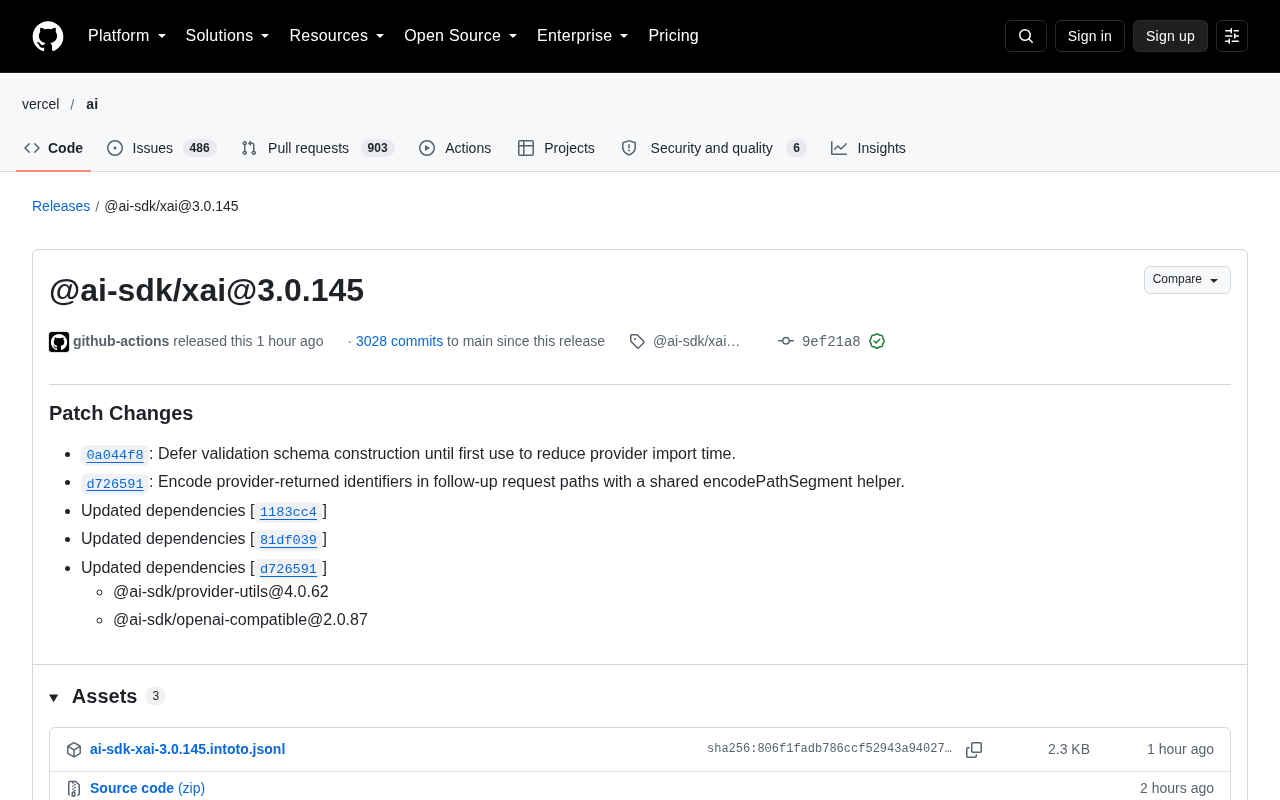
The @ai-sdk/xai in the Vercel AI SDK ecosystem released patch version 3.0.145 with three core changes: deferring validation schema construction until first use to reduce provider import time (especially beneficial in Serverless and edge cold-start scenarios); adding a shared encodePathSegment helper to encode provider-returned identifiers as path segments, preventing path parsing errors and injection risks from special characters; and synchronizing @ai-sdk/provider-utils 4.0.62 and @ai-sdk/openai-compatible 2.0.87. The commit was auto-published by GitHub Actions with a GPG signature. The update is restrained at the feature level but shows the SDK focusing on load performance and request construction robustness—a sign of maturity.
Vercel's AI SDK ecosystem has another noteworthy low-level iteration. While @ai-sdk/xai@3.0.145 is a patch version, its changes touch on two areas that developers often overlook but which affect the experience: module import performance and request path safety. For teams building applications with xAI models, this update is worth including in your upgrade plan.
Patch Overview
According to the GitHub release notes, this version contains three core changes: first, deferring the construction of the validation schema until first use, to reduce the provider's import time; second, encoding identifiers returned by the provider in subsequent request paths, and extracting a shared encodePathSegment helper function; third, synchronizing versions of the @ai-sdk/provider-utils and @ai-sdk/openai-compatible dependencies.
A detail worth noting: this commit was automatically published by GitHub Actions with a GPG-verified signature, indicating it went through a standardized CI process rather than an ad-hoc manual patch.
Why "Lazy Validation" Is a Performance Signal
The Hidden Cost of Import Time
In Node.js and frontend bundling environments, module import time is often underestimated. Many SDKs construct Zod or similar validation schemas at module load time, and such operations directly lengthen the first response time in cold-start scenarios (such as Serverless functions and edge runtimes).
This change defers schema construction until "first use"—essentially a lazy initialization strategy. Its benefits are particularly pronounced in microservices and serverless architectures: if a code path merely imports the provider without immediately calling a model, that validation overhead is completely eliminated.
Lazy Initialization is a common performance optimization pattern: deferring the creation of objects or resources until they are actually needed, rather than completing it at module load or construction time. In the JavaScript/TypeScript ecosystem, this typically manifests as wrapping schema construction logic in a getter or cached variable, e.g., executing z.object({...}) only on first call. Its core trade-off is: exchanging a one-time conditional check for startup-time savings, at the cost of a small additional overhead on the first call. For Serverless and edge runtimes—where cold-start time directly counts toward user request latency—the benefits of lazy initialization are amplified; in long-lived service processes, the benefits are mainly reflected in module import and execution preparation phases.
Zod is a widely used schema declaration and validation library in the TypeScript ecosystem. The AI SDK uses it to define request/response structures and perform runtime validation. Building a large schema involves a lot of object creation and type inference, which counts toward import time when executed at the module top level—exactly what this change aims to avoid.
Practical Impact on Developers
This optimization does not change any API signatures or break existing calling patterns. But from an engineering perspective, it reflects the xAI provider moving toward a more mature, production-grade SDK—starting to pay attention to low-level metrics like load performance, not just feature coverage.
Path Segment Encoding: An Easily Overlooked Security Detail
The Problem Lies in "Identifiers Returned by the Provider"
The second change deserves more discussion. The SDK uses identifiers returned by the provider to concatenate URL paths in subsequent requests. If these identifiers contain special characters (such as /, ?, #, or spaces), direct concatenation can lead to path parsing errors, and in extreme cases, injection-type issues.
This fix introduces a shared encodePathSegment helper function that uniformly encodes all path segments. The difference from generic URL encoding is that path segment encoding rules differ from query parameter encoding—characters like slashes have semantic meaning in paths and must be handled carefully.
URL Path Segment Encoding is not entirely equivalent to the conventional encodeURIComponent. According to RFC 3986, a path consists of several segments separated by /; the slash serves as a structural separator in paths, so characters like /, ?, and # within a single path segment must be percent-encoded, otherwise they will be treated by the parser as separators or as the start of a query/fragment. If an identifier contains ../, it could also cause path traversal, making the request land on an unintended endpoint. JavaScript's encodeURIComponent encodes /, basically satisfying path segment needs, but different runtimes and implementations handle characters like !'()* differently. Therefore, SDKs often encapsulate a semantically explicit encodePathSegment to fix behavior, express intent, and centralize testing. This type of injection risk is analogous to SQL injection: the danger is not in the characters themselves, but in unconstrained string concatenation.
Design Intent of the Shared Helper Function
Extracting the encoding logic into a shared function suggests this pattern may be reused in other provider packages. This is a typical "fix once, consolidate once" approach that benefits cross-package consistency going forward. For projects depending on multiple providers, this means behavior will be more predictable.
What Dependency Synchronization Means
This release synchronizes @ai-sdk/provider-utils@4.0.62 and @ai-sdk/openai-compatible@2.0.87. Since xAI's API overlaps with the OpenAI compatibility layer, aligning the version of the openai-compatible package is particularly important. Dependency synchronization usually means upstream fixes or interface adjustments are propagated down; when upgrading, it's advisable to check the behavior changes of both packages.
Upgrade Recommendations
For production environments, it's recommended to proceed in the following order: first verify in a staging environment whether import time decreases as expected; then run regression tests on code paths that use provider-returned IDs to concatenate requests; finally confirm that the openai-compatible dependency upgrade does not introduce behavioral differences. Since this is a patch version, under semantic versioning rules there should be no breaking changes, but the path encoding changes are still worth attention for edge cases.
Overall, this patch is restrained at the feature level but has a clear direction at the engineering quality level—it focuses attention on load performance and the robustness of request construction, which is precisely a sign of an SDK maturing.
One-line Summary
The AI SDK's xAI provider patch defers schema construction to speed up imports and adds path segment encoding to fix request security.
Paragraph Summary
The @ai-sdk/xai in the Vercel AI SDK ecosystem released patch version 3.0.145, containing three core changes: deferring validation schema construction until first use to reduce provider import time, with benefits especially pronounced in cold-start scenarios like Serverless and edge runtimes; adding a shared encodePathSegment helper function to encode identifiers returned by the provider as path segments, avoiding path parsing errors and even injection risks caused by special characters; and synchronizing the @ai-sdk/provider-utils 4.0.62 and @ai-sdk/openai-compatible 2.0.87 dependencies. This commit was automatically published by GitHub Actions with a GPG signature, following a standardized CI process. The article concludes that this update is restrained at the feature level but demonstrates that the SDK is beginning to focus on load performance and the robustness of request construction, marking a step toward maturity.
Related articles

AgentCore in Practice: Connecting Custom Tools and MCP Servers to Agents
DebuggerCafe tutorial shows how to connect custom tools and MCP servers to Amazon Bedrock AgentCore agents, covering tool contract design, MCP reuse, and production concerns.

816B Parameters Scores Only 39? The Real Cost-Effectiveness of the Open-Source LLM Parameter Race
Meta's 816B Muse Spark Open scores just 39 on Artificial Analysis, while 180B Qwen3.8-Flash-Next scores 40. This article analyzes 11 open-weight models' parameters vs. scores, exploring the real impact of activated parameters, quantized size, and deployment cost.

Aerial Manipulators: The Next Step for Drones from 'Seeing' to 'Changing'
Starting from a Reddit discussion, this article analyzes the technical challenges, potential applications, and deployment bottlenecks of aerial manipulators, exploring the key challenges for drones moving from environmental perception to physical manipulation.