@ai-sdk/xai 3.0.150 Patch Release: Just a Dependency Sync

@ai-sdk/xai releases patch 3.0.150, syncing dependencies only with no API changes.
In the Vercel AI SDK ecosystem, the official adapter package `@ai-sdk/xai` for connecting to xAI (Grok series models) has released version 3.0.150. Judging from the release notes, this is a typical patch-level release: under Patch Changes there are only two "Updated dependencies" entries pointing to two commits, along with a transitive bump of `@ai-sdk/openai-compatible` to 2.0.91. In other words, the package's own code is unchanged; it simply raises dependency versions after upstream protocol package changes to keep the monorepo dependency tree aligned, auto-published by github-actions with verified signatures on commits. The article notes that developers using the package directly can upgrade safely without changing business code, with very low risk; but when locking dependencies or auditing, they should pay attention to changes in the underlying `openai-compatible`, because xAI's adapter layer is built on top of the OpenAI-compatible protocol. What's really worth anticipating is new model parameters, tool calling, or streaming response adjustments that subsequent minor versions may bring.
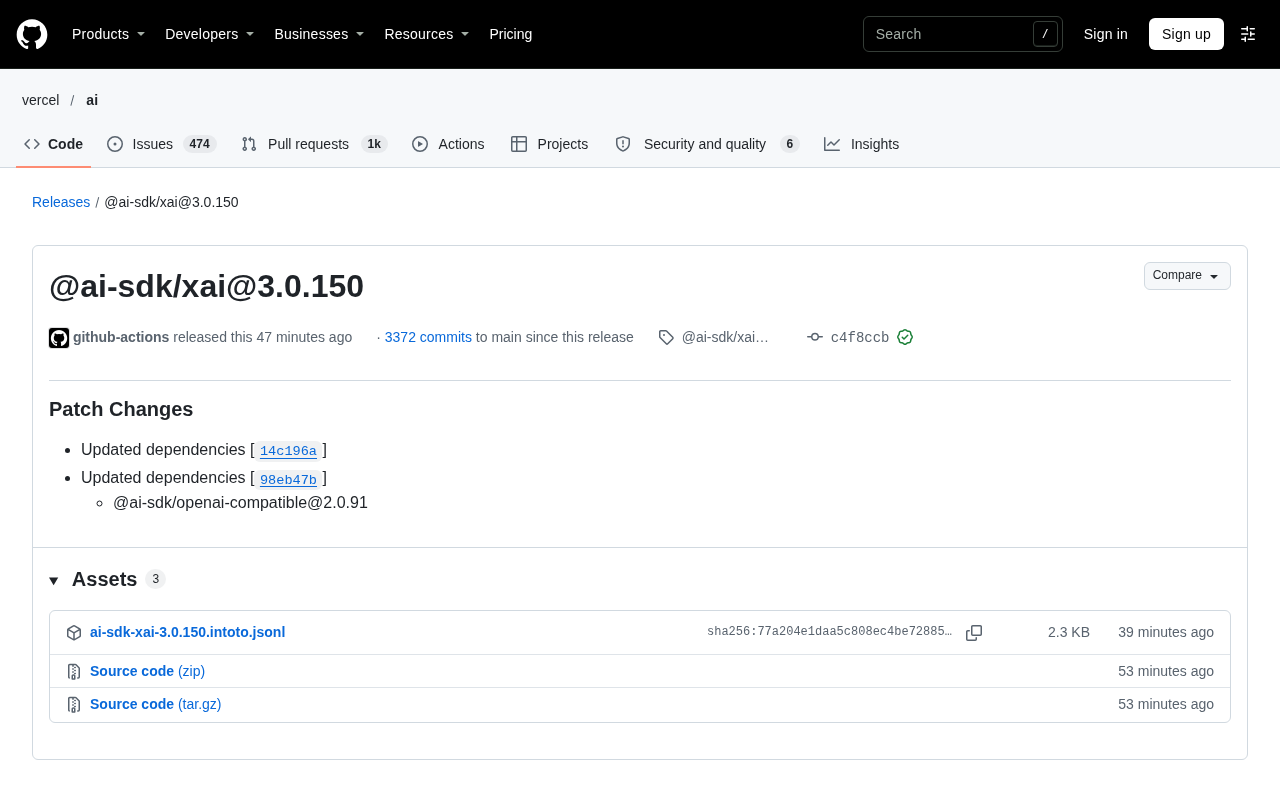
In Vercel's AI SDK ecosystem, @ai-sdk/xai is the official adapter package for connecting to xAI (i.e., the Grok series of models). The package has just released version 3.0.150, and judging from the changelog, this is a typical patch-level release with no new features and no breaking changes.
What Actually Changed in This Update
The release notes are very restrained: under Patch Changes there are only two "Updated dependencies" entries, pointing to two commits (14c196a and 98eb47b) and a transitive upgrade of @ai-sdk/openai-compatible@2.0.91.
In other words, the code of @ai-sdk/xai itself hasn't changed; it just bumped the version number of an underlying dependency. This kind of update is very common in monorepos — when the upstream openai-compatible package has changes, every provider package built on top of it ships a release too, keeping the dependency tree aligned.
Why Care About "Just a Dependency Bump"
For developers using @ai-sdk/xai directly, these patch versions can usually be upgraded safely with very low risk. But if you're doing dependency locking (lockfile) or auditing, it's still worth taking a look at what changed in @ai-sdk/openai-compatible 2.0.91, because xAI's adapter layer is built on top of the OpenAI-compatible protocol, and fixes or adjustments in the underlying protocol package propagate through.
From the release information, this commit is associated with the main branch at 3372 commits, was auto-published by github-actions, and carries a GitHub verified signature. This indicates it went through the standard automated release process, not a frantic hotfix.
The relationship between patch versions and lockfiles in Semantic Versioning (SemVer)
Under the SemVer specification, the three segments of a version number MAJOR.MINOR.PATCH mean: MAJOR indicates incompatible API changes, MINOR indicates backward-compatible feature additions, and PATCH indicates backward-compatible bug fixes. The third segment in 3.0.150 is the patch position, which in theory only carries internal fixes and doesn't involve public interface adjustments — this is also the basis for the article's judgment that it's "safe to upgrade."
Paired with SemVer is the package manager's version range syntax: in package.json, writing "^3.0.150" allows patch and minor upgrades, writing "~3.0.150" allows only patch upgrades, and writing an exact version number locks it completely. The lockfile (package-lock.json for npm, pnpm-lock.yaml for pnpm, yarn.lock for yarn) records the exact version and integrity hash that each package ultimately resolves to, ensuring that different machines and different CI environments install a completely consistent dependency tree.
So "relaxing the patch range to let the package manager follow automatically" and "lockfile locking" are not contradictory: the version range determines the acceptable interval, and the lockfile determines the actual version that lands within that interval. When auditing dependencies, what really needs to be compared is whether the resolved result of @ai-sdk/openai-compatible in the lockfile changes accordingly.
The layered structure of the OpenAI-compatible protocol and provider adapter layers
The so-called "OpenAI-compatible protocol" refers to the fact that a large number of model providers mimic OpenAI's Chat Completions specification at the HTTP interface level: the request body looks like {"model": ..., "messages": [{"role": ..., "content": ...}], "stream": true}, the response follows fixed fields such as choices, delta, and finish_reason, and streaming output uses the SSE format of data: {...}. xAI's Grok series exposes this interface through its compatible endpoint, so that any client written to the OpenAI specification can work by pointing directly at xAI's base URL.
The AI SDK takes advantage of this to layer things: @ai-sdk/openai-compatible carries the generic implementation of the protocol layer — request construction, message serialization, SSE parsing, error code mapping, streaming delta merging; provider packages like @ai-sdk/xai only layer vendor-specific content on top, such as the default base URL, authentication method, model ID list, vendor-specific parameters (such as reasoning-related fields), and capability declarations.
The benefit of this layering is reuse and consistency: bug fixes or edge-case handling in the protocol layer are done once, and all providers benefit simultaneously; the cost is that the changelog of a provider package often only shows "Updated dependencies," with the real behavioral changes hidden in the depended-upon package, requiring tracing along the dependency chain.
What This Means for Developers Using xAI
If you're calling Grok models in the AI SDK, upgrading to 3.0.150 doesn't require changing any business code. What really deserves attention is subsequent minor versions — only when @ai-sdk/xai moves up from 3.0.x might it bring new model parameters, tool-calling capabilities, or adjustments to streaming responses.
The information content of this release is indeed limited; it's better treated as a signal of dependency health: the ecosystem is being continuously maintained, and the provider package keeps pace with upstream. For most projects, just relax the patch version range in package.json and let the package manager follow automatically.
Automated releases and version alignment in monorepos
In monorepos like pnpm workspace or Turborepo, dozens of packages share the same repository and the same CI. When an underlying package (such as openai-compatible) has a new commit, if only that package is published, the dependency declarations of other packages that depend on it on npm still point to the old version, and users may end up with an inconsistent dependency tree after installation. For this reason, toolchains usually use mechanisms like changesets: the PR author declares the change level (patch/minor/major), and after merging, a GitHub Actions bot uniformly calculates the affected downstream packages, increments version numbers, generates CHANGELOGs, and publishes in batches.
This explains several details in the article: the publisher is github-actions, the commit carries a GitHub verified signature, and the changelog contains only machine-generated "Updated dependencies" entries. Such pipelines need npm's provenance or trusted publishing configured so that release artifacts carry provenance attestations usable for supply chain auditing.
The practical significance for users is: when encountering this kind of "pure dependency sync" patch version, there's usually no need to read the log item by item, but you can quickly confirm which layer actually shifted via npm view @ai-sdk/xai@3.0.150 dependencies or by comparing the lockfiles of two releases.
Summary
@ai-sdk/xai@3.0.150 is a patch release that is purely a dependency sync, with no API changes. Attention should be focused on the iteration of @ai-sdk/openai-compatible, because that's the actual source of xAI's adapter capabilities.
Related articles
 Tech Frontiers
T3 Code: Free, Open-Source, and a Unified Way to Manage All AI Coding Agents
T3 Code is a free open-source app that aggregates AI coding tools like Cloud Code and Codex into one interface, with conversation handoff, branch isolation review, automatic PR creation, and remote access.
 Tech Frontiers
Conductor Cloud Service Shutting Down? A Comparative Review of Three Parallel AI Coding Agent Solutions
Conductor's cloud service is shutting down—how can developers keep running AI coding agents in parallel? This article compares three alternatives: Orca, Codex, and Cursor: Orca is open-source and free and compatible with old workspaces, Codex is built into the ChatGPT desktop app and supports cloud handoff, and Cursor offers multi-agent windows within the editor. Choose the tool that best fits your workflow.
 Tech Frontiers
Cursor Launches Live Apps: One-Click Shareable Links
Cursor launches Live Apps for cloud agents: auto-build a web app, configure Postgres and Cursor login, run security checks, deploy to your domain, and generate a shareable link. Here's what it covers, its governance controls, and getting-started advice.