AI SDK xAI 3.0.155 Patch Release: Dependency Update Breakdown
@ai-sdk/xai releases maintenance patch 3.0.155, syncing upstream dependencies only, with no functional changes.
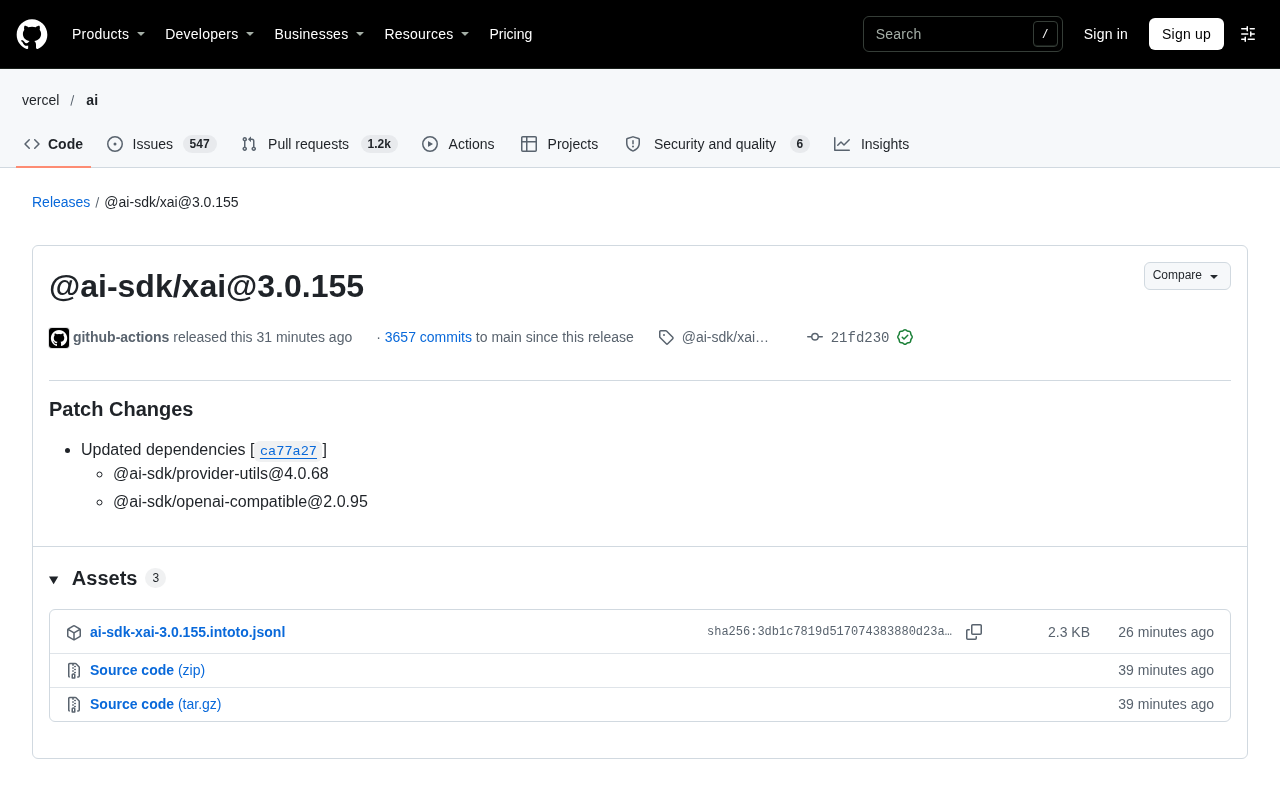
The article covers the 3.0.155 patch release of `@ai-sdk/xai` in the Vercel AI SDK ecosystem. Auto-generated by GitHub Actions (commit 21fd230, verified signature) through the official release channel, its only change is a dependency sync: `@ai-sdk/provider-utils` to 4.0.68 and `@ai-sdk/openai-compatible` to 2.0.95, triggered by commit ca77a27. Since xAI's API is OpenAI-compatible, reusing the openai-compatible abstraction is sound architecture. The upgrade brings no API or functional changes and is low risk, but watch for lockfile conflicts and run regression tests on streaming output and tool calling paths that depend on provider-utils.
A Typical Patch Release
The @ai-sdk/xai repository on GitHub has released version 3.0.155, a patch-level update. According to the commit history, this release was automatically generated by github-actions, based on 3657 commits on the main branch. The commit hash is 21fd230 and carries a GitHub verified signature, indicating the release went through the official automated channel.
Automated releases like this are already very common in the AI SDK ecosystem. The AI SDK series maintained by Vercel relies on GitHub Actions for version management, with each patch version corresponding to a dependency sync or minor fix. For developers using @ai-sdk/xai, the version number change itself is often more noteworthy than the content, because it usually signals a change in the upstream dependency chain.
Patch Content: Dependency Chain Sync
The only change in this patch is a dependency update involving two packages: @ai-sdk/provider-utils@4.0.68 and @ai-sdk/openai-compatible@2.0.95. Commit ca77a27 triggered this dependency update.
provider-utils is the shared low-level utility library for all AI SDK providers, handling request construction, error handling, streaming response parsing, and other common logic. openai-compatible provides an abstraction layer for OpenAI-compatible interfaces. Since xAI's API is designed to be compatible with the OpenAI interface, it is a reasonable architectural choice for @ai-sdk/xai to reuse this layer.
This means 3.0.155 itself introduces no new features or behavior changes; what it does is align upstream dependencies to the latest patch versions. After developers upgrade, the actual effective changes come from the 4.0.68 / 2.0.95 versions of provider-utils and openai-compatible.
Vercel AI SDK's layered architecture: The AI SDK is not a monolithic library, but a multi-layer structure composed of a core layer, a provider abstraction layer, and concrete provider packages. At the bottom is @ai-sdk/provider, which defines the unified interface that providers must implement (such as doStream and doGenerate); the middle layer is @ai-sdk/provider-utils, which provides shared request construction, streaming chunk parsing, retry, and error wrapping for all providers; above that is @ai-sdk/openai-compatible, which abstracts OpenAI's /chat/completions protocol into a reusable base class; and at the top are concrete integration packages like @ai-sdk/xai. Understanding this layering explains why patches to @ai-sdk/xai often just "bump the middle layer by one version"—it has almost no independent logic of its own, and most behavior is determined by the lower three layers.
What Dependency Updates Actually Mean
In the npm ecosystem, patch-version dependency updates typically include bug fixes, type definition corrections, or security patches, without breaking changes. As the xAI provider integration package for the Vercel AI SDK, @ai-sdk/xai keeping its release cadence in sync with upstream is the norm.
For consumers, upgrading to 3.0.155 carries low risk, but there are still two things to watch for. First, if your project directly pins the versions of provider-utils or openai-compatible, you need to check whether the lockfile conflicts. Second, dependency updates sometimes fix edge cases in streaming parsing or error retries, so if you have previously encountered related exceptions, it is worth doing regression verification after upgrading.
Semantic versioning and lockfile interaction: npm's semver convention allows ^4.0.68 to install any higher patch/minor version within 4.x, while ~4.0.68 only allows 4.0.x. When @ai-sdk/xai specifies its dependency range as ^4.0.68, the version actually installed is determined by the consuming project's lockfile, which can result in a situation where "the xai package is upgraded but provider-utils is still the old version." Therefore, checking whether npm ls @ai-sdk/provider-utils shows multiple versions or dedupe failures is more meaningful than simply looking at the @ai-sdk/xai version number. This is also what "lockfile conflict" actually refers to in this article.
Recommendations for Developers
Patch versions like this are suitable for inclusion in routine dependency maintenance. Upgrading can be done with npm update @ai-sdk/xai or by adjusting the version range in package.json. Since there are no API-level changes, no business code modifications are needed.
If your project has high stability requirements for the AI SDK, it is recommended to run your existing chat or completion test cases in CI to confirm consistent behavior after dependency alignment. xAI-related functionality in applications typically involves streaming output and tool calling, both of which depend on the provider-utils implementation, so regression tests should cover these two paths.
Summary
3.0.155 is a maintenance patch whose core action is upgrading provider-utils to 4.0.68 and openai-compatible to 2.0.95. It has no functional changes; its value lies in keeping the dependency chain consistent and reducing the hidden risks brought by version drift. For teams that continuously follow the AI SDK, merging updates like this on schedule is low-cost healthy maintenance.
One-line Summary
@ai-sdk/xai releases maintenance patch 3.0.155, syncing upstream dependencies only, with no functional changes.
Paragraph Summary
The article covers the 3.0.155 patch release of @ai-sdk/xai in the Vercel AI SDK ecosystem. This version was automatically generated by GitHub Actions, with commit hash 21fd230 and a verified signature, going through the official automated release channel. The only change is a dependency sync, upgrading @ai-sdk/provider-utils to 4.0.68 and @ai-sdk/openai-compatible to 2.0.95, triggered by commit ca77a27. Since xAI's API is compatible with the OpenAI interface, reusing the openai-compatible abstraction layer is a sound architecture. The upgrade itself brings no API or functional changes and carries low risk, but attention should be paid to lockfile conflicts, and regression verification is recommended for the streaming output and tool calling paths that depend on provider-utils.
Related articles

Nothing CMF Buds 2A Drops to $17.89 on Black Friday: A New Low for ANC Earbuds
Nothing CMF Buds 2A wireless earbuds Black Friday deal: just $17.89 on Amazon, about $11 off retail and a record low. ANC earbuds at an entry-level price.

When AI Creation Gets Accused of "Spitting": Hacker News Heats Up Over the Glaude Controversy
A Hacker News post, "Spitting in the Face of Glaude," sparks debate on AI creation transparency and attribution ethics. This analysis examines the blurred creator identity behind the controversy and offers practical advice for AI content production.

Akai Embraces Custom Firmware: MPC Sample 1.4 Lets Users AI-Program Their Sampler
Akai embraces the modding community with MPC Sample 1.4 firmware, supporting vibe-coded custom firmware and effects. We analyze the impact of this open strategy on music hardware and AI-assisted programming.