AI SDK xAI 5.0.26 Released: Dependency Updates and Ecosystem Impact

@ai-sdk/xai 5.0.26 is a patch release that only synchronizes underlying dependencies, with no new features and low upgrade risk.
The article explains the release of `@ai-sdk/xai@5.0.26` in the Vercel AI SDK ecosystem. Released on October 20, this patch update introduces no new features; the core change is upgrading `@ai-sdk/provider` to 4.0.31 and `@ai-sdk/provider-utils` to 5.0.64 via automated dependency upgrades triggered by two commits. It notes that while such dependency synchronization is nearly imperceptible at the code level, it may imply compatibility fixes for streaming response boundary handling and error standardization. The author advises developers to watch peer dependency matching and run existing tests in development before pushing to production, and analyzes AI SDK's conservative release strategy and its pros and cons for production.
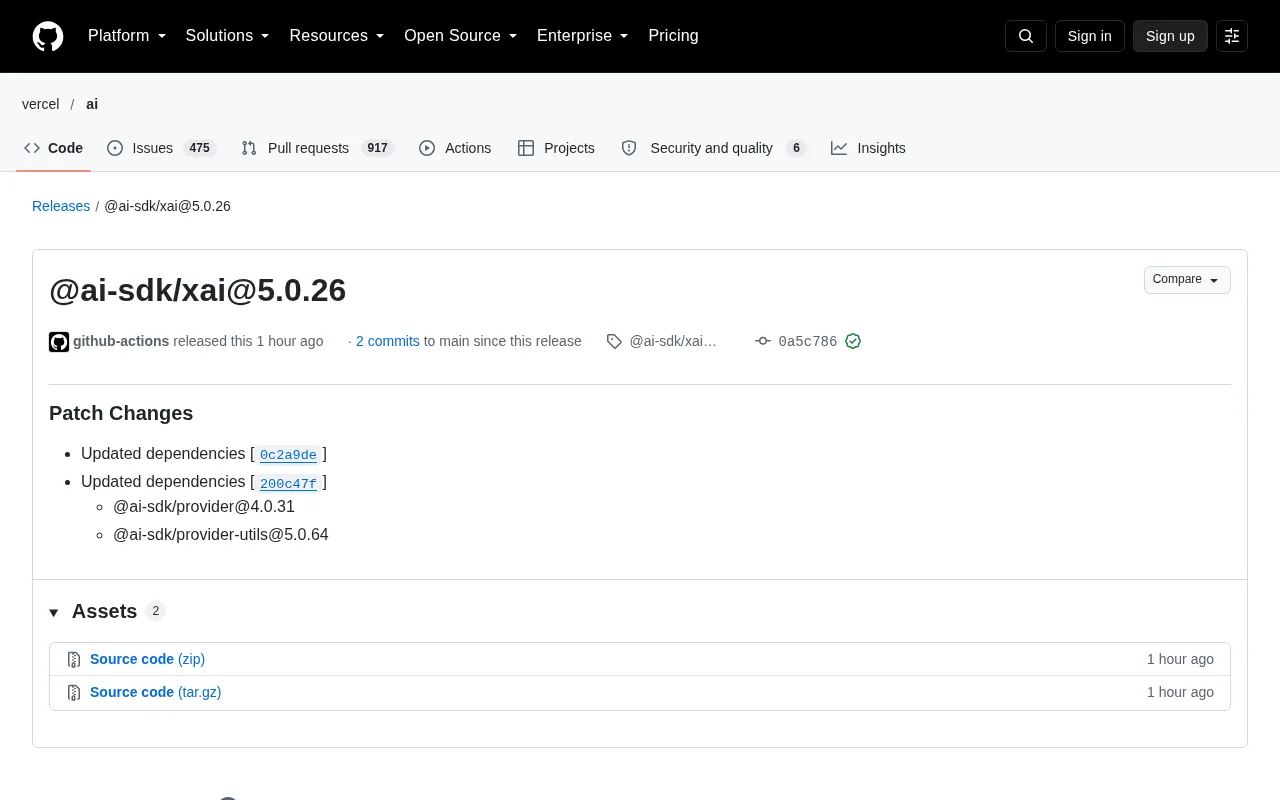
The AI SDK ecosystem has seen another minor version iteration. According to the GitHub release records, @ai-sdk/xai@5.0.26 was released on October 20 as a patch version update. This release introduces no new features and instead focuses on updating underlying dependencies. For developers using Vercel AI SDK to integrate xAI models, this is a routine maintenance update worth noting but not worrying about.
Breakdown of the Patch Update
According to the release notes, the core change in @ai-sdk/xai@5.0.26 is the version bump of two dependencies: @ai-sdk/provider upgraded to 4.0.31, and @ai-sdk/provider-utils upgraded to 5.0.64. These two packages form the underlying infrastructure of the AI SDK—the former defines the unified interface for model providers, and the latter provides common utility functions such as request handling and streaming responses.
Patch versions typically mean fixes rather than features. The release notes mark "Patch Changes" and reference two commit hashes (0c2a9de and 200c47f), indicating that this update was triggered by automated dependency upgrades. This pattern is common in AI SDK's monorepo management: after the underlying provider package is updated, each provider adapter package (such as xAI, OpenAI, Anthropic) follows suit to ensure version consistency.
Semantic Versioning (SemVer) and Patch Numbers: Semantic versioning splits a version number into major.minor.patch, corresponding respectively to incompatible breaking changes, backward-compatible new features, and backward-compatible bug fixes. Therefore, the increment of 26 in 5.0.26 usually represents only defect fixes and dependency synchronization, and theoretically does not change how the public API is called. However, SemVer is only a convention, not a mandate—especially in monorepos, where patch upgrades of underlying packages can still indirectly change runtime behavior. So "patch version = absolutely safe" does not hold, and test results should still be the final arbiter.
Why Dependency Updates Are Worth Watching
For developers calling the xAI API directly, this update is almost imperceptible at the code level. But synchronized updates across the dependency chain often imply compatibility fixes. Version changes in @ai-sdk/provider-utils may involve boundary handling for streaming responses, standardization of error messages, or detailed adjustments to request parameter serialization. These changes may not appear prominently in the changelog, yet they can affect stability in edge cases.
From an engineering perspective, this release cadence signals that the provider adapter layer is treated as an independently evolving module. The xAI package version has already reached 5.x, while the provider core is still at 4.x, indicating that the adapter layer has its own iteration logic. When upgrading, developers should pay attention to peer dependency matching to avoid type errors caused by version mismatches.
Peer Dependencies and Dependency Mismatches: A peer dependency indicates the version of a dependency that a package expects the host project to provide; npm/pnpm will check whether the version satisfies the requirement accordingly, but will not necessarily install it automatically. After AI SDK split the provider core and each provider adapter package into separate packages, adapter packages usually reference @ai-sdk/provider and @ai-sdk/provider-utils as peer or regular dependencies. If multiple version copies exist in the project simultaneously, issues such as inconsistent type definitions, failed instanceof checks, or duplicate bundling may occur. During troubleshooting, you can use npm ls @ai-sdk/provider to inspect the dependency tree and unify versions via the package manager's overrides/resolutions fields.
Practical Impact on Developers
If you use @ai-sdk/xai in your project, the direct benefit of upgrading to 5.0.26 is obtaining fixes from the underlying provider. Given that this is a patch version, the upgrade risk is low. It is recommended to first run existing tests in the development environment to confirm that xAI model invocation, streaming output, and error handling paths behave consistently before pushing to production.
Note that such automated dependency updates do not change how the API is used. The configuration options of createXai, model names, and request parameters all remain stable. For developers new to AI SDK, there is no need to relearn the documentation because of a version number change.
Ecosystem Perspective: AI SDK's Versioning Strategy
AI SDK's multi-package architecture allows it to quickly follow API changes from various model providers. As a relatively young provider, xAI's adapter package iterates at a frequency roughly in sync with other mainstream providers. The benefit of this modular design is that updates from one provider do not affect other modules; the cost is that the version matrix becomes complex, and developers need to pay attention to version alignment in the dependency tree.
This release shows that the AI SDK team leans conservative in maintenance: patch versions only synchronize dependencies and do not mix in new features. This is good for production environments, reducing the probability of unexpected behavior changes.
Monorepo and Automated Dependency Upgrades: AI SDK is managed as a monorepo (single repository with multiple packages), where the provider core, utility libraries, and each provider adapter package are developed in the same repository and released independently. The commit hashes referenced in release records often come from dependency upgrade PRs initiated by automation tools such as Renovate or Dependabot: they detect new upstream package releases, automatically bump version numbers, run CI, and merge. This mechanism allows dozens of adapter packages to stay version-aligned at low cost, and also explains why patch releases often "only touch dependencies, not code" and why changelogs show only version number changes.
Upgrade Recommendations
In the short term, 5.0.26 is a low-risk maintenance update. It is recommended to maintain the habit of updating dependencies, but there is no need to schedule a dedicated upgrade window for it. If your project is pinned to an older version and runs stably, you can also wait for the next minor version that includes feature changes before acting. Following the commit records on the GitHub releases page can help determine the actual content of each update.
For applications built on top of AI SDK, the value of dependency updates lies in the accumulated stability fixes. Staying in sync with upstream can reduce debugging costs in the long run.
One-line Summary
@ai-sdk/xai 5.0.26 is a patch release that only synchronizes underlying dependencies, with no new features and low upgrade risk.
Paragraph Summary
The article explains the release content of @ai-sdk/xai@5.0.26 in the Vercel AI SDK ecosystem. Released on October 20, this version is a patch update that introduces no new features; the core change is merely upgrading @ai-sdk/provider to 4.0.31 and @ai-sdk/provider-utils to 5.0.64, an automated dependency upgrade triggered by two commits. The article notes that although such dependency synchronization is almost imperceptible at the code level, it may imply compatibility fixes such as boundary handling for streaming responses and error standardization. The author recommends that developers pay attention to peer dependency matching, run existing tests in the development environment before pushing to production, and analyzes the conservative release strategy of AI SDK's multi-package architecture and its pros and cons for production environments.
Related articles

A New Paradigm for Text Editing in Compose: TextFieldState Replaces the Old API
Jetpack Compose introduces the TextFieldState API to fix dropped characters and cursor jumps from async input. The old value/onValueChange callbacks will be deprecated in 1.13. This article covers InputTransformation, OutputTransformation, four state hoisting patterns, and new formatted text editing capabilities.

Remote Compose: A New Document-Driven Paradigm for Cross-Platform UI on Android
Remote Compose transmits compact binary documents instead of screen pixels, enabling efficient UI rendering on remote surfaces like Wear OS and widgets. This article covers its document creation API, expression animations, size optimization techniques, and Wear OS progress.

How Crashlytics Eliminates Android Memory and Responsiveness Issues
Through the Chroma Clip case study, this article explains how Firebase Crashlytics uses Application Exit Info, Profiling Manager, GWP ASAN, and ARM MTE to pinpoint ANRs, OOMs, memory limit terminations, and native memory corruption—solving the challenge of stack traces that don't point to the real culprit.