AI SDK xAI 5.0.51 Update: Dependency Upgrade and Ecosystem Impact
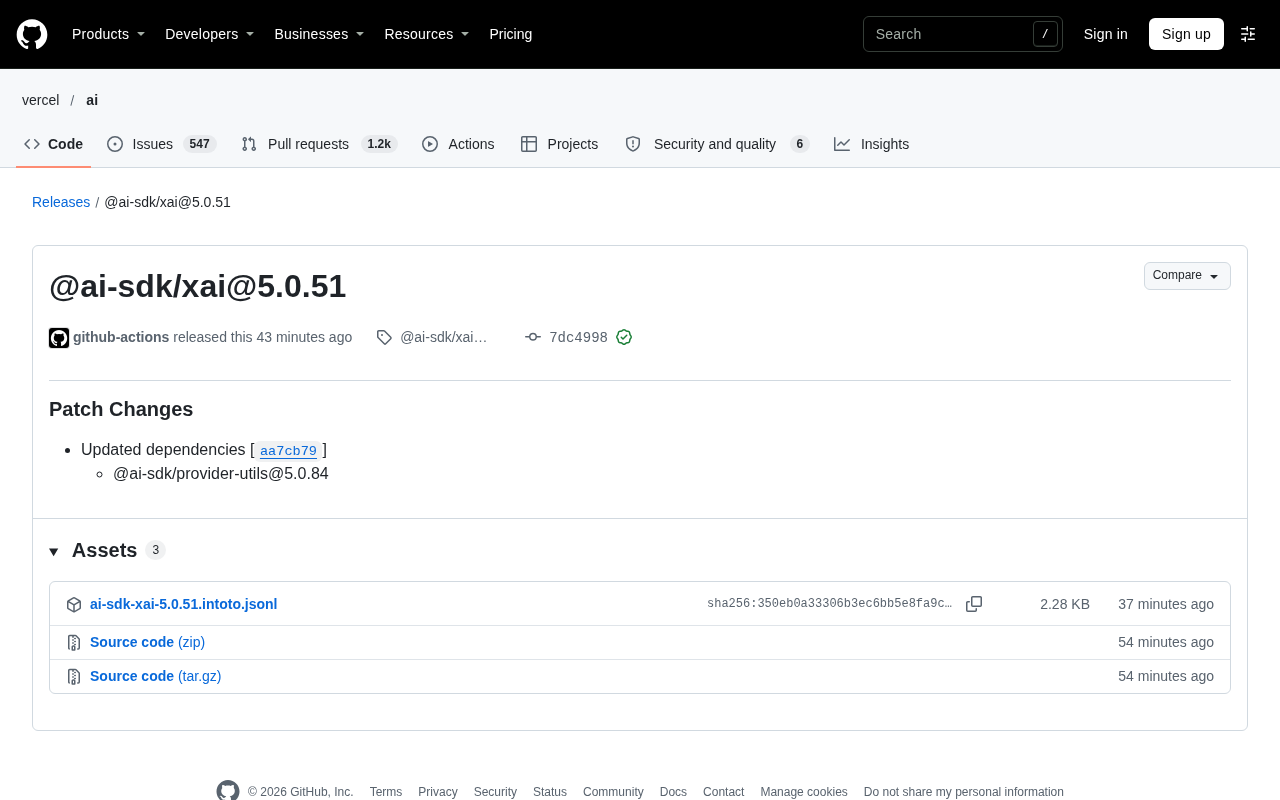
@ai-sdk/xai releases patch 5.0.51, syncing provider-utils to 5.0.84.
@ai-sdk/xai has released patch version 5.0.51, auto-published by github-actions with a GPG-verified signature. It is a patch-level change with no breaking modifications; the core action is upgrading the underlying dependency @ai-sdk/provider-utils to 5.0.84 to reuse upstream fixes and maintain dependency tree consistency in multi-provider projects. The release notes do not disclose the specific fixes, so functional changes should not be over-speculated. For developers, the upgrade risk is very low with unchanged interfaces, and whether to follow immediately depends on the project's dependency consistency requirements. The article also notes that such high-frequency automated releases reflect the maturity and supply chain security awareness of the AI SDK ecosystem.
The AI SDK ecosystem has always been known for its high-frequency, small-step updates. As the adapter layer that connects the Vercel AI SDK to xAI models, every version iteration of @ai-sdk/xai affects developers up and down the dependency chain. Version 5.0.51 may look like just a minor patch release, but the dependency relationships and ecosystem coordination behind it are worth discussing.
Release Overview
According to the auto-published record on GitHub by github-actions, @ai-sdk/xai@5.0.51 was released on the 25th at 21:23, with commit hash 7dc4998 and a GitHub-verified signature (GPG key ID: B5690EEEBB952194). This release is marked as Patch Changes, meaning it's a patch-level update—it contains no breaking changes and is primarily aimed at bug fixes and dependency synchronization.
From the release page, this version introduces no new APIs or features; the only change listed in the changelog is a dependency update. This kind of lightweight release is common in the AI SDK's maintenance cadence, typically intended to keep sub-packages aligned with the core toolchain versions.
Semantic Versioning (SemVer) and Patch Changes
In the npm ecosystem, version numbers typically follow the Semantic Versioning specification (SemVer), in the format major.minor.patch. An increment in the patch number (e.g., 5.0.50 → 5.0.51) represents backward-compatible bug fixes that introduce no new features and break no existing APIs; a minor version increment represents backward-compatible feature additions; a major version increment may contain breaking changes. The "Patch Changes" in the release notes is exactly the marker that the Changesets toolchain uses for patch-level changes—this convention lets dependents safely use range declarations like ^5.0.51 to automatically receive patch updates without worrying about interface breakage.
GitHub Actions Auto-Release and GPG Signature Verification
github-actions is the CI/CD service provided by GitHub; the AI SDK repository has an automated release workflow configured: when changes are merged into the main branch, the bot automatically calculates the version, generates the changelog, publishes to npm, and tags the Git release. The GPG signature in the release record (GPG key ID: B5690EEEBB952194) proves that the commit was genuinely produced by the official CI environment, preventing supply chain poisoning. Developers can verify the authenticity of the source via npm view @ai-sdk/xai@5.0.51 dist.integrity or the "Verified" badge on GitHub—this is a standard part of modern open-source supply chain security practices.
Core Change: provider-utils Dependency Sync
The specific content of this patch is updating the dependency @ai-sdk/provider-utils to version 5.0.84, with the associated commit aa7cb79. provider-utils is the underlying utility package in the AI SDK that carries common provider logic, responsible for shared cross-adapter capabilities such as request construction, streaming response handling, and error wrapping.
Aligning the xAI adapter with the latest provider-utils has practical significance: on one hand, it ensures the xAI adapter layer can reuse the latest upstream fixes and behavioral adjustments, avoiding compatibility issues caused by a lagging utility package version; on the other hand, this synchronization also reduces the risk of version conflicts in multi-provider projects—when developers use multiple AI SDK sub-packages simultaneously, the consistency of the dependency tree directly affects installation size and runtime behavior.
It's worth noting that the original release notes did not disclose exactly what issues provider-utils 5.0.84 fixes, so here we can only understand its value from the perspective of dependency governance, and should not over-speculate about functional-level changes.
The Role of @ai-sdk/provider-utils and Dependency Tree Consistency
@ai-sdk/provider-utils is the shared underlying package of the AI SDK, encapsulating logic common to all provider adapters (such as xAI, OpenAI, Anthropic): request parameter serialization, SSE streaming response parsing, error type normalization, token usage statistics, and more. Each provider package declares it as a dependency, so when multiple sub-packages reference different versions of provider-utils, npm will create nested duplicate copies in node_modules, which both increases installation size and may cause inconsistent runtime behavior (for example, two copies parsing the same streaming response with different logic). Bumping the xAI adapter's dependency to 5.0.84 aims to align it with the core toolchain and other sub-packages, so the dependency tree can be deduplicated and converge to a single version.
Lock Files and Dependency Auditing
Lock files (package-lock.json, pnpm-lock.yaml, yarn.lock) record a precise snapshot of the dependency tree. When upstream releases a patch, the lock file does not automatically update—you need to explicitly run npm update @ai-sdk/xai or reinstall to pull the new version. Teams can incorporate such patch-level dependency changes into their regular dependency audit process (e.g., Dependabot or Renovate automatically submitting PRs), run tests in CI before merging, thereby maintaining dependency health while controlling upgrade risk.
Practical Impact on Developers
For projects that directly use @ai-sdk/xai, this update falls into the category of "recommended to follow but very low risk." Patch-level versions do not change public interfaces, and the upgrade path is typically just changing the version number and reinstalling. For teams using lock file management, whether to upgrade immediately depends on the requirements for dependency consistency: if the project already uses a higher version of provider-utils, following this update helps eliminate duplicate dependencies; if the project is in a freeze period, delaying the upgrade won't introduce obvious security risks.
From a broader perspective, this kind of high-frequency patch release reflects the maturity of the AI SDK ecosystem—the automated release process (driven by github-actions) ensures sub-packages can quickly respond to upstream changes, while the signature verification mechanism provides basic safeguards for supply chain security. Developers should still pay attention to the dependency change entries in release notes and incorporate them into their regular dependency audit process.
Summary
@ai-sdk/xai@5.0.51 is a typical dependency-sync patch release, with the core action being upgrading provider-utils to 5.0.84. It brings no new features, but it has practical significance for maintaining the dependency health of multi-provider projects. Against the backdrop of the AI SDK's rapid iteration, understanding the positioning of such minor version updates is more valuable than chasing every version number.
One-line Summary
@ai-sdk/xai releases patch 5.0.51, syncing provider-utils to 5.0.84.
Paragraph Summary
@ai-sdk/xai has released patch version 5.0.51, auto-published by github-actions with a GPG-verified signature. This update is a patch-level change with no breaking modifications; the core action is upgrading the underlying dependency @ai-sdk/provider-utils to 5.0.84 to reuse upstream fixes and maintain dependency tree consistency in multi-provider projects. The release notes do not disclose the specific fixes in provider-utils, so functional changes should not be over-speculated. For developers, this upgrade carries very low risk with unchanged interfaces, and whether to follow immediately should be decided based on the project's requirements for dependency consistency. The article also notes that such high-frequency automated releases reflect the maturity and supply chain security awareness of the AI SDK ecosystem.
Related articles

Nothing CMF Buds 2A Drops to $17.89 on Black Friday: A New Low for ANC Earbuds
Nothing CMF Buds 2A wireless earbuds Black Friday deal: just $17.89 on Amazon, about $11 off retail and a record low. ANC earbuds at an entry-level price.

When AI Creation Gets Accused of "Spitting": Hacker News Heats Up Over the Glaude Controversy
A Hacker News post, "Spitting in the Face of Glaude," sparks debate on AI creation transparency and attribution ethics. This analysis examines the blurred creator identity behind the controversy and offers practical advice for AI content production.

Akai Embraces Custom Firmware: MPC Sample 1.4 Lets Users AI-Program Their Sampler
Akai embraces the modding community with MPC Sample 1.4 firmware, supporting vibe-coded custom firmware and effects. We analyze the impact of this open strategy on music hardware and AI-assisted programming.