AI SDK xAI Module Update: Dependency Upgrades and Ecosystem Integration

@ai-sdk/xai releases 2.0.106 patch, upgrading only two underlying dependencies—a maintenance update.
The xAI provider module @ai-sdk/xai in the Vercel AI SDK ecosystem has released patch version 2.0.106, mainly upgrading @ai-sdk/provider-utils to 3.0.48 and @ai-sdk/openai-compatible to 1.0.65. The update was completed automatically by GitHub Actions and verified with a signature, introducing no new features or breaking changes. These two dependencies are the shared utility function library for all providers and the abstraction layer for OpenAI-compatible APIs; their upgrades typically bring stability improvements in error handling, request construction, or stream parsing. For developers, this is a maintenance release—simply upgrade directly without changing business code; it also reflects the norm under AI SDK's modular architecture where improvements in upstream toolkits gradually propagate to each provider module.
A Low-Key Version Iteration
In Vercel's AI SDK ecosystem, the provider module for xAI, @ai-sdk/xai, has released version 2.0.106. As the version suffix suggests, this is a patch-level update. According to the GitHub release page, this update mainly involves dependency upgrades and does not introduce new features or breaking changes.
Specifics of the Dependency Update
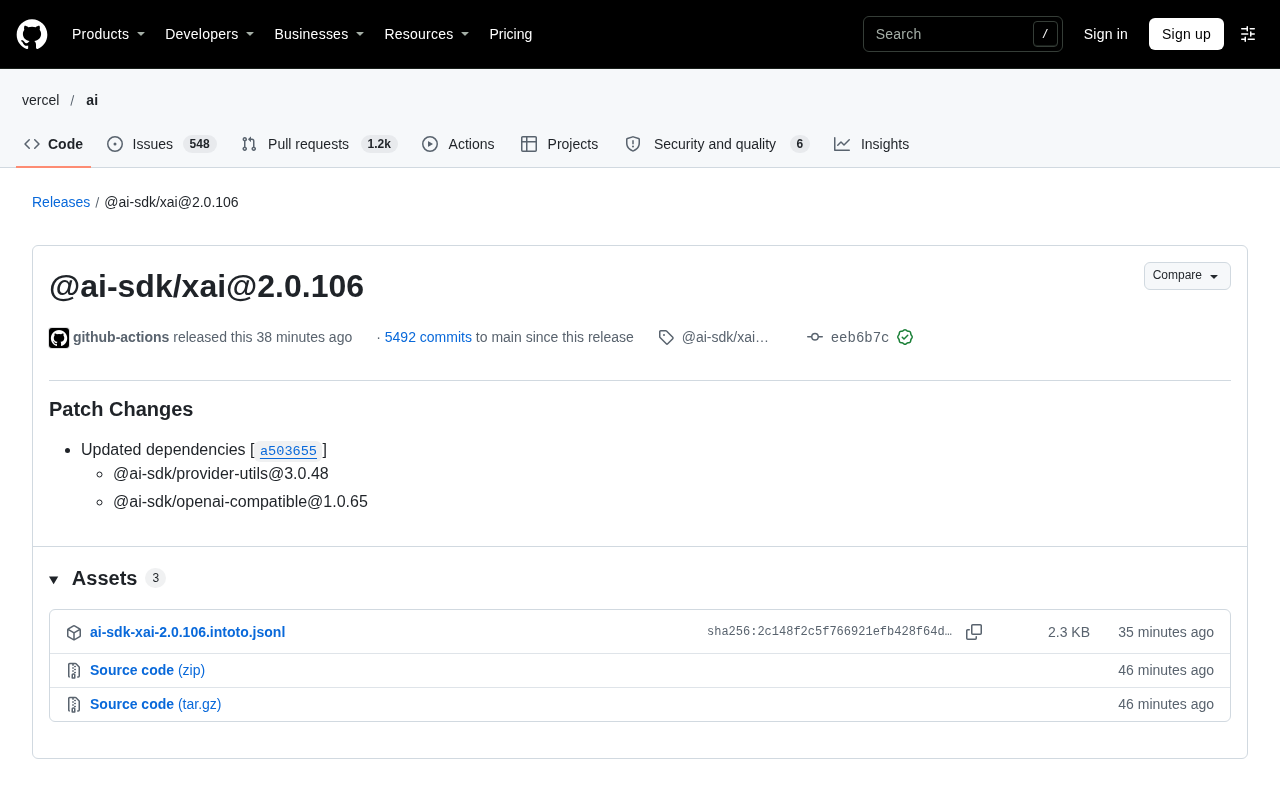
The release notes explicitly list the updated dependencies: @ai-sdk/provider-utils upgraded to version 3.0.48, and @ai-sdk/openai-compatible upgraded to version 1.0.65. These two packages form the infrastructure for AI SDK provider implementations. The former contains utility functions shared across various providers, while the latter provides an abstraction layer for OpenAI-compatible APIs, enabling services like xAI that are compatible with the OpenAI interface to reuse the same code logic.
This upgrade was automatically completed by GitHub Actions, and the commit record shows the change was verified with a GitHub signature. For developers using AI SDK to integrate xAI services, such dependency updates typically mean bug fixes or compatibility adjustments in the underlying utility functions—simply upgrade directly without modifying business code.
The modular provider architecture of AI SDK is the key background for understanding this update. Vercel AI SDK adopts a layered design: the core layer (the ai package) provides unified APIs such as generateText and streamText; the provider layer is split into independent npm packages by service provider, such as @ai-sdk/openai, @ai-sdk/anthropic, @ai-sdk/xai, etc. Each provider package internally depends on two types of shared infrastructure: @ai-sdk/provider (which defines the provider interface specification) and @ai-sdk/provider-utils (which implements common logic such as request construction, error wrapping, and stream parsing). This design means that adding a new model provider only requires implementing a small amount of adapter code, while improvements to common capabilities can benefit all providers at once by upgrading provider-utils.
The role of @ai-sdk/openai-compatible deserves separate mention. Many AI service providers (including xAI, DeepSeekAd, Together AI, etc.) design their APIs to mimic OpenAI's Chat Completions interface, but with subtle differences in parameter naming, streaming response formats, or error codes. The @ai-sdk/openai-compatible package provides a configurable abstraction: it reuses the core logic of the OpenAI provider while allowing each service provider to adapt to its own characteristics through override configurations. Therefore, @ai-sdk/xai does not implement request logic from scratch but is built on this compatibility layer, which explains why a patch upgrade of openai-compatible indirectly affects the behavior of the xAI provider.
Practical Impact on Developers
From an engineering perspective, this update to @ai-sdk/xai is a maintenance release. AI SDK adopts a modular design, with each model provider released as an independent package, allowing integrations like xAI to quickly follow upstream changes. The version bumps of provider-utils and openai-compatible may include improvements in error handling, request construction, or streaming response parsing. Although the release notes do not elaborate, such patch updates are typically aimed at improving stability and compatibility.
For developers currently using or planning to use xAI models, it is recommended to keep dependency versions in sync with official releases to obtain the latest fixes. Since xAI's API design is compatible with the OpenAI specification, updates to @ai-sdk/openai-compatible may indirectly affect the behavior of the xAI provider—for example, making parameter mapping or response format handling more robust.
Continuous Evolution of Ecosystem Integration
AI SDK abstracts different AI service providers through a unified interface, reducing the cost for developers to switch between or combine multiple models. The frequent small version iterations of @ai-sdk/xai reflect that the xAI service itself may be evolving rapidly, and the SDK side needs to continuously adapt. Although this update is limited in content, it reflects the norm of dependency management in the open-source ecosystem: improvements in upstream toolkits gradually propagate to each provider module, ultimately benefiting end developers.
In the future, as xAI model capabilities are updated or its API changes, we can expect more substantive feature releases from @ai-sdk/xai. Developers should follow the official release notes to stay informed of new features or necessary migration guides.
The meaning of Semantic Versioning (SemVer) and patch numbers helps assess the risk level of this update. Under the SemVer specification, in version number 2.0.106, the major version number 2 indicates the current major API version, the minor version number 0 indicates that no new features have been introduced, and the patch number 106 indicates this is the 106th bug-fix release in the series. By convention, patch versions contain only backward-compatible bug fixes and dependency adjustments, without changing public API signatures. For applications depending on @ai-sdk/xai, using a range such as ^2.0.0 or ~2.0.106 in package.json will automatically pick up such updates; combined with a lock file (package-lock.json / pnpm-lock.yaml), CI environments can be made reproducible.
Automated releases via GitHub Actions and signature verification are another background aspect of this update process. The AI SDK repository is configured with an automated release workflow: when a dependency bot (such as Renovate or Dependabot) detects a new version of an upstream package, it automatically creates a PR and runs tests; after merging, GitHub Actions executes npm publish and generates a commit signature. The "Verified" signature shown on the release page indicates that the commit was signed with GitHub's key, which can be used to confirm that the package source has not been tampered with. When auditing supply chain security, developers can combine this with npm's provenance attestation to verify the build source of release artifacts.
One-line Summary
@ai-sdk/xai releases 2.0.106 patch, only upgrading two underlying dependencies—a maintenance update.
Paragraph Summary
The xAI provider module @ai-sdk/xai in the Vercel AI SDK ecosystem has released patch version 2.0.106, mainly upgrading @ai-sdk/provider-utils to 3.0.48 and @ai-sdk/openai-compatible to 1.0.65. The update was automatically completed by GitHub Actions and verified with a signature, introducing no new features or breaking changes. These two dependencies are the shared utility function library for all providers and the abstraction layer for OpenAI-compatible APIs, respectively; their upgrades typically bring stability improvements in error handling, request construction, or stream parsing. For developers, this update is a maintenance release—simply upgrade directly without changing business code; it also reflects the norm under AI SDK's modular architecture where improvements in upstream toolkits gradually propagate to each provider module.
Related articles

Nothing CMF Buds 2A Drops to $17.89 on Black Friday: A New Low for ANC Earbuds
Nothing CMF Buds 2A wireless earbuds Black Friday deal: just $17.89 on Amazon, about $11 off retail and a record low. ANC earbuds at an entry-level price.

When AI Creation Gets Accused of "Spitting": Hacker News Heats Up Over the Glaude Controversy
A Hacker News post, "Spitting in the Face of Glaude," sparks debate on AI creation transparency and attribution ethics. This analysis examines the blurred creator identity behind the controversy and offers practical advice for AI content production.

Akai Embraces Custom Firmware: MPC Sample 1.4 Lets Users AI-Program Their Sampler
Akai embraces the modding community with MPC Sample 1.4 firmware, supporting vibe-coded custom firmware and effects. We analyze the impact of this open strategy on music hardware and AI-assisted programming.