AI SDK Z.ai Adapter Update: @ai-sdk/zai 3.0.52 Explained
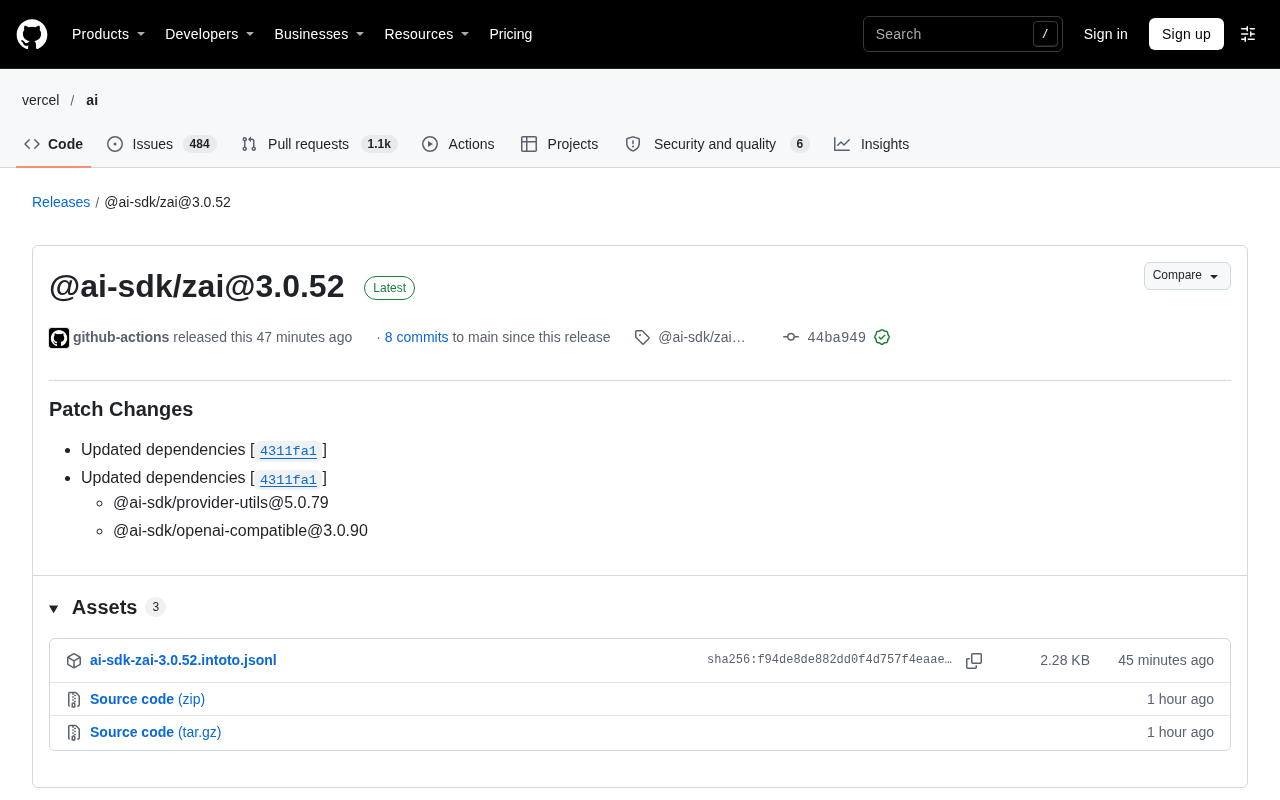
@ai-sdk/zai 3.0.52 is a pure dependency-sync patch with no functional changes.
This article analyzes the 3.0.52 patch release of the Zhipu adapter package @ai-sdk/zai in the Vercel AI SDK ecosystem. Marked as Patch Changes, the core change is only dependency synchronization: @ai-sdk/provider-utils upgraded to 5.0.79 and @ai-sdk/openai-compatible to 3.0.90, auto-published by GitHub Actions, with no API changes or model invocation logic fixes. The article explains why the adapter builds on the openai-compatible layer—the Zhipu API is compatible with the OpenAI interface specification, and reusing request construction and streaming parsing logic reduces maintenance costs, with upstream fixes propagating naturally. On upgrade advice, patch risk is low, but when multiple adapters coexist, watch for version constraint conflicts on provider-utils; more noteworthy is the fast ecosystem iteration cadence, suggesting such dependency updates be incorporated into automated processes.
The Z.ai adapter package @ai-sdk/zai in the AI SDK ecosystem has released patch version 3.0.52. Judging from the version number and changes, this is a typical dependency synchronization update rather than a feature iteration. For developers using the Vercel AI SDK to integrate Zhipu models, understanding the positioning of such patches helps determine upgrade cadence.
Version Changes: A Pure Dependency Sync
According to the GitHub release record, 3.0.52 is marked as Patch Changes, with the core change being dependency updates. Two packages are involved: @ai-sdk/provider-utils upgraded to 5.0.79, and @ai-sdk/openai-compatible upgraded to 3.0.90. The release was automatically completed by github-actions, containing 8 commits with GitHub-verified signatures.
This change pattern indicates that the adapter itself has no API-level changes, no new parameters, and no fixes to model-specific invocation logic. Its value lies in maintaining version alignment with the upstream toolchain to avoid compatibility issues caused by dependency drift. Patch versions are generally safe to upgrade, but it's still recommended to verify in a test environment before pushing to production.
Patch number in Semantic Versioning (SemVer): In the MAJOR.MINOR.PATCH versioning scheme, an increment in the patch number indicates backward-compatible bug fixes without new features or breaking changes. Therefore, 3.0.52 is a safely replaceable upgrade relative to 3.0.51.
AI SDK package layering: @ai-sdk/provider defines the unified interface for model providers, @ai-sdk/provider-utils provides common utilities such as request construction, stream parsing, and error mapping, while @ai-sdk/openai-compatible implements server-side integration for the OpenAI specification. Together, the three form an infrastructure chain from abstract to concrete, with the adapter package at the top layer, responsible only for vendor-specific configuration and a small amount of differential logic.
Why the Adapter Package Depends on openai-compatible
@ai-sdk/zai is built on top of @ai-sdk/openai-compatible, a design choice that reflects the compatibility between the Zhipu API and the OpenAI interface specification. The AI SDK reuses request construction, streaming response parsing, and other logic through the compatibility layer, so the adapter only needs to handle a small amount of differential configuration.
This also means that fixes and adjustments to the upstream openai-compatible will propagate directly to the Z.ai adapter. When the compatibility layer handles new response formats or error types, the adapter packages that depend on it benefit accordingly. provider-utils handles the more fundamental utility function responsibilities, and both dependencies being updated simultaneously is typically a routine follow-up in the upstream release chain.
OpenAI-compatible interface: Many model providers (including Zhipu) offer HTTP interfaces with the same paths, request bodies, and response structures as OpenAI Chat Completions, including the messages array, stream parameter, and SSE streaming chunk format. This compatibility allows client libraries to reuse the same protocol implementation, only needing to replace baseURL, API Key, and model name. The AI SDK therefore centralizes protocol details in the openai-compatible package, with the adapter package only declaring the vendor's default endpoints and model list, significantly reducing maintenance costs—but also meaning that upstream behavior changes propagate down the dependency chain.
Upgrade Recommendations and Considerations
For projects locked to older versions, upgrading to 3.0.52 carries low risk, but attention should be paid to version constraints on transitive dependencies. If a project also uses other @ai-sdk/* adapters, different packages may have conflicting version requirements for provider-utils, and the package manager will provide warnings.
What deserves more attention than this patch itself is the version cadence. Adapter packages in the AI SDK ecosystem iterate frequently, with dense patch releases, indicating that the upstream toolchain is still being adjusted rapidly. Teams can establish automated dependency update processes, incorporating such pure dependency-sync upgrades into routine maintenance to reduce manual judgment costs.
Summary
@ai-sdk/zai 3.0.52 is a dependency-sync patch release with no functional changes. Its significance lies in maintaining version consistency between the adapter and the AI SDK upstream toolchain. For users, it can be handled through the standard patch upgrade process, while keeping an eye on version alignment of transitive dependencies.
Note: The original release information contains only version numbers and dependency changes, without disclosing specific feature improvements or performance data. This article makes no additional inferences about unmentioned content.
Related articles

Gemini 4 Neon Leak: A Potential Strong Contender Against Opus 5.5
A Hacker News thread suggests Gemini 4 Neon looks like an Opus 5.5 competitor. This article unpacks the product positioning behind this community signal, shifts in the top-model competitive landscape, and what it means for developers' model selection strategy.

Claude Fable 5.2's Self-Authored Short Film 'Fable' Sparks Discussion
A short film 'Fable,' credited to Claude Fable 5.2 for script, visuals, and directing, appears on Hacker News. This article analyzes the significance of full-pipeline AI creation, community reactions, and what it means for content creators.

Anthropic IPO Pricing: A Signal of AI Giants Going Public
Anthropic's IPO pricing draws attention. This article analyzes its potential impact on AI industry valuation, commercialization paths, and the competitive landscape, and highlights public-market expectations and challenges for AI companies.