@ai-sdk/zai 2.0.14 Patch Release: Dependency Upgrade Explained

@ai-sdk/zai 2.0.14 patch only syncs the compatibility layer dependency, reflecting the maintenance logic of the modular AI SDK.
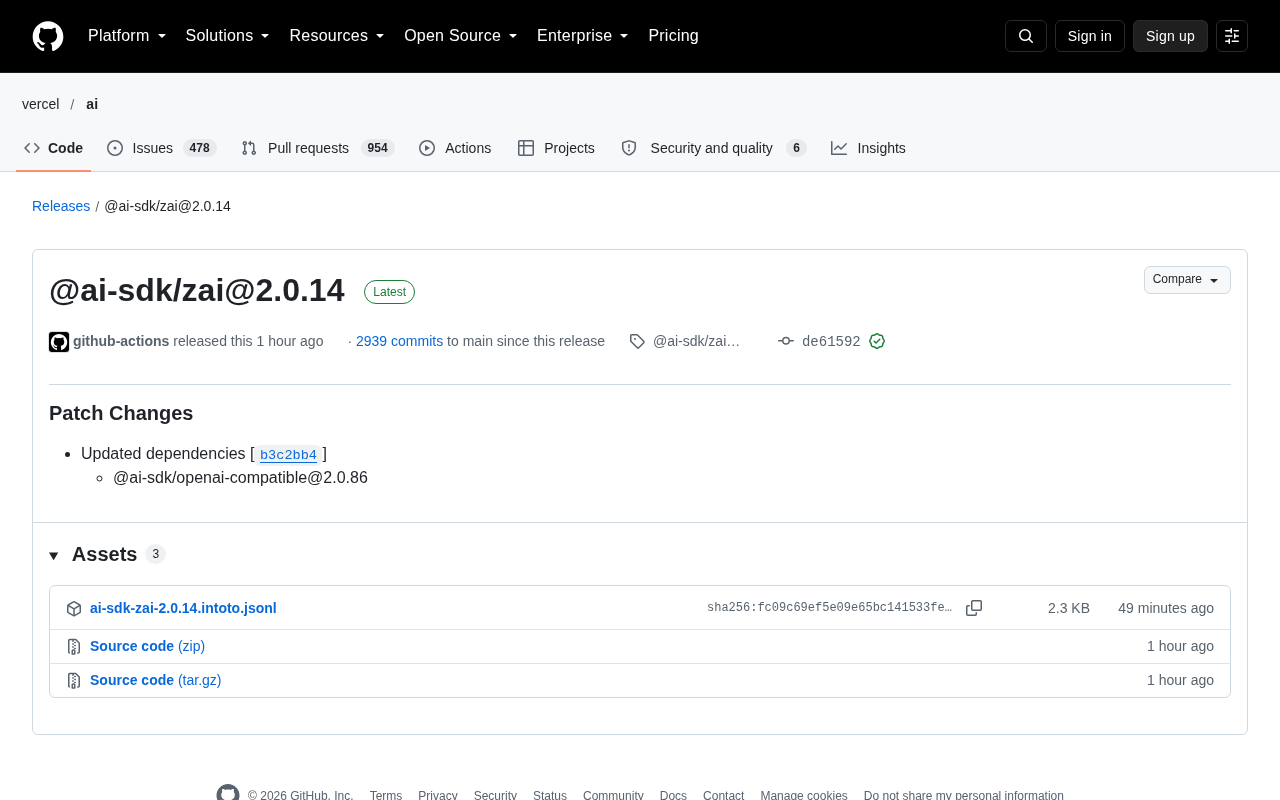
The AI SDK ecosystem under Vercel has released the @ai-sdk/zai@2.0.14 patch version, with no new features or breaking changes; the only change is upgrading the dependency @ai-sdk/openai-compatible to 2.0.86. The article points out that @ai-sdk/zai is merely a thin adapter layer for Z.ai, with the real compatibility logic consolidated in the shared openai-compatible package, so this upgrade may simultaneously affect multiple provider adapter packages. The release was automatically completed by github-actions with a verified signature, reflecting a standardized CI process. The article further analyzes the version propagation mechanism of independent provider package releases under a monorepo, and recommends that developers check the lockfile resolution results and follow the compatibility layer changelog, while treating this version as a sample for evaluating the AI SDK's multi-provider abstraction capability.
A Low-Key Patch Update That Reveals the Maintenance Logic of the AI SDK Ecosystem
The AI SDK ecosystem under Vercel recently released the @ai-sdk/zai@2.0.14 patch version. Looking at the GitHub Releases page, this update has no new feature announcements and no breaking change notes—just a single Patch Changes entry: the dependency @ai-sdk/openai-compatible was updated to version 2.0.86. For developers unfamiliar with the AI SDK's modular architecture, this line is easy to overlook; but it happens to reflect a typical maintenance pattern in today's AI application development toolchain—decoupling model provider adapter layers from the core SDK through fine-grained package management.
Why a Dependency Update Is Worth Noticing
@ai-sdk/zai is the adapter package in the AI SDK for Z.ai (Zhipu-family model services). It does not directly implement inference logic; instead, it relies on the general compatibility layer @ai-sdk/openai-compatible to map Z.ai's API onto the AI SDK's unified invocation interface. In other words, @ai-sdk/openai-compatible is the common foundation for many "OpenAI-compatible" model services, and its version changes may simultaneously affect multiple provider adapter packages.
Upgrading the compatibility layer to 2.0.86 this time is a patch-level dependency sync. From the release record, this commit was automatically published by github-actions and carries a GitHub verified signature, indicating the entire process runs through a standardized CI release pipeline. For consumers, the upgrade risk is low, but it is still advisable to verify in a test environment before merging into production dependencies.
OpenAI-compatible layer refers to an intermediate abstraction layer: it defines a unified interface following the OpenAI Chat Completions API request/response format (such as the messages array, choices field, and SSE streaming chunks), and then translates this format into the protocol actually required by each model service. Many services such as Z.ai, DeepSeekAd, and Together claim to be "OpenAI-compatible," but their tolerance for fields, error codes, and streaming end markers often differ subtly. The responsibility of @ai-sdk/openai-compatible is to absorb these differences so that upper-layer provider packages only need to declare a baseURL and a small amount of configuration. Therefore, a single patch upgrade of it may simultaneously change how multiple providers handle request headers, timeouts, or streaming parsing—which is why this article emphasizes the need to check its changelog.
Version Propagation Mechanism of Modular SDKs
The AI SDK is managed as a monorepo, with each provider package released independently. The benefit of this design is that when a model service adjusts API details, only the corresponding adapter package and shared compatibility layer need updating, without forcing a major version upgrade of the entire SDK. The cost is that the version matrix becomes complex—developers need to pay attention to the version correspondence between @ai-sdk/zai and @ai-sdk/openai-compatible.
The changelog for 2.0.14 explicitly points to the dependency commit b3c2bb4, and this traceability is very valuable for troubleshooting production issues. If request format or streaming response anomalies occur after the upgrade, you can follow the dependency chain to locate the specific changes in the compatibility layer.
monorepo refers to managing multiple interrelated npm packages in the same Git repository, usually with tools such as pnpm workspace, Turborepo, or Nx. The AI SDK adopts this pattern, allowing @ai-sdk/zai, @ai-sdk/openai-compatible, and core packages to share the same CI, testing, and release scripts while each having its own independent version number and changelog. During release, tools like Changesets automatically calculate and publish new versions for affected packages based on the change type (patch/minor/major) declared in commits—the automatic publication by github-actions with a signature in this article is an example of this process. The cost is that developers need to understand how dependency ranges between packages (such as ^2.0.86) resolve, to avoid mixing incompatible combinations into the lockfile.
Practical Impact on Developers
For teams already using @ai-sdk/zai in their projects, this update is most likely "imperceptible": no API signature changes, no configuration items added or removed. The recommended approach is to confirm the dependency resolution result in the lockfile and to check the changelog of @ai-sdk/openai-compatible 2.0.86 to determine whether it involves fixes to request headers, error code mapping, or streaming parsing.
For developers who have not yet integrated it, this version can serve as a sample for evaluating the AI SDK's multi-provider abstraction capability: a provider adapter package bears only a thin layer of conversion responsibility, while the real compatibility logic is consolidated in the shared package. This layered approach is also a microcosm of how AI application infrastructure is gradually moving toward standardization.
lockfile (such as package-lock.json, pnpm-lock.yaml, yarn.lock) records the exact version and integrity hash that each dependency resolves to in an installation, and is the basis for ensuring consistent installation results across environments. Because @ai-sdk/zai typically declares the compatibility layer with a ^ range, running an install directly in the project may silently bump @ai-sdk/openai-compatible to a newer version. It is advisable to check the lockfile diff before merging to confirm that the compatibility layer version has indeed changed to 2.0.86, and to use npm ci or pnpm install --frozen-lockfile in CI to lock the resolution result and avoid version drift between production and test environments.
Summary
@ai-sdk/zai@2.0.14 is a routine patch release, with the core action being syncing @ai-sdk/openai-compatible to 2.0.86. It reminds us that in the modular AI SDK ecosystem, dependency version management itself is an engineering practice that requires ongoing attention.
Related articles

Gemini 4 Argon Hands-On: AI Builds Board Games, Constructs Temples, and Trains Robots Autonomously
Gemini 4 Argon hands-on roundup: AI autonomously builds a desk racetrack and temple in Blender, writes a ray tracing engine, trains a humanoid robot to sink 7 shots, plus API pricing and developer access.

The Magic Octagonal Coin: Why Only 9% of People Can Predict Its Flip?
Only 9% of people can correctly predict the Magic Octagon coin flip. This article explains its spatial rotation mechanism, common cognitive pitfalls, and a new hypothesis based on Relevance Theory, exploring the limits of human spatial reasoning.

Sam Altman: AI Is Entering the Era of Scientific Discovery — Math Breakthroughs Will Replicate in Biology and Energy
Sam Altman says AI is entering the era of scientific discovery — math breakthroughs will replicate in biology, materials science, and energy to help develop new drugs and energy sources.