@ai-sdk/zai 2.0.23 Released: Dependencies Synced, Stability Improved
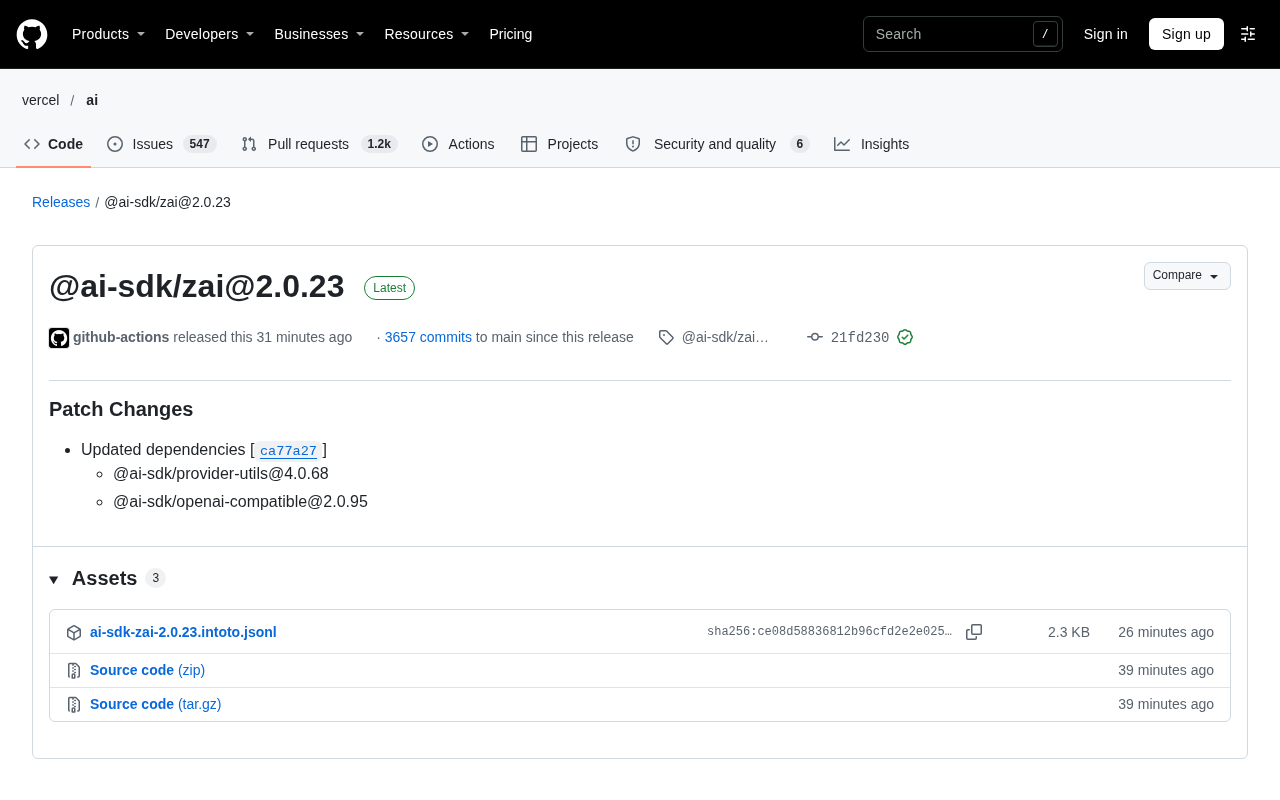
@ai-sdk/zai releases 2.0.23 patch, syncing underlying dependency versions with no breaking changes.
The @ai-sdk/zai package has released patch version 2.0.23. This update introduces no new APIs or feature logic; its core is syncing underlying dependencies by upgrading @ai-sdk/provider-utils to 4.0.68 and @ai-sdk/openai-compatible to 2.0.95, thereby indirectly inheriting upstream utility fixes and compatibility improvements. The update was automatically published by GitHub Actions with a verified signature and is a common version alignment operation in a monorepo. For developers, upgrade risk is low and no business code changes are needed. It is recommended to pin the version to 2.0.23 or higher to maintain dependency health and reduce type conflicts and hidden behavioral inconsistencies.
Version at a Glance: A Small but Important Patch Update
The @ai-sdk/zai package in the Vercel AI SDK ecosystem has reached version 2.0.23. This is a patch-level update whose main change is syncing underlying dependencies. According to the release record on GitHub, this update was automatically published by github-actions, with commit hash 21fd230, and comes with a GitHub verification signature.
Looking at the changes, @ai-sdk/zai itself does not introduce new APIs or feature logic. Instead, by updating @ai-sdk/provider-utils to version 4.0.68 and @ai-sdk/openai-compatible to version 2.0.95, it indirectly inherits fixes and optimizations to the underlying toolchain. This kind of dependency sync is very common in monorepo-managed SDK projects, with the goal of ensuring version consistency across packages and avoiding runtime issues caused by dependency mismatches.
The Significance of Dependency Updates: Compatibility and Fix Propagation
The core trigger for this update is commit ca77a27, which updated the two key dependencies @ai-sdk/provider-utils and @ai-sdk/openai-compatible. provider-utils typically contains shared utility functions and type definitions for provider adapters, while openai-compatible handles integration with services that are compatible with the OpenAI interface.
For developers using @ai-sdk/zai, this means:
- Upstream fixes take effect automatically: If
provider-utilsoropenai-compatiblecontains fixes related to request handling, streaming responses, or error mapping, this patch brings those improvements to the ZAI provider. - Version alignment: When mixing different versions of AI SDK packages in the same project, version alignment reduces the probability of type conflicts and dependency resolution failures.
- No breaking changes: The patch version number indicates that this update does not involve API signature changes, so upgrade risk is low.
Impact on Developers: Upgrade Recommendations
If you are using @ai-sdk/zai in your project, it is recommended to pin the version to 2.0.23 or higher. Since this is a patch update, you typically do not need to modify business code. To upgrade, simply run the usual package manager update command and check whether AI SDK-related tests in CI pass.
For projects that rely on @ai-sdk/openai-compatible to connect to self-hosted or third-party compatible interfaces, this sync also means that the ZAI adapter you use stays consistent with the latest openai-compatible implementation, reducing hidden behavioral inconsistencies caused by version differences.
Patch versions follow Semantic Versioning (SemVer), with the format major.minor.patch. An increment in the patch number indicates that the release contains only backward-compatible bug fixes and internal improvements, with no new features and no changes to the public API. For dependents, patch updates can usually be safely auto-upgraded. In a monorepo, packages reference each other through the workspace protocol, and at release time tools such as Changesets uniformly calculate versions and rewrite dependency ranges. Therefore, a patch release of an underlying package triggers synchronized version bumps in upper-layer packages—this is exactly why this change is a version number change for @ai-sdk/zai rather than a code change.
About the ZAI Provider and the AI SDK Ecosystem
@ai-sdk/zai is the provider package for the ZAI service in the Vercel AI SDK ecosystem. It is built on the OpenAI-compatible layer, allowing developers to call ZAI's model capabilities through unified interfaces such as generateText and streamText. This design lowers the cost of switching providers and reflects the AI SDK's continued investment in the direction of "unified interfaces, multi-provider adaptation."
This release record shows that the repository has a cumulative total of 3,657 commits, which indirectly indicates a high iteration frequency in this ecosystem. For production projects, paying attention to such patch updates and upgrading regularly is a standard practice for maintaining dependency health. Although there are no feature-level changes this time, the continuous maintenance of the dependency chain itself is the foundation of SDK reliability.
Vercel AI SDK is an open-source TypeScript toolkit launched by Vercel, designed to provide a unified calling interface for different large model providers. Its core design is the "provider adapter" pattern: each provider (such as OpenAI, Anthropic, and ZAI) is implemented as a separate npm package that internally translates unified calls such as generateText and streamText into the corresponding provider's HTTP request and response formats. @ai-sdk/provider-utils is the shared foundation library for these adapters, encapsulating common logic such as request construction, streaming parsing, and error mapping; @ai-sdk/openai-compatible further provides ready-made implementations for all services compatible with the OpenAI Chat Completions protocol, and the ZAI adapter is built on top of it. This layering allows new providers to focus only on the differences, and it also explains why patch updates to underlying dependencies automatically benefit upper-layer packages.
Key Takeaways
@ai-sdk/zai@2.0.23is a patch update that mainly syncs@ai-sdk/provider-utils@4.0.68and@ai-sdk/openai-compatible@2.0.95.- The update was automatically published by GitHub Actions, the commit has a verification signature, and the change itself is non-breaking.
- Upgrade risk is low. Developers using this SDK are advised to keep versions aligned to obtain upstream fixes and compatibility improvements.
- The ZAI provider is built on the OpenAI-compatible layer, reflecting the AI SDK's design philosophy of unified interfaces and multi-provider adaptation.
Related articles

Nothing CMF Buds 2A Drops to $17.89 on Black Friday: A New Low for ANC Earbuds
Nothing CMF Buds 2A wireless earbuds Black Friday deal: just $17.89 on Amazon, about $11 off retail and a record low. ANC earbuds at an entry-level price.

When AI Creation Gets Accused of "Spitting": Hacker News Heats Up Over the Glaude Controversy
A Hacker News post, "Spitting in the Face of Glaude," sparks debate on AI creation transparency and attribution ethics. This analysis examines the blurred creator identity behind the controversy and offers practical advice for AI content production.

Akai Embraces Custom Firmware: MPC Sample 1.4 Lets Users AI-Program Their Sampler
Akai embraces the modding community with MPC Sample 1.4 firmware, supporting vibe-coded custom firmware and effects. We analyze the impact of this open strategy on music hardware and AI-assisted programming.