@ai-sdk/zai 3.0.32 Patch Release: Dependency Upgrade Analysis
@ai-sdk/zai 3.0.32 patch update upgrades three core dependencies, recommended for production.
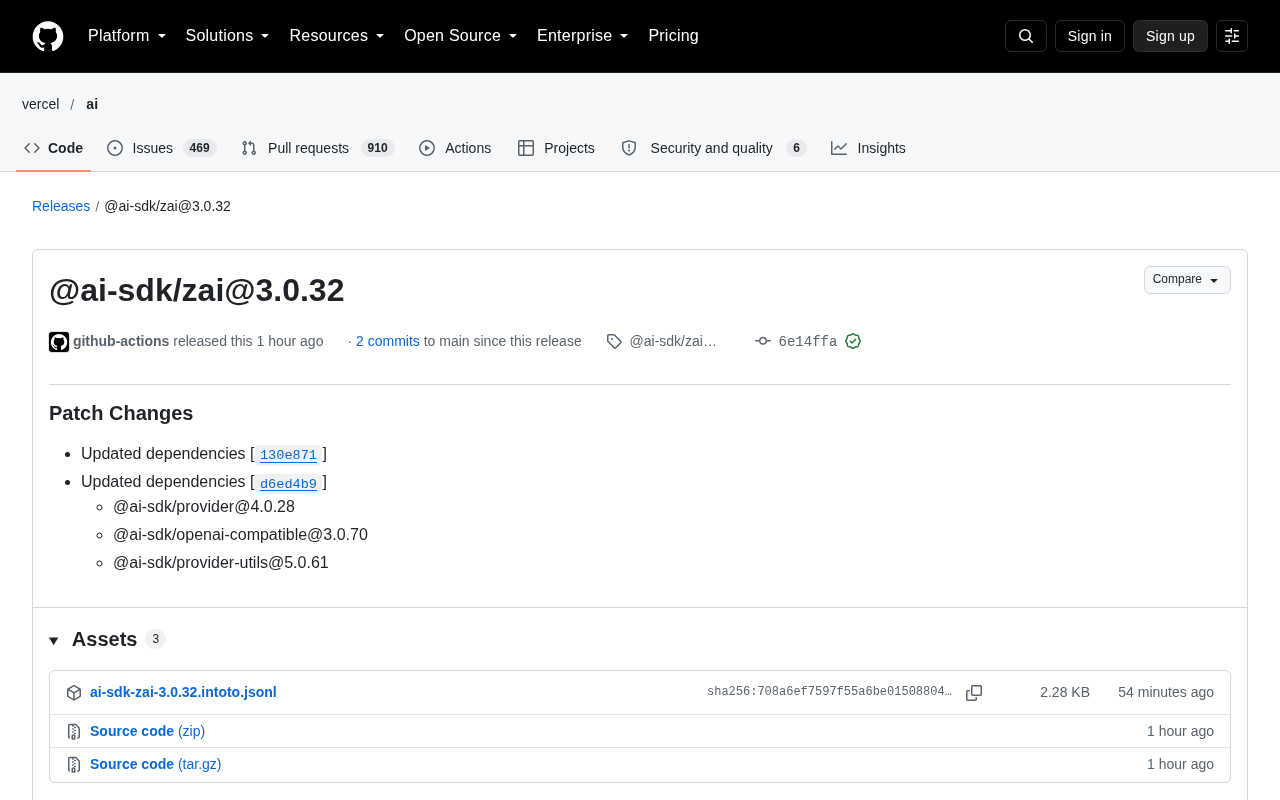
@ai-sdk/zai released patch version 3.0.32, containing only two commits but upgrading three core dependencies: @ai-sdk/provider, @ai-sdk/openai-compatible, and @ai-sdk/provider-utils. Patch version numbers mean no breaking changes but typically include bug fixes and type corrections. This release was automated via github-actions with GPG signing. The article recommends following up in production to gain upstream fixes and compatibility, while experimental environments can wait for a major version. It also notes that understanding the AI SDK dependency topology captures real changes better than watching any single package's release notes.
A Low-Key Patch Iteration
On GitHub, @ai-sdk/zai@3.0.32 has been quietly released. This is not a major feature update, but a typical Patch Changes release—containing only two commits, yet triggering synchronized upgrades of three core dependency packages. For developers deeply embedded in the Vercel AI SDK ecosystem, updates of this scale often determine the stability of project builds.
The Chain Reaction of Dependencies
The most noteworthy aspect of this update is the linked dependency versions:
@ai-sdk/providerupgraded to 4.0.28@ai-sdk/openai-compatibleupgraded to 3.0.70@ai-sdk/provider-utilsupgraded to 5.0.61
These three packages handle the AI SDK's abstract interfaces, OpenAI compatibility layer, and utility functions respectively. The patch version number changes mean there are no breaking changes, but they typically include bug fixes, type definition corrections, or edge case handling. For developers relying on @ai-sdk/zai to call Z.ai models, this update ensures that the underlying provider layer remains compatible with the latest toolchain.
Semantic Versioning is the key to understanding the scope of impact of this update. It specifies that version numbers consist of three segments: MAJOR.MINOR.PATCH. A MAJOR upgrade represents backward-incompatible breaking changes; a MINOR upgrade represents new features with backward compatibility; and a PATCH upgrade involves only backward-compatible bug fixes and internal improvements. Therefore, when @ai-sdk/provider goes from 4.0.x to 4.0.28, it means its public API contract has not changed in any way, though internal implementations or type definitions may have been quietly corrected. For developers relying on lockfile mechanisms, the semantic promise of such patches is that even if upgraded directly, they are almost impossible to cause compilation errors or sudden runtime behavior changes—making them low-risk changes.
Why These Updates Are Easily Overlooked
Many developers, after locking dependency versions in package.json, tend to only pay attention to patch updates when features break. But the AI SDK ecosystem is in a period of rapid iteration, and frequent patches to provider and provider-utils can accumulate to the point where they fix streaming response issues for certain edge-case models or token calculation deviations.
This release was automatically completed by the github-actions bot, with commits bearing GitHub verified signatures (GPG key ID: B5690EEEBB952194), indicating that the entire release process is fully automated. This pattern reduces human error and means that the update cadence is driven by upstream dependencies.
github-actions is a CI/CD automation service provided by GitHub. In such release workflows, a workflow is typically triggered automatically after code is merged into the main branch: it verifies tests pass, executes the build, calls npm publish or the changesets tool to increment the version number, and finally generates a Git tag with a machine signature. The GPG key ID shown in the image is GitHub Actions' built-in signing key, used to prove to the npm registry and consumers that the version was indeed produced by the official repository's automated pipeline, not manually forged. This pattern eliminates the risks of manual releases such as version number errors, forgotten tags, and release permission leaks, but it also requires developers to adapt to minimal release notes written by bots rather than humans.
Is It Worth Upgrading?
If you are using @ai-sdk/zai to build production applications, it is recommended to follow this update. There are three reasons: first, the version bumps of the three dependency packages typically resolve known issues already fixed upstream; second, patch versions carry extremely low risk and almost never introduce breaking changes; third, keeping the provider ecosystem versions consistent avoids hard-to-debug type mismatches at runtime.
For developers using it only in experimental environments, you can wait for the next feature release to upgrade all at once. But if you rely on Z.ai models to handle long context or complex reasoning tasks, updates to provider-utils may directly improve request stability.
The Right Way to Read Changelogs
The release page itself contains limited information—only commit hashes and dependency lists, with no detailed changelog descriptions. This is a typical characteristic of automated releases: the version number is the signal, and the real change details are hidden in the release notes of the upgraded dependencies themselves.
An efficient approach is to follow the update records of @ai-sdk/provider and @ai-sdk/openai-compatible, rather than just staring at the @ai-sdk/zai release page. In the AI SDK toolchain, upper-layer packages are often transmitters of changes from lower layers, and understanding the dependency topology is more valuable than reading the diff of a single package.
One-line Summary
@ai-sdk/zai 3.0.32 patch update, linked upgrade of three core dependencies, recommended for production environments.
Paragraph Summary
@ai-sdk/zai released patched version 3.0.32, containing only two commits but synchronously upgrading three core dependencies: @ai-sdk/provider, @ai-sdk/openai-compatible, and @ai-sdk/provider-utils. The patch version number means no breaking changes, but typically includes bug fixes, type corrections, and edge case handling. This release was automatically completed by github-actions with GPG signatures, making the process fully automated. The article recommends following up in production environments to gain upstream fixes and compatibility assurance, while experimental environments can wait for a major version. It also points out that understanding the AI SDK's dependency topology captures real changes better than watching any single package's release notes.
Related articles

A Single Prompt Triggers a Global PHP Security Storm: Is AI a Savior or a Hidden Risk?
A single AI prompt triggered a global PHP security crisis affecting Wikipedia and the Internet Archive. This article reviews the incident, analyzes the OpenAI-Amazon controversy, and explores the security paradox of lowered vulnerability discovery barriers in the AI era and developer response strategies.

When AI Is Taken Away: How Reliance on Shortcuts Undermines Your Problem-Solving Resilience
A study of 1,222 people found that after using AI to answer questions, once AI was removed, people gave up on more problems than a control group that never used AI. The article analyzes the impact of AI reliance on learning resilience and metacognition, and explores design implications for AI learning tools.

Carta and NewView Partner to Let Startup Employees Cash Out Equity Early
Carta and NewView Capital partner to simplify startup tender offers, helping employees sell equity early. Analysis of the mechanism, liquidity pain points, and impact.