@ai-sdk/zai 3.0.40 Released: Patch Update and Dependency Sync
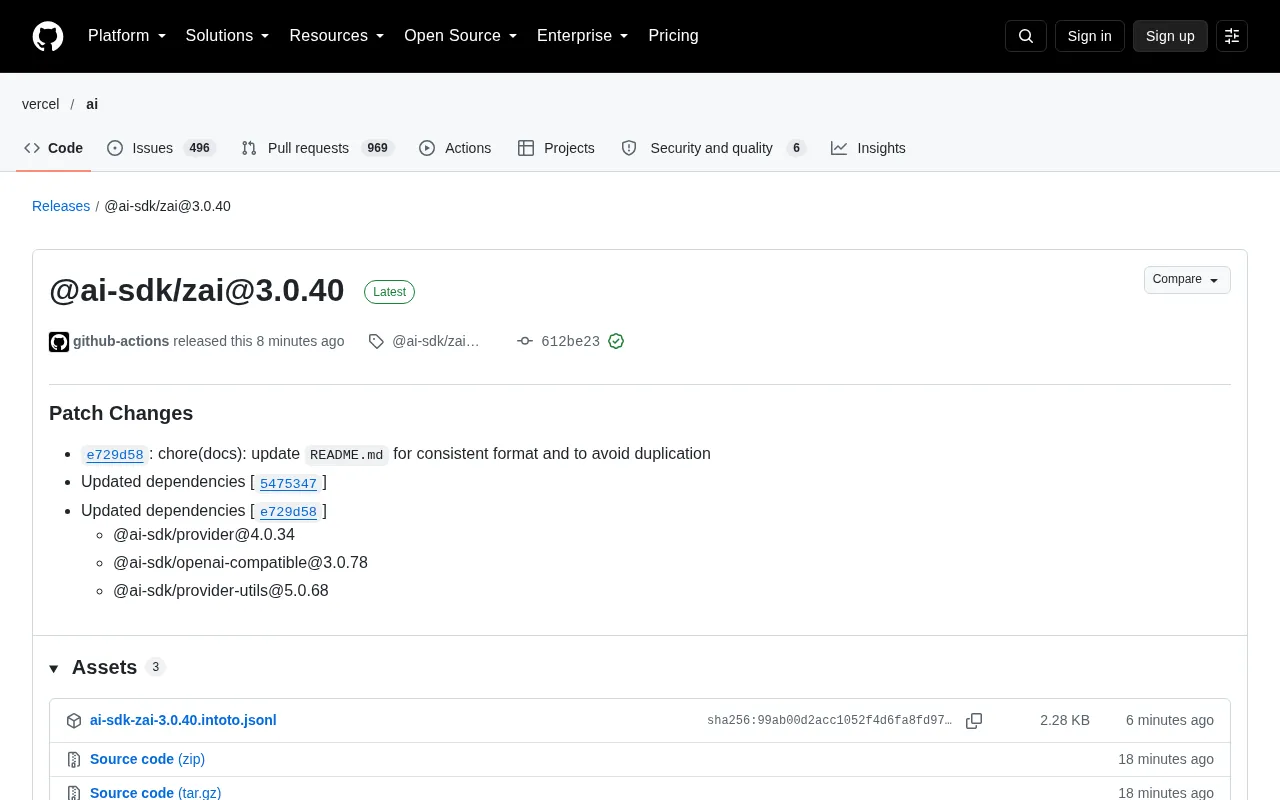
@ai-sdk/zai 3.0.40 released, organizing documentation and syncing three underlying dependencies to new versions.
@ai-sdk/zai released patch version 3.0.40, automatically triggered by GitHub Actions with GPG signature verification, making it a low-risk maintenance update. Changes include updating README.md to unify documentation formatting and eliminate duplicate content, and synchronously upgrading three underlying dependencies: @ai-sdk/provider to 4.0.34, @ai-sdk/openai-compatible to 3.0.78, and @ai-sdk/provider-utils to 5.0.68. The article notes that such patches, while introducing no new APIs, help maintain version consistency across the AI SDK ecosystem and prevent version drift between adapters and upstream abstraction layers. For developers directly depending on this package, upgrade risk is low under semantic versioning conventions, though running existing tests after upgrading to confirm consistent behavior is still recommended.
@ai-sdk/zai 3.0.40 Released: Patch Update and Dependency Sync
The Z.ai adapter package in the AI SDK ecosystem has received a minor version iteration. @ai-sdk/zai@3.0.40 has been automatically released via GitHub Actions and is a patch-level maintenance update. For developers relying on Vercel AI SDK to build multi-model applications, such updates, while not introducing new features, are important for dependency chain stability and documentation consistency.
Core Changes in This Update
According to the GitHub Release page, version 3.0.40 mainly includes two types of changes. The first is commit e729d58, a documentation maintenance change: updating README.md to unify formatting and avoid duplicate content. This kind of change does not touch runtime logic, but for developers using the package, clearer documentation means lower integration costs.
The second is dependency synchronization. This version synchronizes three underlying packages: @ai-sdk/provider upgraded to 4.0.34, @ai-sdk/openai-compatible upgraded to 3.0.78, and @ai-sdk/provider-utils upgraded to 5.0.68. These dependencies form the bridge between the Z.ai adapter and the AI SDK core, and keeping versions aligned helps avoid compatibility issues at the type definition or utility function level.
Division of Responsibilities Between @ai-sdk/provider and @ai-sdk/provider-utils
In the architecture of Vercel AI SDK, @ai-sdk/provider defines abstract contracts independent of specific model vendors, including interfaces such as LanguageModelV1, type definitions for messages and tool calls, and the standardized structure of streaming responses. As long as vendor adapters (such as @ai-sdk/zai) implement these interfaces, they can be uniformly orchestrated by the AI SDK core. @ai-sdk/provider-utils provides utility functions and infrastructure repeatedly used when implementing these interfaces, such as stream parsing helpers, JSON schema validation, error wrapping, and readable stream conversion. The versions of the two need to evolve in coordination: when provider changes interface shapes, provider-utils often provides matching tools at the same time, and adapters must follow up, otherwise type mismatches or runtime parsing failures may occur. This also explains why adapter releases usually upgrade these two packages together to specified versions.
The Significance of the openai-compatible Compatibility Layer
@ai-sdk/openai-compatible is a general adapter base provided by AI SDK for connecting to any model service that follows the OpenAI Chat Completions interface specification. Many model vendors (including some services such as Z.ai) expose APIs that are highly similar to OpenAI's request/response format, so there is no need to implement the provider interface from scratch; only a small amount of configuration and field mapping based on the openai-compatible layer is needed. The advantage is reusing mature request construction, streaming parsing, and tool call handling logic, reducing maintenance costs; the tradeoff is that behavior is affected by the implementation details of this compatibility layer. When openai-compatible releases a new version, vendor adapters that depend on it must be upgraded in sync to ensure consistency with upstream in areas such as parameter handling and streaming chunk parsing.
Why Patch Versions Are Worth Noticing
In fast-evolving toolchains like AI SDK, patch versions are often overlooked, but they play a role in maintaining ecosystem consistency. As the integration layer for Z.ai models, @ai-sdk/zai depends on the provider abstraction layer and the openai-compatible compatibility layer. When upstream packages release fixes or fine-tuning, downstream adapters following up in time can prevent potential version drift.
The commit in this release carries a GitHub verified signature (GPG key ID: B5690EEEBB952194), indicating that the release process has undergone automated verification. The release was triggered by the github-actions bot on October 24 at 18:01, reflecting the repository's standardization of continuous integration and continuous delivery.
Semantic Versioning and the Boundaries of Patch
The Semantic Versioning specification (SemVer) stipulates that version numbers take the form MAJOR.MINOR.PATCH: MAJOR changes indicate incompatible API modifications, MINOR indicates backward-compatible feature additions, and PATCH indicates backward-compatible bug fixes. Under this convention, 3.0.40 relative to previous versions in 3.0.x should not introduce breaking changes, so upgrade risk is low. It should be noted that SemVer's promise only covers the package's own public API; if a patch update also raises dependency versions (such as provider-utils 5.0.68 in this case), and the dependency itself has behavior fine-tuning, it may theoretically still indirectly affect runtime behavior. This is why even for patch upgrades, running tests in critical projects is still a prudent practice.
GPG Signature Verification and the Automated Release Pipeline
The GPG key ID shown on the Release page indicates that the commit has been signed. Recipients can use the corresponding public key to verify that the commit was indeed created by the party holding the private key and that the content has not been tampered with after signing. In the npm ecosystem, such signatures are often combined with provenance attestation to prove that a package version was indeed built by a specified CI pipeline from a specific repository and commit, rather than manually uploaded locally. For releases like @ai-sdk/zai triggered by the github-actions bot, signatures and automated processes together form the foundation of supply chain trust: developers can trace the source code commit corresponding to a version, reducing the risk of dependencies being replaced or poisoned.
Practical Impact on Developers
If your project directly depends on @ai-sdk/zai, upgrading to 3.0.40 is a low-risk operation. Since it is a patch version, under semantic versioning conventions it should not contain breaking changes. However, it is still recommended to run existing tests after upgrading to confirm consistency with the behavior of @ai-sdk/provider-utils 5.0.68.
For teams calling multiple models through the unified AI SDK interface, such dependency synchronization updates can reduce debugging costs caused by "version mismatch between different adapters under the same SDK." Keeping the Z.ai adapter in sync with the openai-compatible layer also means that when switching to models compatible with the OpenAI interface, behavior expectations are more controllable.
Summary
@ai-sdk/zai 3.0.40 is a typical maintenance release: documentation cleanup plus dependency alignment. It does not bring new APIs, but reflects the discipline of the AI SDK ecosystem in version management. Paying attention to such changes helps keep projects stable in the rapidly changing model integration layer.
One-line Summary
@ai-sdk/zai 3.0.40 released, organizing documentation and synchronizing three underlying dependencies to new versions.
Paragraph Summary
@ai-sdk/zai released patch version 3.0.40, automatically triggered by GitHub Actions and verified with GPG signatures, making it a low-risk maintenance update. This change includes two parts: first, updating README.md to unify documentation formatting and eliminate duplicate content; second, synchronously upgrading three underlying dependencies, with @ai-sdk/provider raised to 4.0.34, @ai-sdk/openai-compatible to 3.0.78, and @ai-sdk/provider-utils to 5.0.68. The article points out that while such patches introduce no new APIs, they play a role in maintaining version consistency across the AI SDK ecosystem and can prevent version drift between adapters and upstream abstraction layers. For developers directly depending on this package, upgrade risk is low under semantic versioning conventions, but running existing tests after upgrading to confirm consistent behavior is still recommended.
Related articles
Ollama+RAG Local Knowledge Base Setup: A Step-by-Step AnythingLLM Tutorial
Based on a Bilibili tutorial, this guide details building a local RAG knowledge base with Ollama + AnythingLLM: from general LLM knowledge limits and RAG principles to document upload, vector storage, and verification.
The Ultimate Ollama Tutorial: A Beginner's Guide to Running Large Models Locally for Free
Ollama is an open-source local large model management tool supporting free download and deployment of models like DeepSeek, with command-line and Web UI, cross-platform, automatic GPU/CPU scheduling — ideal for AI beginners and private deployment.
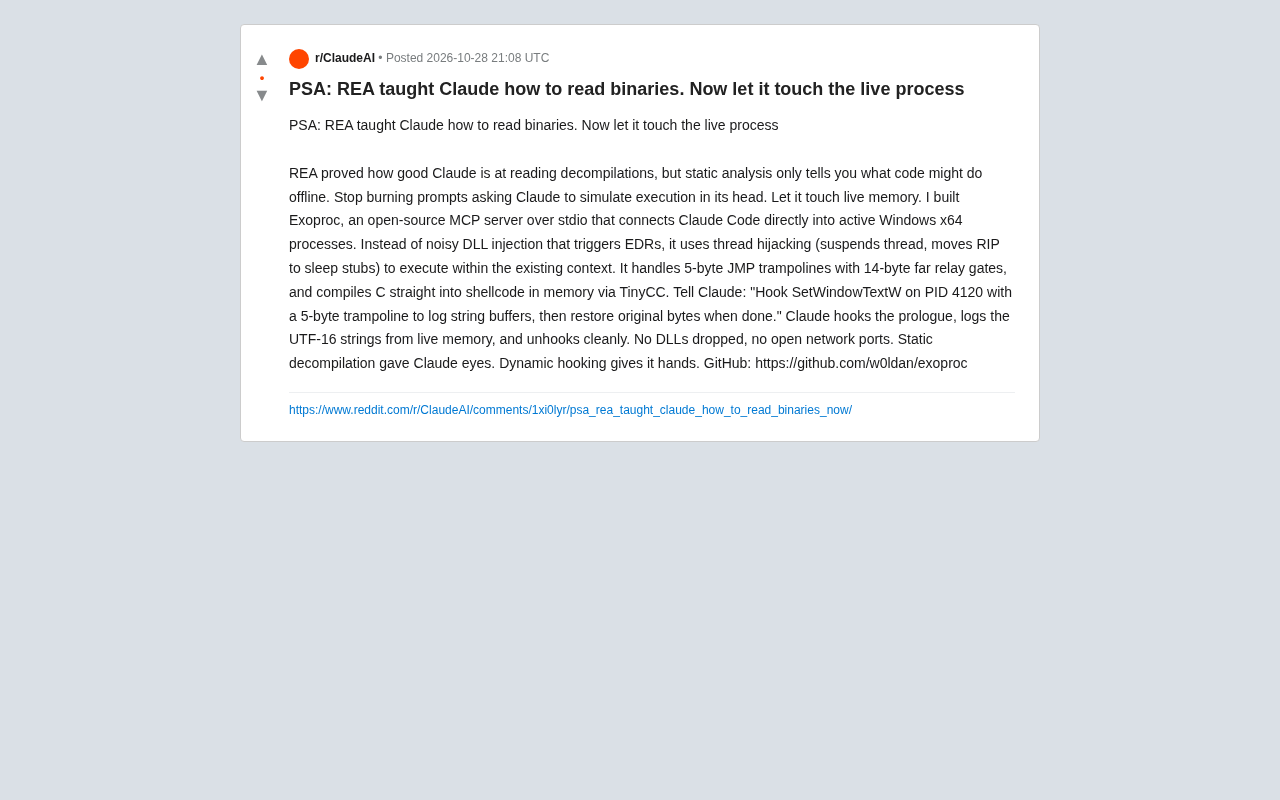
Giving Claude "Hands": Exoproc Open-Source MCP Server Enables Live Process Hooking
Exoproc is an open-source MCP server enabling Claude Code to hook live Windows x64 processes via thread hijacking, bypassing EDR for dynamic analysis. Static decompilation gave Claude eyes; dynamic hooking gives it hands.