AI SDK Zai Adapter 1.0.13 Release Update Analysis

@ai-sdk/zai releases 1.0.13 patch syncing underlying dependency versions with no breaking changes.
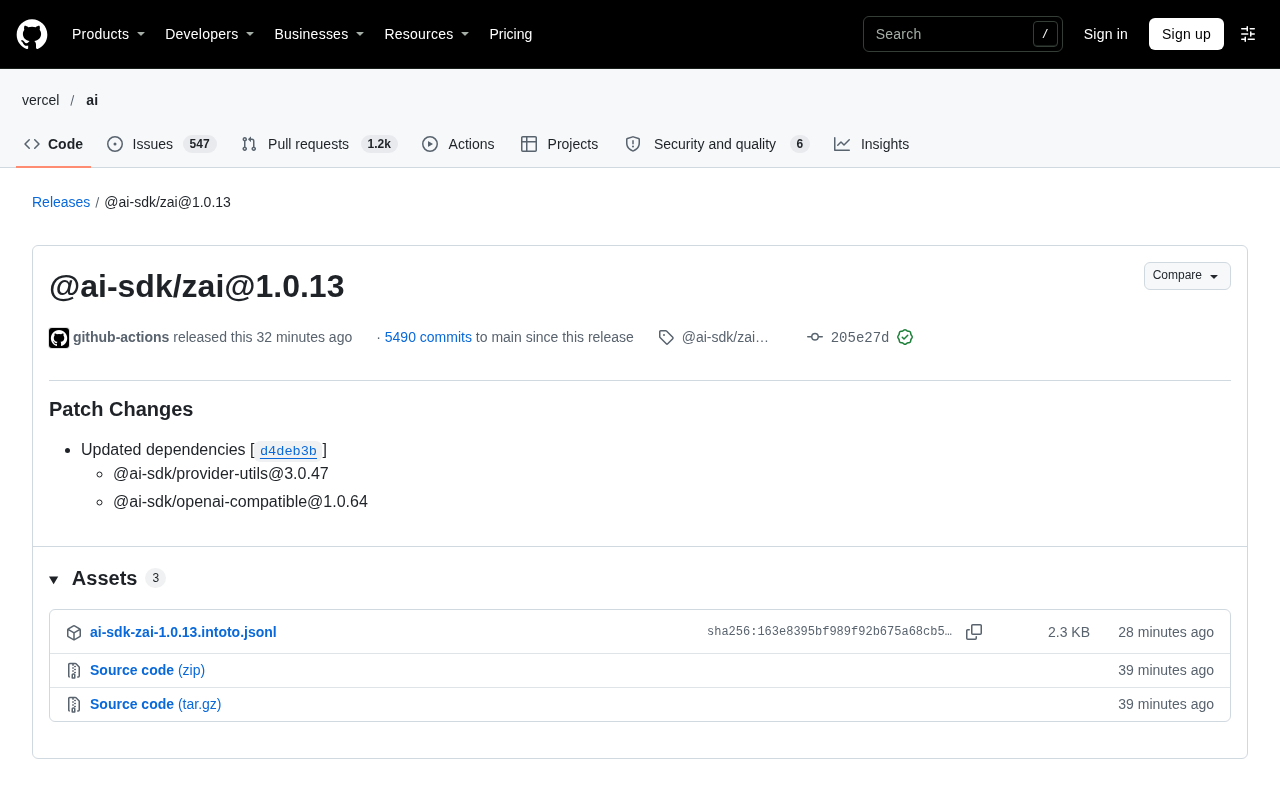
@ai-sdk/zai 1.0.13 is a patch version whose core change upgrades dependencies @ai-sdk/provider-utils to 3.0.47 and @ai-sdk/openai-compatible to 1.0.64. Released automatically by github-actions with commit hash 205e27d and a GitHub verified signature. The adapter is built on the openai-compatible layer, reusing the OpenAI-compatible protocol to connect to Zai model services. This update is part of the AI SDK monorepo's regular maintenance rhythm, aimed at keeping underlying utility functions and the compatibility layer consistent, with no new features or breaking changes. Developers need not modify business code when upgrading, but if the project directly references these two underlying packages, ensure version alignment to avoid type inconsistencies from multiple versions coexisting.
The @ai-sdk/zai adapter package for Zai models in the AI SDK ecosystem has released version 1.0.13. As a patch update, this release introduces no new features and instead focuses on maintaining version consistency of underlying dependencies, ensuring developers get stable interface compatibility when using Zai models.
Core Content of the Patch Update
According to the GitHub release notes, @ai-sdk/zai@1.0.13 is a Patch Changes type, with the main action being updating two dependencies: @ai-sdk/provider-utils to 3.0.47 and @ai-sdk/openai-compatible to 1.0.64. These two packages serve as the foundational utilities for provider functions and the OpenAI-compatible layer in the AI SDK respectively; their version synchronization typically means upstream fixes or minor adjustments have been propagated to the Zai adapter.
The release was automatically completed by github-actions, with commit hash 205e27d, and carries a GitHub verified signature. Looking at the commit history, this release has accumulated 5,490 commits since the last release on the main branch, indicating that the AI SDK main repository is in a high-frequency iteration state, and adapter packages need to keep pace with the main repository's rhythm.
AI SDK's monorepo architecture: AI SDK is maintained by Vercel and uses a monorepo to manage dozens of independently released provider adapters (such as @ai-sdk/openai, @ai-sdk/anthropic, @ai-sdk/zai, etc.). These adapters share a set of underlying utility packages, where @ai-sdk/provider-utils provides common capabilities like stream processing, header parsing, and error mapping, while @ai-sdk/openai-compatible abstracts OpenAI's request/response format into a reusable compatibility layer. The monorepo allows underlying fixes to propagate to all adapters at once, but it also means that minor version changes in underlying packages trigger patch releases across many adapters—this is exactly the context behind releases like 1.0.13.
Practical Impact on Developers
For developers using @ai-sdk/zai directly, such patch updates generally require no changes to business code. The dependency version bumps are more about maintaining consistency in underlying behavior, such as boundary handling of utility functions in provider-utils or compatibility adjustments to request formats in the openai-compatible layer. In projects with strict dependency locking, it's recommended to run integration tests after upgrading to confirm that the Zai model invocation chain has not been indirectly affected.
From the overall architecture of AI SDK, the Zai adapter is built on top of the openai-compatible package, meaning it reuses the OpenAI-compatible protocol to connect to Zai's model services. This layered design keeps the adapter thin and lightweight, but also requires that updates to the openai-compatible layer be propagated in a timely manner. The release of 1.0.13 is a manifestation of this mechanism.
Semantic Versioning (SemVer) and patch numbers: SemVer specifies that in the version number MAJOR.MINOR.PATCH, an increment in the patch position only indicates backward-compatible bug fixes or internal adjustments. Therefore, going from 1.0.12 to 1.0.13 theoretically introduces no incompatible changes. However, note that SemVer's compatibility promise only applies to the package's own public API; dependency upgrades may indirectly change runtime behavior (for example, boundary condition changes in a utility function within provider-utils). This is why the original text recommends running integration tests in projects with strict dependency locking—the "safety" of patch-level upgrades is at the contract level, not an absolute guarantee at the behavioral level.
Observations on Version Maintenance Rhythm
AI SDK uses a monorepo to manage a large number of provider adapters, each released independently but sharing underlying utility packages. In this model, minor version changes in provider-utils and openai-compatible trigger patch releases across multiple adapters. @ai-sdk/zai's 1.0.13 is part of the regular maintenance rhythm, with no breaking change notes and no new APIs or configuration options.
For teams following the AI SDK ecosystem, such release records can serve as a reference for judging dependency health: if an adapter does not follow underlying package updates for an extended period, it may indicate stalled maintenance; whereas patches like 1.0.13 that promptly track dependencies indicate active maintenance.
Layered design of AI SDK adapters: A typical AI SDK provider adapter is divided into three layers: the top layer is the developer-facing model interface (such as zai('model-id')), the middle layer is the provider implementation (responsible for constructing requests and parsing streaming responses), and the bottom layer is the shared utility packages. The Zai adapter chooses to reuse the openai-compatible layer rather than implementing the protocol from scratch because Zai's server-side interface is highly similar to the OpenAI Chat Completions format. This "thin adapter" strategy reduces maintenance costs, but also means that the adapter's behavior partially depends on implementation details of the openai-compatible layer, and underlying updates need to be tracked promptly to maintain behavioral consistency.
Upgrade Recommendations
If the project uses pnpm or npm to manage dependencies, simply perform the regular version upgrade. Since it's a patch version, SemVer rules guarantee no incompatible changes. Note that @ai-sdk/provider-utils 3.0.47 and @ai-sdk/openai-compatible 1.0.64 are the direct dependencies of this update; if the project also directly references these two packages, ensure version alignment to avoid type inconsistencies caused by multiple versions coexisting.
Overall, @ai-sdk/zai@1.0.13 is a routine dependency synchronization release, suitable for inclusion in projects as a regular maintenance upgrade.
Related articles

Nothing CMF Buds 2A Drops to $17.89 on Black Friday: A New Low for ANC Earbuds
Nothing CMF Buds 2A wireless earbuds Black Friday deal: just $17.89 on Amazon, about $11 off retail and a record low. ANC earbuds at an entry-level price.

When AI Creation Gets Accused of "Spitting": Hacker News Heats Up Over the Glaude Controversy
A Hacker News post, "Spitting in the Face of Glaude," sparks debate on AI creation transparency and attribution ethics. This analysis examines the blurred creator identity behind the controversy and offers practical advice for AI content production.

Akai Embraces Custom Firmware: MPC Sample 1.4 Lets Users AI-Program Their Sampler
Akai embraces the modding community with MPC Sample 1.4 firmware, supporting vibe-coded custom firmware and effects. We analyze the impact of this open strategy on music hardware and AI-assisted programming.