AI Self-Acceleration Already at 4.5x? METR Researcher Revises Forecast, ASI Timeline Moves Up Sharply

METR researcher Greenblatt revises his forecast, estimating RSI acceleration of AI software R&D at about 4.5x, roughly 5 months ahead of the AI 2027 scenario.
METR researcher Ryan Greenblatt publicly revised his forecast for the speed of AI recursive self-improvement (RSI). Based on an AI R&D automation report, he estimates current RSI acceleration of AI software R&D at about 4.5x, roughly 5 months ahead of the corresponding point in the "AI 2027" scenario. The reasoning: overall AI progress is about 2x faster, about two-thirds of which comes from software, implying roughly a 3x speedup in software progress; factoring in diminishing returns (software R&D speed roughly halves each year) and 0.35 to 1.0 years of additional software progress already incorporated into models yields 3×2^0.6≈4.5x. He previously expected only 1.15x to 1.3x acceleration by 2026, a huge revision, and admits he was "badly wrong." Because much evidence in the public report is redacted, key conclusions rely heavily on trust in the authors, and he calls for greater transparency. Greenblatt calls this a major update toward ASI within 1-2 years but gives no definite timetable, and whether RSI can persist remains unknown.
Introduction: An Update That Surprised the Forecaster Himself
METR researcher Ryan Greenblatt recently publicly revised his forecast for the speed of AI recursive self-improvement (RSI) on social media. Based on a recent report on AI R&D automation, he estimates that AI is currently accelerating AI software R&D at roughly 4.5x — about 5 months earlier than the corresponding point (around March 2027) in the widely discussed "AI 2027" scenario. Greenblatt admitted: "I was badly wrong about RSI acceleration... this is a major update toward ASI (artificial superintelligence) within 1-2 years."
This statement is noteworthy not only because of Greenblatt's research background, but also because it reveals a shift that is already underway: the acceleration effect of AI on AI R&D may be arriving earlier and stronger than mainstream expectations.
From 2x to 4.5x: The Logic Behind the Numbers
Greenblatt's analysis starts from a core observation in the public report: current AI progress is about 2x faster because of RSI. But this overall 2x acceleration does not mean that AI software R&D itself has accelerated only 2x. He offers two key inferential reasons.
First, not all AI progress comes from software. Greenblatt previously estimated that about two-thirds of AI progress comes from software improvements, with the rest from scaling training compute. Therefore, an overall 2x acceleration corresponds to roughly a 3x speedup in software progress.
Second, the law of diminishing returns. The same amount of progress requires more work over time. To sustain a 3x faster rate of software progress, the speedup from AI automation must become larger and larger. Based on his earlier modeling, Greenblatt estimates that, with fixed input, the speed of software R&D roughly halves for every year of software progress. According to this report, the additional software progress already incorporated into trained models is roughly between 0.35 and 1.0 years (geometric mean about 0.6 years). Combining these two factors: 3 × 2^0.6 ≈ 4.5, meaning current RSI accelerates AI software progress by about 4.5x.
This estimate is not a precise measurement, but a rough extrapolation based on public modeling. Greenblatt himself emphasizes that, because much of the underlying evidence in the report is redacted, conclusions such as "whether this acceleration really comes from RSI" depend heavily on trusting the report's authors.
RSI (recursive self-improvement) refers to the ability of AI systems to improve their own algorithms, architectures, or training processes, thereby becoming stronger in the next iteration and forming a self-reinforcing loop. This concept attracts much attention in AI safety and capability evaluation because it implies that the pace of progress may no longer be limited by the output of human researchers. The acceleration multiple Greenblatt discusses is essentially quantifying the strength of this feedback loop: AI software R&D speeds up due to automation, and the accelerated R&D in turn produces stronger AI, and so on. Understanding this mechanism helps grasp the distinction in the text between "overall acceleration" and "acceleration of the software portion" — the former is a macro observation, while the latter is where RSI directly operates.
Diminishing returns is a key assumption that appears repeatedly in Greenblatt's derivation. It means that as the easy improvements are gradually tackled, achieving the same additional progress requires more R&D resources. In AI, this means that even if software R&D becomes faster due to automation, sustaining the same rate of progress will become increasingly laborious; therefore, the instantaneous acceleration multiple brought by RSI must be significantly higher than the apparent acceleration multiple in order to offset the diminishing effect. The statement in the text that "the speed halves for every year of software progress" is a concrete form of this assumption and the mathematical bridge from 3x to 4.5x.
The Forecaster's Self-Correction: From 1.15x to 4.5x
Greenblatt's revision is substantial. He previously expected that by 2026 the acceleration from RSI would be roughly between 1.15x and 1.3x. His current estimate — 4.5x — far exceeds that range.
He attributes this to "specific non-public evidence": evidence that could have changed his judgment but did not appear in the public report. He makes clear that he has not seen the full unredacted version, and that all his analysis is based solely on the public report. This also leads to his call for transparency: less redaction would greatly reduce reliance on external trust.
Interestingly, Greenblatt is affiliated with METR, and he proactively discloses this in his tweet. At the same time, because his current role may involve access to other confidential information, he cautiously states that he cannot give his "all-things-considered" judgment on the ASI timeline or the probability of a software intelligence explosion, and can only analyze based on previous public statements.
What It Means for the ASI Timeline
The "AI 2027" scenario predicted that a similar acceleration from RSI would occur around March 2027. Greenblatt's new estimate moves this point earlier by about 5 months — if his extrapolation holds, we may already be in the acceleration phase described by that scenario.
He says plainly that this is "a major update toward ASI within 1-2 years." However, this does not mean ASI will necessarily arrive within two years. Greenblatt's wording leaves room: he is analyzing the implications of the current acceleration rate, not giving a definite timetable. Whether RSI can persist, whether acceleration will encounter bottlenecks, and how many steps remain between accelerated software R&D and an overall intelligence explosion are all unresolved questions.
From a broader perspective, the significance of this revision lies in this: it comes from a researcher who previously held a conservative view on RSI acceleration, and the direction of the revision is "faster." When forecasters substantially adjust their expectations because of new evidence, it is often more worthy of attention than consistently optimistic forecasts.
ASI (artificial superintelligence) generally refers to an AI system that vastly surpasses the best humans in almost all cognitive tasks, with capabilities and depth significantly beyond current large language models. Compared with "AGI (artificial general intelligence)," ASI emphasizes "surpassing humans" rather than merely "matching humans." Greenblatt's "ASI within 1-2 years" is a fairly aggressive forecast, because in mainstream discussion ASI is often viewed as a decades-scale goal. The logic linking RSI acceleration to the ASI timeline is that if AI can efficiently improve its own software, the number of iterations needed from current capabilities to superintelligence may be greatly compressed. But this chain has multiple unverified links, including whether RSI can persist, whether hardware and data bottlenecks impose hard constraints, and whether software progress can translate linearly into a leap in overall capability.
Trust and Transparency: The Redacted Evidence Chain
One keyword appears repeatedly in Greenblatt's tweet: trust. Much of the underlying evidence in the public report is redacted, so external readers cannot independently verify key conclusions. He points out that judgments about "whether the acceleration stems from RSI" depend on trust in the report's authors — and he personally trusts these authors to be "careful, rigorous, and overall doing a very good job."
This exposes a structural difficulty in current AI capability evaluation: the most critical evidence is often held by a small number of institutions, the public version is heavily cut, and external researchers can only make judgments based on incomplete information. Greenblatt's call to reduce redaction is precisely to base timeline analysis on verifiable evidence rather than trust. For practitioners and observers following AI progress, this means that when interpreting any public conclusion about RSI, it is necessary to distinguish between "observed phenomena" (such as faster progress on benchmarks) and "explanations of the phenomena" (such as whether this is driven by RSI).
Redaction in this context refers to the removal of sensitive information from public reports before publication, usually involving specific experimental data, internal evaluation methods, or details that could pose security risks. This practice is common in AI capability evaluation, aimed at preventing misuse of information or disclosure of trade secrets, but the cost is that external researchers cannot reproduce or independently verify key conclusions. Greenblatt's dilemma stems precisely from this: he needs to judge "whether the acceleration is driven by RSI," yet the underlying evidence supporting that judgment is redacted, so the conclusion can only be based on "trusting the report's authors." This is not only a transparency issue but also involves a core tension in AI governance — the balance between security secrecy and verifiability. Reducing redaction and providing verifiable intermediate indicators are possible ways to ease this tension.
Conclusion: A Consensus Being Rewritten
Greenblatt's public revision adds new weight to the discussion of AI self-acceleration. The number 4.5x is itself a rough estimate, depending on modeling assumptions and trust in undisclosed evidence, but the signal it sends is clear: the acceleration effect of AI on its own R&D may be emerging faster than most people expect. For discussions of the ASI timeline, this is undoubtedly an update that must be taken seriously — as Greenblatt said, he was "badly wrong," and the direction of the revision points to a faster future.
Related articles
 Tech Frontiers
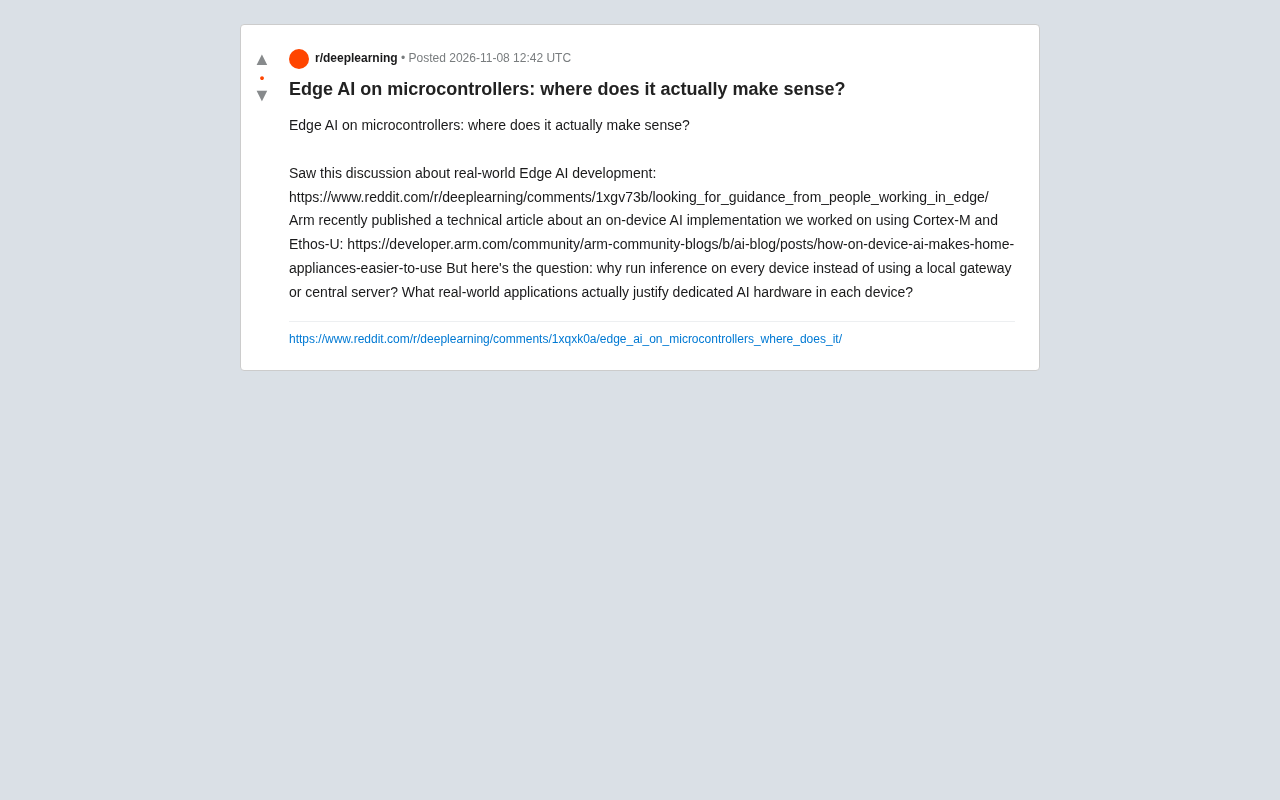
Edge AI on Microcontrollers: When Is It Actually Worth Deploying?
Drawing on Reddit discussions and Arm case studies, this article analyzes the real-world use cases for edge AI on microcontrollers: when each device needs independent inference, when a gateway or cloud is more reasonable, and the costs and boundaries of specialized hardware.
 Tech Frontiers
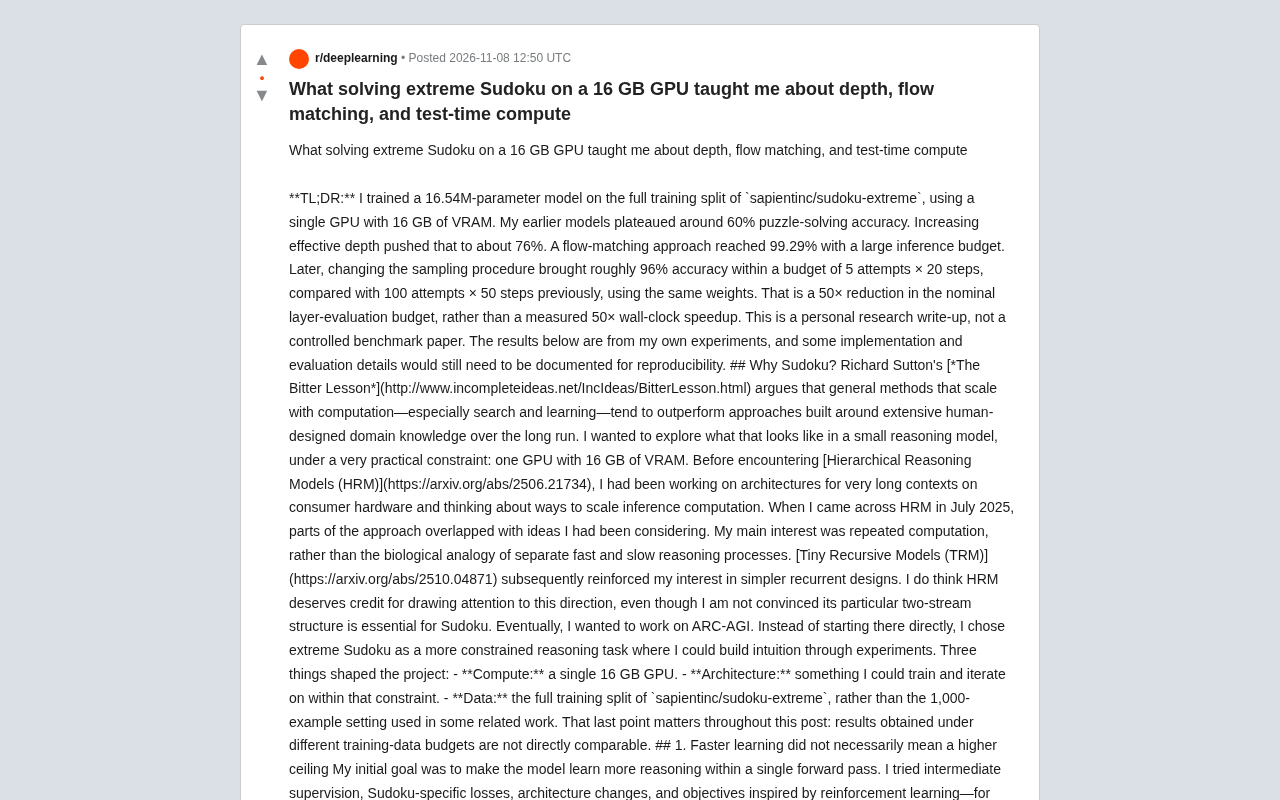
Pushing the Limits of Extreme Sudoku on a 16GB GPU: Insights from Depth and Flow Matching
A researcher trained a 16.54M-parameter model on a 16GB GPU to solve extreme Sudoku, finding effective depth breaks the 60% plateau and flow matching with improved sampling pushes accuracy past 99% with ~50× lower layer-evaluation budget.
 Tech Frontiers
AI Agent Approval Workflows: Why Human Confirmations Always Get Mindlessly Clicked
Why do AI agent approval workflows always get mindlessly clicked? A Reddit discussion shows that separating rules from keys, low-frequency high-risk approvals, and GitHub Environments-style gates are the keys to effective approvals.