AI Short Drama Production Tutorial: Complete Workflow from Script Writing to Storyboard Generation

AI short drama success depends on scripts over visuals, requiring a full methodology from track selection to storyboard adjustment.
This article systematically breaks down the complete methodology for AI short drama production. The core thesis is that script quality matters far more than visual polish—short dramas are essentially 'industrialized emotion written for algorithms.' The full pipeline includes: choosing the right platform and track, designing emotional hooks with viral structures (3-second explosion + high information density + suspense twist), writing AI-friendly scripts (minimal characters/scenes, externalized emotions), using LLMs to generate and refine storyboard scripts, and dynamically adjusting based on AI generation tool capabilities rather than mechanically copying AI output.
AI short dramas are becoming one of the hottest tracks in content creation. Many people have heard stories of "making 100K per month with AI short dramas" but can never find their way in. The problem usually isn't the track itself—it's that 90% of beginners make mistakes from the very start: scripts that don't match platform viral logic, rough visuals that can't retain viewers, or choosing the wrong monetization path and wasting effort.
This article breaks down the complete methodology from script creation to storyboard production based on a comprehensive AI short drama production tutorial, helping you avoid pitfalls and get started quickly.
Core Insight for AI Short Dramas: Visuals Aren't Priority—Scripts Are
Many beginners have a fundamental misconception about AI short dramas—they think visual quality is the top priority. The truth is quite the opposite. AI short dramas have very low requirements for visual polish. Even live-action short dramas barely have any special effects, let alone AI-generated content.
What truly determines the success or failure of an AI short drama is the script.
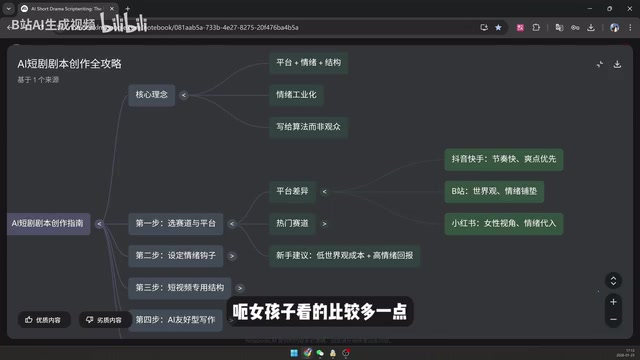
The core philosophy of AI short drama script writing can be summarized in three keywords: Platform + Emotion + Structure. At a deeper level, this is an "industrialization of emotion"—the scripts we write are essentially written for algorithms, not directly for audiences.
To understand this, you need to grasp the underlying logic of the short drama market. Short dramas (typically 1-5 minutes per episode, with total episode counts ranging from dozens to over a hundred, in vertical format) experienced explosive growth in 2023-2024, with China's short drama market exceeding tens of billions of yuan. The core driving force is platform recommendation algorithms—platforms like Douyin and Kuaishou judge content quality through metrics like completion rate, engagement rate, and share rate. Content with high emotional density naturally gains more algorithmic favor. This means short drama creators are essentially "conversing" with recommendation algorithms, rather than directly communicating with audiences as in traditional film and TV. Understanding this is the prerequisite for grasping why "scripts are written for algorithms."
The short drama market has already developed a mature system—what content attracts people, what pacing retains viewers—it's all traceable. Put bluntly, you need "dopamine hits"; put professionally, you need to design systematically following the steps below.
Step 1: Choose the Right Track and Platform, Identify Your Target Audience
Different platforms have vastly different user preferences, which directly determines your AI short drama content strategy:
- Douyin/Kuaishou: Fast-paced, dopamine-first; users have extremely low patience and you need to grab attention within the first few seconds
- Bilibili: Higher content quality requirements, which is why you rarely see short dramas or Hongguo ad placements on Bilibili
- Xiaohongshu (RED): High proportion of female users; short dramas often take a female perspective, with "pampered princess" themes being especially popular
In terms of hot tracks, sweet romance revenge, rebirth, urban power fantasy, and Chinese-style fantasy are all market-validated directions. Chinese-style fantasy is particularly suitable for AI production—live-action fantasy requires massive special effects with high costs that contradict short dramas' "quick and snappy" nature, while AI generation solves this problem perfectly.
For beginners, it's recommended to choose the "low world-building cost, high emotional payoff" model. Stories like "Battle Through the Heavens" that need hundreds of episodes to build a world aren't suitable for short dramas. The short drama logic is: the world collapses right away, instant rebirth, skip the setup and go straight to the dopamine hit.
While determining your track, you also need to think through your monetization path in advance. Mainstream monetization methods for AI short dramas include: platform revenue sharing (like Douyin's traffic-based payouts, Hongguo's pay-to-unlock model), ad placement, mini-program traffic conversion to paid content, and IP licensing. Mini-program short drama platforms like Hongguo use a "free first episodes + paid unlock for later episodes" model, where a single hit drama can generate revenue of millions or even tens of millions of yuan. For AI short drama creators, production costs are far lower than live-action (no actors, locations, or equipment needed), offering larger profit margins, but competition is intensifying—content quality and update speed become key competitive moats. Choosing the wrong monetization path may result in quality content failing to convert into revenue, which is another common pitfall for beginners.
Step 2: Set Emotional Hooks and Build a Viral Short Drama Structure
The reason short dramas can attract massive audiences despite not being high quality is essentially because viewers are "listening to a novel story"—visuals are just supplementary to the story. The key is to maximize emotional intensity.
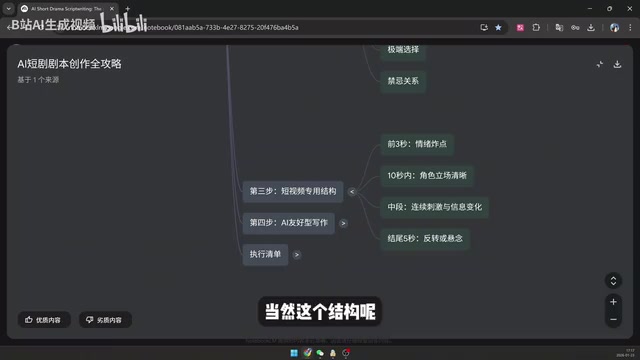
A standard AI short drama structure template looks like this:
| Position | Function | Description |
|---|---|---|
| First 3 seconds | Emotional explosion | Quickly present core conflict, instantly hook the viewer |
| First half | Character positioning | Let viewers quickly identify who's the protagonist and who's the antagonist |
| Middle section | Information density | Dense plot changes, maintaining viewer tension |
| Last 5 seconds | Suspense twist | Leave a hook to drive viewers to watch the next episode |
This structure works because it aligns perfectly with platform algorithm evaluation logic. The emotional explosion in the first 3 seconds directly determines whether users continue watching (affecting the 3-second completion rate, a core metric). The high information density in the middle section ensures overall completion rate, while the suspense twist at the end drives users to click the next episode or follow the account, boosting engagement and follower conversion rates. In essence, this structure template is a form of "reverse engineering" the algorithm's recommendation logic.
Classic ending techniques like "a last-second reprieve" or a mysterious figure suddenly appearing are all designed to create suspense for the next episode. This structure serves as a "dedicated template" for beginners; once you're proficient, you can dynamically adjust based on your subject matter.
Step 3: AI-Friendly Script Writing—Making Scripts AI Can "Film"
This is a crucial step that many AI short drama tutorials overlook. Not all scripts are suitable for AI visual generation—we need to consider the capability boundaries of AI video generation tools during the writing phase.
To understand these limitations, you first need to understand the current state of AI video generation technology. Mainstream AI video generation tools (such as Jimeng, Kling, Runway, Pika, etc.) are based on Diffusion Models or Transformer architectures, capable of generating short video clips from text prompts or reference images. However, these tools have significant technical bottlenecks: face consistency in multi-person scenes is hard to guarantee, complex camera movements (like long tracking shots) easily produce visual distortion, and control over characters' micro-expressions and fine body movements remains immature. Additionally, single-generation video duration is typically 4-10 seconds, which directly affects storyboard design granularity. Understanding these limitations allows you to avoid unrealizable visual designs at the script stage.
Minimize Scenes and Character Count
If the plot involves 5 characters appearing in one scene simultaneously, AI generation will very likely produce facial distortions—unless it's close-up or medium shot. Once you cut to a wide shot, multiple faces will have serious issues. It's recommended to keep main characters to 2-3 people.
Externalize Emotions with Visual Expression
In live-action, actors can convey inner thoughts through micro-expressions and eye contact, but AI struggles with such subtle internalized emotions. Therefore, emotions must be "externalized"—using intense facial expressions and exaggerated actions to replace subtle psychological hints.
Keep Dialogue Short and Punchy, Avoid Abstract Descriptions
Avoid long dialogues and abstract psychological descriptions. Overly abstract content cannot be accurately translated into corresponding visuals through prompts. Every line of dialogue should correspond to a specific visual image.
Step 4: Use LLMs Like Doubao to Generate AI Short Drama Scripts
Scripts are text-based creation, so you need to use large language models (like Doubao, ChatGPT, DeepSeekAd, Tongyi Qianwen, etc.), not image generation models like Jimeng or Kling.
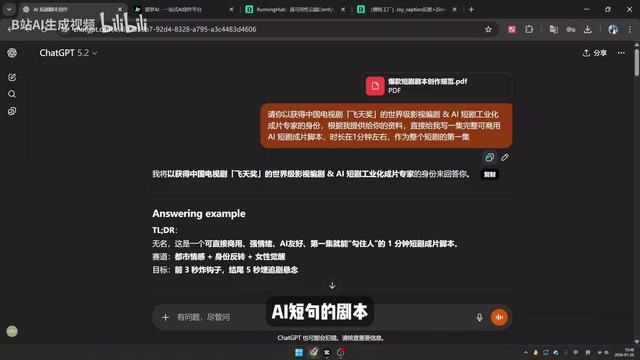
The specific workflow breaks down into the following steps:
Provide Viral Script Writing Guidelines
First, provide the AI with "viral short drama script writing guidelines" as reference material, so it understands what kind of scripts meet the requirements. These guidelines contain all the detailed requirements covered earlier—structure templates, emotional hook design, and AI-friendly writing principles.
Set a Professional Screenwriter Identity
Give the AI a powerful identity setting, for example: "Please act as a world-class film and TV screenwriter who has won China's Flying Apsaras Award, and an expert in AI short drama industrialized production..." The more specific the identity, the better—this significantly improves output quality.
This involves an important technical concept in LLM applications—Prompt Engineering. Prompt engineering refers to the methodology of guiding large language models to output high-quality content through carefully designed input instructions. In script creation scenarios, key techniques include: role-playing setup (having the model play a professional screenwriter to activate relevant knowledge), few-shot learning (providing excellent script examples as references), structured constraints (explicitly requiring output formats like storyboard tables), and chain-of-thought (having the model first conceive an outline then gradually refine it, rather than producing everything in one step). Performance differences between models are also worth noting—Doubao and Tongyi Qianwen have stronger cultural understanding in Chinese contexts, ChatGPT often shows more creativity in narrative structure design, and DeepSeek has advantages in cost-effectiveness. Choosing the appropriate model based on your needs, or cross-using multiple models to leverage their respective strengths, are both viable strategies.
Generate the First Draft Script
Using the tutorial's case as an example, the AI generated a complete rebirth-revenge themed script:
- Female lead: Lin Wan, 26 years old, ordinary office worker
- Male lead/antagonist: Zhou Ming, 28 years old, a refined egotistical "perfect boyfriend"
- Core plot: After dying, the female lead is reborn three days earlier. Facing the boyfriend who is about to abandon her, she chooses to strike first this time
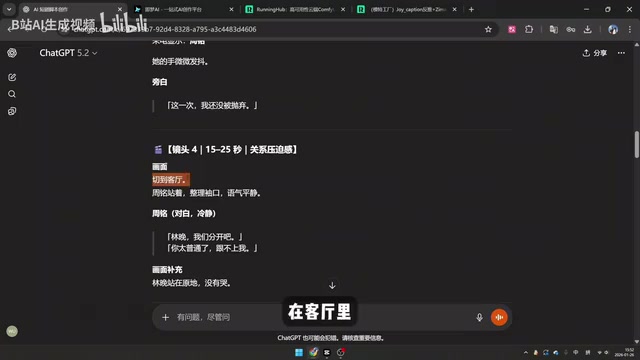
Eight storyboard frames unfold sequentially: female lead collapsed in a dim room → white flash rebirth → checking phone to confirm timeline → male lead proposing breakup → female lead's unusual calmness → unexpectedly agreeing to break up → equity agreement hinting at identity reversal → suspense ending.
Refine into Professional Storyboard Script Tables
The first draft is just a rough framework—you need the AI to further refine it into a professional script table containing shot number, shot size, camera movement, duration, visual content, and voiceover/dialogue. This step is the critical transformation from "story outline" to "executable production plan."
Here it's necessary to explain the professional meaning of each element in storyboard scripts. A Storyboard Script is a key document in film production that transforms written scripts into executable shooting plans. Shot number is the numbering system used for reference and sequencing during post-production editing; shot size is divided into five levels—extreme close-up, close-up, medium shot, full shot, and wide shot—determining the information density and emotional intensity of the frame (close-ups suit emotional details, while full shots establish spatial relationships); camera movement includes push, pull, pan, dolly, track, etc., affecting the dynamic feel and narrative rhythm; duration refers to each shot's length in seconds, directly affecting overall pacing. In AI short drama production, the visual content descriptions in storyboard scripts need special attention to be converted into prompt formats that AI tools can understand—this is the bridge connecting creative vision with technical execution, and the key factor determining final visual quality.
Pitfall Guide: Why You Can't Simply Copy AI Output Scripts Verbatim
Here's an important lesson that many free tutorials won't tell you: Don't just use whatever the AI gives you.
If you strictly follow the 8 storyboard frames the AI provides, the final product will often feel very stiff and unremarkable. There are two reasons:
- Mechanical execution lacks rhythmic flow: 8 frames for a one-minute video means each shot averages 7-8 seconds, creating overly uniform pacing that causes viewers to lose interest
- Some AI suggestions are technically difficult to execute: Complex camera movements, multi-person interactions, etc.—current AI video generation tools like Jimeng and Kling may not be capable of these
The correct approach is: understand the narrative logic and emotional rhythm the AI provides, then dynamically adjust based on actual AI generation capabilities—adding transition shots, adjusting shot size changes, and simplifying difficult-to-execute visuals. This is the critical leap from "being able to do it" to "doing it well."
Specifically, dynamic adjustments can include the following strategies: splitting a 7-second long shot into two 3-4 second short shots to fit AI tools' generation duration limits; inserting cutaway shots (like rain outside a window, a coffee cup on a table) before and after emotional turning points as transitions, which both relieves the pressure of AI-generating character shots and enhances narrative atmosphere; replacing AI-suggested wide multi-person scenes with close-up reaction shot alternations, which both avoids multi-face distortion issues and creates tension through rapid editing. These adjustments may seem minor, but they're the crucial details that determine final production quality.
Summary: The Core Pipeline of AI Short Drama Production
The complete workflow for AI short drama production is: Choose track → Set emotional hooks → Build structure → AI-generate script → Refine storyboard → Dynamic adjustment → Generate visuals → Edit final cut.
In this workflow, script quality matters far more than visual polish, and understanding AI's capability boundaries while adjusting your creative direction accordingly is what separates beginners from experts.
Tools will continue to iterate, but the methodology is universal. Once you master this thinking framework, you can efficiently produce commercially valuable AI short drama content regardless of whether you use Doubao, Jimeng, Kling, or other tools. It's worth noting that as next-generation video generation models like Sora and Veo continue to evolve, AI video duration, consistency, and controllability will all improve dramatically—at which point many of the technical limitations described in this article will be gradually overcome. However, the creative methodology of "script as core, emotion as driver, algorithm as guide" will always remain the foundational logic of AI short drama production.
Related articles
 Tutorials
ChatGPT Plus Subscription Guide: Are GPT-5.5, image-2, and Codex Worth the Upgrade?
A detailed look at ChatGPT Plus features — GPT-5.5, image-2, and Codex — with a Plus vs Pro comparison and a complete step-by-step subscription guide for users outside the US.
 Tutorials
Harness AI Engineering in Practice: Using Claude Code to Master Enterprise-Level E-Commerce Development
Deep dive into Harness AI Engineering: master enterprise e-commerce development with Claude Code using the Rules, Skills, Wiki, and Changes framework.
 Tutorials
Cursor + Codex Dual-IDE Collaboration: A Practical Methodology for Open-Source Project Customization
A complete methodology for open-source project customization based on real-world experience, detailing the Cursor+Codex dual-IDE workflow, seven-stage process, MVP validation, and AI source code reading techniques.