AI Side Hustle Reality Check: Testing 7 Methods Over 30 Days and a Blueprint for Actual Profit

Real 30-day test: 7 AI side hustles, $0 earned — here's why and how to actually profit.
A person with a full-time job rigorously tested seven AI money-making methods over six months. AI freelance writing earned just $15 after 38 hours; a custom GPT solving a specific professional problem earned over $12,000. The article exposes the structural reasons most AI side hustles fail — commoditized output, a brutal 60–90 day traffic dead zone — and argues the winning move is shifting from selling AI output to selling complete business workflows, building three-layer moats via data, behavior, and workflow integration, and carefully managing real variable costs where gross revenue never equals net revenue.
Busting the AI Get-Rich-Quick Myth With Real Data
Social media is flooded with claims that "a few prompts can build a passive income empire." But when one ordinary person with a full-time job actually put seven AI money-making methods to a rigorous test, the first month's result was sobering — zero dollars.
This isn't meant to crush anyone's dreams. It's about putting the truth on the table: if you're starting from scratch with no existing audience, the timeline to real profitability is far longer than any online guru will tell you. The most dangerous thing about AI is that it's great at making everything sound viable. It can brainstorm 50 business ideas in seconds and write an entire e-book in an afternoon — but creating content is not the same as creating demand.
Because AI has made content production so cheap, competition has exploded in kind. The real goal isn't to keep churning out generic content that drowns in a saturated internet with no one to read it. It's to find the places where AI can actually create leverage.
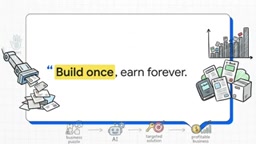
Why Most AI Side Hustles Are Structurally Doomed
A six-month test laid bare a brutal contrast. AI freelance writing brought in just $15 after 38 hours of work — because competing in generic AI writing is fundamentally a race to the bottom. Faceless YouTube channels and Canva AI template stores yielded almost nothing either: without months or even years of built-up authority, you're invisible to algorithms and the world alike.
The key insight is that these failures are structural problems, not effort problems.
In sharp contrast, custom GPT bots brought in over $12,000. The reason: instead of selling generic AI output, they solved a highly specific, recurring professional problem for a targeted client.
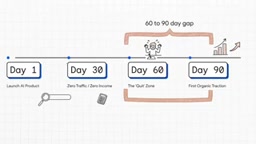
Another trap that causes people to quit is misjudging the timeline. Between launching an AI product and seeing organic traffic grow, there's a brutal 60-to-90-day dead zone. The first two months after launch are often total silence — zero traffic, zero income. Around day 60 sits what you might call the "quitter's valley," where most creators give up, mistakenly concluding the whole approach is a scam. For SEO-driven affiliate blogs, the data — like climbing search impressions — actually proves the method is working well before any revenue arrives.
The Winning Formula: Specificity and Automation
The core variable that determines success isn't which shiny new model you're using — it's problem specificity. You need to lock in on a specific person with a highly specific problem.
One success story didn't sell "AI" broadly. It built a custom GPT for a management consultant to handle their weekly update emails, trained on that consultant's own documents. It targeted a repetitive task and delivered immediate, measurable ROI — saving the consultant 90 minutes every week.
The mental shift here is critical: move from selling AI output to selling complete business workflows.
As one developer who tested seven methods in 30 days put it precisely: "It wasn't the AI that made me money. It was the automation." AI is just one small piece of a larger pipeline. The real business value comes from automating the repetitive, painful, revenue-draining tasks that businesses deal with every day. What people actually pay for is the engineering and workflow wrapped around the AI — not the raw prompt output itself.
Building a Moat That's Hard to Copy
If you're building software on top of AI, you're building what the industry calls a "wrapper." But there's a world of difference between a thin wrapper and a thick one.
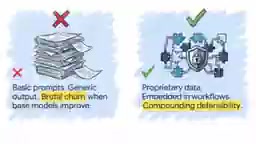
A thin wrapper is essentially a basic prompt template with a pretty UI slapped on top, producing generic, commoditized output. These products face brutal churn — the moment ChatGPT updates, users vanish, because there's no reason to stay.
A thick wrapper uses proprietary data pipelines, deeply embedded in a user's daily workflow, creating compounding, defensible value over time. To prevent a competitor from cloning your product over a weekend, you need to build three layers of moat:
The Three-Layer Defense
- Data moat: Capture user corrections and accumulate a unique dataset no one else has
- Behavioral moat: Design feedback loops where every thumbs-up or edit makes the product measurably smarter
- Workflow moat: Embed the tool directly into a company's CRM or daily processes, raising switching costs until removing your product becomes a genuine operational nightmare for the customer
For truly fortifying the data moat, one of the most powerful tools available is RAG (Retrieval-Augmented Generation) — arguably the highest-leverage technical investment you can make. RAG connects a base model to a unique, proprietary knowledge base — think internal company documents or historical support tickets — so that instead of guessing from the open internet, the AI retrieves facts from your specific data and anchors its answers in reality. This is how you build a product that enterprises actually trust.
A note on "wrappers": The term is contentious in AI startup circles. In narrow terms, it refers to developers calling the APIs of large models like those from OpenAI or Anthropic, building a user interface and business logic on top rather than training their own model. The appeal is obvious: without hundreds of millions in compute investment, anyone can quickly assemble what looks like a fully functional AI product. Critics, however, point out that pure thin wrappers lack any technical moat — any improvement in the underlying model can directly replace the product's core value, and a competitor can clone the same functionality in a weekend. This is exactly why the thin vs. thick distinction matters so much. A truly valuable wrapper's defensibility comes from its accumulation of industry-specific data, its deep integration into user workflows, and feedback mechanisms that compound over time — not from the model's capabilities themselves.
A note on RAG: RAG (Retrieval-Augmented Generation) is an architectural pattern that combines large language models with external knowledge bases. The core idea: when a user asks a question, the system first retrieves the most relevant passages from private company documents, databases, or historical records, then sends those passages along with the original question to the language model, which generates an answer based on the retrieved content rather than purely on memorized training knowledge. This addresses two critical LLM weaknesses: "hallucination" (the model fabricating nonexistent facts) and the knowledge cutoff problem (inability to access information after training). For enterprise applications, RAG means private data like internal SOPs, contract terms, and customer service history can be given directly to the AI — without uploading it to the model's training set — offering a degree of data privacy protection. This is why RAG has become one of the dominant technical approaches for enterprise AI deployment.
The AI Economics Trap: Gross Revenue Is Not Net Revenue
Traditional software adds new users at near-zero marginal hosting cost. AI applications have real variable costs. Every API call, every generation, every token processed costs real money.
If you charge a flat subscription fee but allow unlimited generation, a handful of heavy users can rack up enormous API bills that completely wipe out your margin. Without continuously tracking the AI cost "per generation," an app that looks profitable can instantly become a massive financial loss. In AI, gross revenue absolutely does not equal net revenue.
This is why choosing a monetization model is a life-or-death decision:
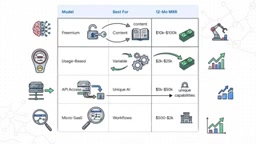
- Freemium subscription: Works for broad content tools
- Usage-based billing: The right choice when costs scale directly with usage — such as per-generation fees or a credit system
- AI access licensing: Suitable for products with highly unique capabilities
- SaaS micro-products: Good for hyper-specific, narrow business tasks, though they take time to build recurring revenue
Choosing the wrong structure for how users actually behave can kill a startup before it ever gets off the ground.
A note on token-based billing: Understanding AI application cost structures requires understanding how tokens are charged. A token is the basic unit by which large language models process text — roughly every 750 English words or 500 Chinese characters corresponds to about 1,000 tokens. Major model APIs charge separately for input tokens and output tokens: input tokens are what the user sends to the model (including system prompts, conversation history, and retrieved document fragments); output tokens are the model's generated response. In practice, a seemingly simple conversation may carry thousands of tokens of system prompt and context, making real costs far higher than expected. For products that allow long document processing or multi-turn conversations, a single request can easily consume tens of thousands of tokens — this is the technical root of why "heavy users rack up enormous bills." Careful management of prompt length, context window strategy, and caching mechanisms must therefore happen at the product design stage. Otherwise, as user scale grows, the cost curve will rise non-linearly.
A Four-Step Blueprint for Sustainable Profit
All of these insights converge into one precise action plan:
- Find problems people already want to solve. Don't try to invent entirely new problems. Look for places where people are already wasting time or money.
- Give AI a clear, tightly scoped job. Keep it inside a workflow. Don't try to make it do everything.
- Build a revenue-oriented MVP and immediately test whether real people are willing to pay.
- Design for retention. The product must deliver a measurable success outcome on the very first use, or users have no reason to come back.
This leaves one genuinely thought-provoking question: What specific problem can you solve faster with AI? Notice that's not "how do you make money with AI."
The technology itself is just a lever. Business has always been about solving real problems. It's time to stop trying to make AI conjure a business out of thin air, and start thinking about how AI can help you build better solutions to real-world problems — because that's exactly where lasting opportunity lives.
Related articles

Should U.S. College Fraternities Be Banned? A Researcher's Incisive Observations
Why not just ban U.S. college fraternities? A researcher finds the key resistance comes from decision-makers' own fraternity identities and schools' "willful ignorance."

Microsoft Discovery: Accelerating Scientific Discovery with AI Agents
Microsoft's Discovery platform runs specialized AI agents to help researchers screen and prioritize the most promising compounds and experimental paths, reducing experiments and accelerating scientific discovery.

Cambridge Heavy Industries Secretly Develops Desktop-Scale Nuclear Fusion Device
Cambridge Heavy Industries is secretly developing a desktop-scale laser-driven nuclear fusion device, targeting the equipment supply market for fusion power plants. This article analyzes its miniaturization technology path, commercialization logic, and unique positioning in the fusion startup wave.