AI Simulates Thousands of Typhoon Seasons, Reshaping Tropical Cyclone Risk Assessment

AXA and NVIDIA use AI to generate thousand-season cyclone simulations, overcoming historical data sparsity to quantify tail risk.
Between 1970 and 2019, tropical cyclones caused $1.4 trillion in economic losses, yet 46 years of historical records remain too sparse to cover the full range of future risks. AXA and NVIDIA Earth-2 are leveraging the order-of-magnitude inference speed of AI models to generate ensemble simulations covering more than a thousand cyclone seasons worldwide. These simulations are not short-term forecasts but dense sampling of the space of possibilities, stabilizing the statistical characteristics of extreme events and helping insurers more accurately assess regional risk differences and tail risk. The article emphasizes that simulation outputs are probability distributions rather than single-point prophecies, making them better suited for insurance pricing and disaster prevention resource allocation, marking a shift in AI's role in climate risk from accelerating computation to expanding the boundaries of cognition.
When Historical Data Isn't Enough: The Simulation Dilemma of Tropical Cyclone Risk
Between 1970 and 2019, reported economic losses from tropical cyclones reached as high as $1.4 trillion. To understand the risks we may face over the next 50 years, historical records alone are far from sufficient—we must simulate storms that have never been observed. This is precisely the direction AXA and NVIDIA Earth-2 are exploring together: using AI to generate thousands of hypothetical cyclone scenarios, pushing beyond the boundaries of historical data.
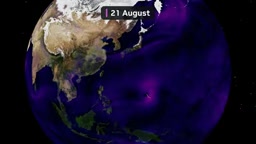
Traditional weather models are costly to run at scale, while AI models offer a significantly faster alternative. AXA is leveraging this speed advantage to shift cyclone risk assessment from "reviewing history" to "generating possibilities."
How AI Generates a "Typhoon Season"
In the NVIDIA Earth-2 demo, a forecaster is presented with three simulated cyclones crossing the Pacific, with yellow lines tracing their paths. These simulations are not short-term forecasts of a few days but extend over months, capturing how storms develop and take divergent paths.
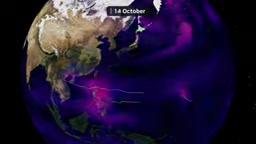
A single typhoon season is just one of many possibilities. When AI generates hundreds or thousands of such seasons, individual paths begin to converge into a broader picture—where cyclones travel and how frequently they appear. This "ensemble simulation" approach essentially embeds probabilistic thinking into risk management: rather than asking "which path will the next storm take," it asks "among all possible paths, which regions are most densely exposed?"
Ensemble Simulation is a core method in meteorology and climate risk. The basic idea is that because the atmospheric system is chaotic, small errors in initial conditions amplify exponentially over time, and the useful range of a single deterministic forecast typically does not exceed two weeks. Ensemble methods introduce a set of slightly differing initial conditions or model parameters and run multiple simulations simultaneously, yielding a set of possible future states. The spread of these results itself reflects forecast uncertainty. In climate risk contexts, ensemble simulation is further extended into long-duration, multi-member "grand ensembles" used to estimate the frequency and spatial distribution of extreme events. AI generating over a thousand cyclone seasons is essentially building a very large ensemble so that the statistical characteristics of rare extreme events can converge.
46 Years of Historical Data vs. Over a Thousand Simulated Seasons
The comparison visual reveals the core of the problem. The globe on the left shows cyclone tracks from 46 years of historical data, with colors indicating the concentration of storm trajectories and showing where cyclones most frequently pass.
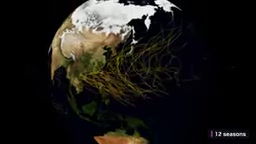
Yet even records spanning decades remain too sparse to capture the full range of cyclone activity.
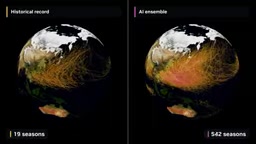
The right side shows an AI-generated ensemble simulation covering more than a thousand cyclone seasons worldwide. This difference in density translates directly into insight: historical data tells you "what happened," while thousand-season simulations tell you "what could happen," including extreme scenarios absent from historical records but physically plausible.
Tail Risk refers to extreme events with very low probability but severe losses, located in the "tail" of the loss distribution curve. In actuarial science, accurate estimation of tail risk is directly tied to reinsurance pricing, capital adequacy, and solvency regulation. Traditional methods rely on limited historical disaster samples and often struggle to produce robust estimates for once-in-a-century or even rarer storm events, leading to systematic underestimation of tail risk. Ensemble simulation generates large numbers of synthetic scenarios—especially extreme combinations that have not appeared in historical records but are physically plausible—providing a richer sample space for tail risk. This enables actuaries to obtain more stable statistics at the far end of the probability distribution, thereby improving the pricing of extreme events and risk transfer arrangements.
What It Means for Insurance and Risk Management
For insurers like AXA, AI-generated ensemble simulations help them understand how cyclone risk varies by region. These insights can improve risk assessment and help clients focus disaster prevention investments where they are most needed.
The key shift here lies in the granularity of risk perception. Traditional reinsurance pricing relies on limited historical disaster samples, and tail risk is easily underestimated. Thousand-season simulations amount to providing actuaries with a "synthetic history" that includes storm combinations that have not yet occurred but could occur. This is not a replacement for historical data but a supplement to the probability space where historical data are sparse.
The Engineering Logic Behind the Speed Advantage
The reason AI models can generate thousands of seasons lies primarily in the dramatic reduction in inference cost. Traditional numerical weather models must solve complex physical equations, and a single run is time-consuming; AI models learn patterns from historical simulations or reanalysis data and achieve order-of-magnitude speedups during inference. NVIDIA Earth-2, as a platform layer, packages this capability into a service that can be invoked at scale.
One detail worth noting: speed itself is not the goal. The real value lies in "enough samples"—only when the number of simulations jumps from dozens to thousands do the statistical characteristics of extreme events begin to stabilize, and only then do regional risk differences become meaningful for decision-making.
Numerical Weather Prediction (NWP) is the mainstream approach to traditional weather and climate simulation. Its core is discretizing and solving the atmospheric state on supercomputers based on equations of fluid dynamics and thermodynamics. NWP models have clear physical mechanisms and strong interpretability, but their computational cost is extremely high: a single global high-resolution seasonal simulation often consumes millions of CPU hours. AI weather models (such as architectures based on Transformers or graph neural networks) take a different path, learning the statistical patterns of atmospheric evolution from historical reanalysis data (such as ERA5) and generating forecasts at orders-of-magnitude lower cost during inference. The relationship between the two is not one of simple substitution: the speed advantage of AI models makes them suitable for large-scale ensemble sampling, while NWP still provides training data and physical constraints for AI. NVIDIA Earth-2 packages GPU-accelerated AI inference into a scalable platform service, making thousand-season simulations engineering-feasible.
Simulation Is Not Prophecy
It is important to recognize clearly that the AI-generated thousand-season cyclone ensemble is a sampling of a "space of possibilities," not a prediction of the future. It answers "under given climate conditions, which storm path combinations are plausible," not "how many typhoons will make landfall next year." For risk management, this is precisely the more appropriate tool: insurance pricing needs probability distributions, not single-point forecasts.
The AXA and NVIDIA exploration shows that the role of AI in climate risk is shifting from "accelerating computation" to "expanding the boundaries of cognition"—allowing us to see the part of the risk landscape that history has never revealed.
The assumption of climate stationarity is a key premise for understanding the boundaries of simulation results. The thousand-season cyclone ensemble is a sampling of the space of possibilities "under given climate conditions," and this "given" usually implies the current or some representative-period climate state. However, in the context of climate change, boundary conditions such as sea surface temperature and atmospheric circulation are themselves drifting, and historical statistical relationships may no longer be stable. Therefore, simulation results should be understood as a characterization of the risk structure under the current climate regime, not as a prediction of future climate. To use simulations for long-term risk assessment, future scenario outputs from general circulation models (GCMs) must be used as boundary conditions to drive cyclone generation models—this is precisely the frontier direction of climate risk modeling.
Related articles

OpenAI Partners with Shield: How the Astra Agent Revolutionizes IT Troubleshooting
OpenAI and Shield launch the Astra agent, which autonomously logs into computers and legacy systems to fix IT issues in real time, 35-40% faster than traditional models, with humans involved only when judgment is needed.

iPhone Duo Battery Life Tested: One Charge a Day Is Unavoidable, and the Large Screen Is the Culprit
iPhone Duo battery test: heavy use needs at least one charge a day, and about 30% remains after 6.5 hours of screen-on time. How often the large screen is unfolded is key; a MagSafe battery pack helps, and long-term degradation is also worth watching.

Kimi K3.1 Pro Open-Sourced: 2.8 Trillion Parameters Close In on Opus
Moonshot releases the open-source MoE model Kimi K3.1 Pro, with 2.8T total parameters and 104B activated, trailing Opus 5.5 by under 1 point on Terminal Bench 4.0.