AI Stocks Shed $2.3 Trillion in a Single Day as Anthropic Valuation Cut to $1.2 Trillion

AI stocks lose $2.3T in a day as Anthropic's valuation is cut, marking AI's shift into a commercialization validation phase.
The Nasdaq 100 plunged 6.4% in a single day, wiping out a record $2.3 trillion in market value. AMD and Micron fell over 17%, Nvidia over 9%, and Asian markets followed, triggering a circuit breaker in South Korea. The trigger was post-midterm anxiety over tighter data-center regulation and unclear AI capex payback. Ahead of Anthropic's IPO roadshow, anonymous sources say its valuation expectation has been compressed from $2 trillion to $1.2–1.3 trillion. On the product side, Meta's avatar launched, Thinking Machines' Inkling R Small and Baidu's ERNIE EIE 5.5 Flash went open-source. Visa's agent shopping test failed 43% of the time, with over half of failures still placing orders — exposing reliability gaps in payment scenarios. The market is shifting from narrative-driven to returns-driven.
The U.S. AI sector just went through a historic selloff. The Nasdaq 100 plunged 6.4% in a single day, wiping out $2.3 trillion in market value — a record one-day loss. This was no ordinary pullback; it was a concentrated repricing of the AI narrative.
The Full Picture: Chip Stocks Lead the Decline, Asian Markets Follow
Chip stocks bore the brunt. AMD and Micron both fell more than 17%, while Nvidia dropped over 9 percentage points. The selloff didn't stop at U.S. markets — the next day, Asian markets picked up the baton, with South Korea's stock market falling as much as 8.7% intraday, directly triggering a circuit breaker.
The immediate trigger for the shift in sentiment was investor anxiety over tighter data-center regulation following the midterm elections. AI infrastructure capex is still expanding at a rapid clip, but the payback timeline remains stubbornly unclear. That "when will all this spending pay off" anxiety was amplified by the election results and ultimately boiled over into concentrated selling.
Circuit breakers are automatic trading halts set by exchanges to control extreme volatility. In South Korea, for example, the KOSPI has a three-tier circuit breaker system: when the index falls 8% from the previous day's close and stays there for one minute, a Level 1 circuit breaker is triggered, halting trading for 20 minutes; a 15% decline triggers Level 2, also a 20-minute halt; and a 20% decline triggers Level 3, which closes the market outright. The purpose of circuit breakers is to give market participants a cooling-off period and prevent panic selling from becoming a self-reinforcing spiral — but they are also often read as a signal of extreme market fear.
Anthropic's Valuation Expectations Shrink Sharply Ahead of IPO Roadshow
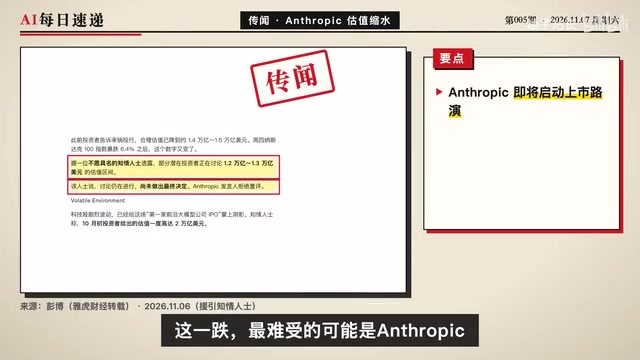
Anthropic finds itself in the most awkward position of this downturn. The company is about to kick off its IPO roadshow, and according to people familiar with the matter cited by The Paper, the valuation in investors' minds has been compressed from $2 trillion in early October to a range of $1.2 trillion to $1.3 trillion.
It's important to note that this figure comes from anonymous sources, the discussions are not finalized, and Anthropic declined to comment. But the fact that valuation expectations were revised down so sharply on the eve of the roadshow itself shows that the primary market's pricing logic for AI companies is shifting from "narrative-driven" to "returns-driven." Losing hundreds of billions in valuation is a severe test for any pre-IPO company.
An IPO roadshow is a series of presentations a company makes to potential institutional investors before going public. Management uses it to explain the business model, financial outlook, and proposed price range, and to gauge subscription interest. The order book built during the roadshow directly determines the final offer price. A sharp downward revision in valuation expectations on the eve of the roadshow means the consensus among underwriters and investors on the pricing range has weakened — the company must either accept a lower IPO valuation or delay the listing.
Product News: Meta's Virtual Avatar Ships, Open-Source Models Roll Out
In contrast to the chill in capital markets, the product side remains busy. Meta's MUSE real-time virtual avatar, previewed at Connect, has officially launched in the U.S. When users have voice conversations with the AI, it appears as an expressive, interactive virtual character.

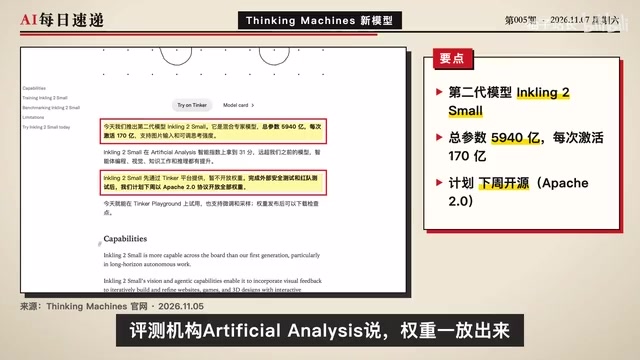
Thinking Machines, founded by former OpenAI CTO Mira Murati, released its second-generation model Inkling R Small — 594 billion total parameters with only 17 billion activated per pass. It is currently available only on the company's own Tinker platform. The company said it will open-source the weights under the Apache 2.0 license next week after completing external safety testing. Benchmarking firm Artific Official Analysis believes that once the weights are released, it will become the highest-scoring open-source model outside China.
Domestically, Baidu open-sourced the base model of ERNIE EIE 5.5 Flash — 280 billion total parameters, 140 billion activated per pass, and a context window of up to 1 million tokens. Note that this is the base model without instruction fine-tuning, suitable for developers to train on their own; the company says a tuned version will follow.
Total parameters vs. activated parameters are key to understanding Mixture-of-Experts (MoE) models. Total parameters refer to the full weight count of the model, while activated parameters refer to the number of parameters actually involved in computation during each forward pass. MoE models use a routing mechanism to activate only a subset of experts, so they can leverage a huge total parameter count with a relatively small per-pass compute budget — Inkling R Small's 594 billion total parameters with only 17 billion activated is exactly this design. Apache 2.0 is a permissive open-source license that allows commercial use, modification, and redistribution, requiring only that copyright notices and the license text be retained. Open-sourcing weights under Apache 2.0 therefore generally means enterprises can deploy and build on the model with considerable freedom.
Developer Tools and the Real Gaps in AI Agents
The coding tool CASA now supports the full pipeline from requirements to launch: users describe what tool they want, and it writes the code, configures the database, runs security checks, and finally deploys it and returns a link. However, users still need to click to approve before deployment.

Another test threw cold water on agents. Visa ran a shopping test with 22 AI models, asking them to buy TVs and computers for people. 43% of the tests failed — and more seriously, in over half of the failure cases, the AI still completed the order. This shows that in scenarios involving real payments, the final human confirmation step is still indispensable.
AI Agents are AI systems that can autonomously plan steps, call tools, and execute multi-step tasks. Unlike chatbots that merely answer questions, they are granted real permissions such as operating a browser, filling out forms, and calling payment APIs. What Visa's test exposed is precisely the agent's "last mile" problem: the model may correctly understand the intent, yet misjudge or skip verification at the confirmation step. In scenarios involving real payments, human-in-the-loop confirmation therefore remains a necessary safety valve — a person gives final authorization before key actions are executed.
Bubble Burst or Normal Pullback?
A single-day loss of $2.3 trillion is enough to make the history books, but reducing it simply to a "bubble bursting" may be too hasty. A more accurate reading: the market is demanding that AI companies show a clear path between capex and revenue, rather than continuing to pay for distant visions. Anthropic's valuation cut and the agent reliability problems exposed by Visa's test both point in the same direction — the commercialization validation phase for AI has arrived. For developers and founders, this isn't necessarily bad news. Once the narrative froth is skimmed off, products that can actually close the loop are more likely to be seen.
Related articles

Hermes Agent Beginner's Guide: Hands-On with a Self-Evolving AI Agent
A beginner's guide to Hermes Agent, the open-source self-evolving AI agent that gained 41.7K GitHub stars in two months—covering Harness Engineering, the learning loop, three-layer memory, WSL installation, and hands-on configuration.

AI Agent in Action: Building a Smart Office Assistant with WorkBuddy
A practical case study shows how Tencent WorkBuddy batch-converts and archives files, compares chat LLMs with AI Agents, and analyzes WorkBuddy's credit system, use cases, and positioning for office automation selection.

From Single-GPU Bottlenecks to Hundreds of Billions of Parameters: 6 Key Questions in Large Model Distributed Parallelism
Based on a Bilibili tutorial, this article organizes core knowledge of large model distributed parallelism: starting from decoder-only architecture's token-by-token generation and the essence of X times W computation, it analyzes six key questions including data parallelism, tensor parallelism, and pipeline parallelism under single-GPU bottlenecks. Suitable for learners in private deployment and model training scenarios to build systematic understanding.