AI Teams in Action: How MiniMax M3 Uses Multi-Agent Collaboration to Reinvent Content Creation

How MiniMax M3's multi-agent system automates end-to-end content creation workflows.
M-Code, an AR computer assistant powered by MiniMax M3, replaces manual content creation workflows with a collaborative AI team. Four specialized agents — for work planning, recording, drafting, and quality review — divide tasks automatically, share persistent memory, and learn your personal style over time, shifting the paradigm from single AI tool to coordinated AI team.
From Single Assistant to AI Team: An Evolution
When most people think of AI productivity tools, they still picture a "question-and-answer" conversational assistant. But what truly unlocks productivity has never been a single, isolated AI — it's a coordinated team of AI agents, each with a defined role. M-Code, an AR computer assistant that recently sparked widespread discussion on Bilibili, is built precisely around this philosophy.
Multi-Agent Systems (MAS) are not a new concept. Their theoretical roots trace back to distributed AI research in the 1980s. In the classic definition, an Agent is a computational entity that can perceive its environment, make autonomous decisions, and take action. When multiple agents work together, the system's overall capability often exceeds the sum of its parts — a manifestation of "emergence" in AI. In recent years, as large language models have made breakthrough advances, Multi-Agent frameworks such as AutoGen, CrewAI, and LangGraph have emerged, all aimed at addressing the limitations of single models on complex tasks: finite context windows, insufficient domain depth, and difficulty with parallel processing. Distributing tasks across multiple specialized agents for parallel execution is, at its core, bringing the "modular design philosophy of software engineering" into AI system design.
According to the Bilibili creator who shared the demo, M-Code is powered by the MiniMax M3 model. This model's core strengths lie in two dimensions: first, its ultra-long context processing capability, which allows it to ingest massive amounts of material in a single pass and complete complex tasks on top of it; second, its multimodal understanding capability, enabling it to simultaneously process text, images, and video.
The context window is the maximum amount of text a large language model can "see" and process at one time. Early GPT-3 had a context window of only about 4K tokens, severely limiting its ability to handle long documents. As technology has evolved, some frontier models have expanded their windows to the million-token range. The ultra-long context capability MiniMax M3 emphasizes allows it to process hundreds of thousands of words of source material in a single pass — instead of "feeding" documents in batches, the AI can "read the full manuscript" like a human editor before synthesizing its output, dramatically reducing information fragmentation and semantic drift. Ultra-long context is also one of the technical foundations for achieving "persistent memory," as historical interaction records can be retained directly in the context for the model to reference.
The multimodal understanding capability is equally worth examining closely. Next-generation multimodal models use a unified Transformer backbone to map text, images, and video into the same vector representation space for reasoning — achieving truly native multimodal understanding. Rather than "translating" images into text for processing, the model reasons across all modalities simultaneously in a unified feature space. For content creation scenarios, this means the AI can directly interpret video screenshots, cover reference images, and competitor materials, incorporating them into its creative decision-making. Together, these two capabilities transform M-Code from a simple Q&A tool into an intelligent collaboration platform that can genuinely execute tasks on your behalf.
Building Your Own Dedicated AI Team
M-Code's most distinctive design feature is that it lets users actively "assemble a team." From the main page, you access the team-building interface and describe your needs in natural language — what kind of assistants you need and what each one is responsible for — and the system will quickly configure an AI team for you.
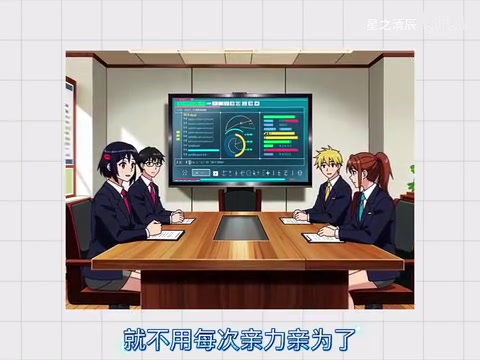
This design delivers particularly strong value in content creation scenarios. Take video production as an example: writing scripts, crafting titles, and conceptualizing thumbnails are all "non-creative but necessary" tasks that consume enormous energy. In M-Code's team mode, you simply pass a topic to the team, and multiple agents will automatically divide the work and advance in parallel — you just need to review the final output.
This is fundamentally a shift from "manually chained workflows" to "AI-orchestrated collaborative flows" — freeing creators from the tedious execution layer so their energy can be focused on the decision-making steps that genuinely require human judgment. The paradigm shift "from tool to team" has become one of the most important product trends in the AI industry between 2024 and 2025. OpenAI's Swarm framework, Anthropic's Computer Use capability, and Microsoft Copilot Wave 2 all point in the same direction: AI is no longer a passive, reactive tool but an active collaborator embedded in workflows. M-Code's choice to integrate with platforms like Feishu and WeChat — tools Chinese users already rely on heavily — ensures that the AI team appears within users' existing work environments, rather than demanding they migrate to a new platform.
How Four Specialized Agents Divide the Work
Based on the creator's live demonstration, M-Code's team consists of multiple dedicated agents, each handling one link in the content creation chain.
Work Planning Agent
In the past, ideas and to-do items were scattered across Feishu, making them time-consuming to find. Now, you simply send a casual message on Feishu, and the Work Planning Agent automatically scans all your records, organizes them into a to-do list, and directly handles the parts it can automate (such as generating drafts or creating plans). Tasks that require human execution are consolidated and pushed to you each morning. Combined with scheduled triggers, the entire workflow can run completely automatically.
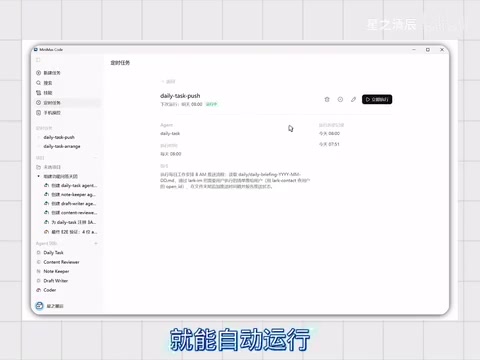
Even more noteworthy is its persistent memory mechanism — as you use it over time, the tasks the agent arranges will increasingly align with your actual work habits. "Persistent memory" is one of the most technically challenging problems in current AI Agent systems. Traditional LLMs are essentially "stateless" — they don't automatically retain user preferences after a conversation ends. There are three mainstream technical approaches to implementing persistent memory: external vector databases (such as Pinecone or Weaviate), which convert historical interactions into vectors for storage and use semantic retrieval to recall relevant memories at runtime; structured memory summaries, where a dedicated memory agent periodically compresses conversations into structured archives; and fine-tuning, which bakes user preferences directly into model weights. M-Code's "the more you use it, the better it knows you" mechanism likely combines the first two approaches — using a vector store to hold raw materials and style samples, and structured summaries to record user preferences and SOP rules, dynamically retrieving and injecting personalized context at generation time.
Recording Agent
Addressing the pain point of inspiration and source material scattered across multiple platforms, the Recording Agent specializes in organizing and archiving. When you send content you want to save via Feishu or WeChat, it automatically categorizes and organizes it, gradually helping you build a personal, dedicated knowledge library.
Draft Agent
This is the link that best demonstrates the core value. When you throw out a topic, the Draft Agent automatically scans all the notes and materials you've accumulated, combines your perspectives and examples, and produces a draft that carries your personal style with minimal "AI flavor."
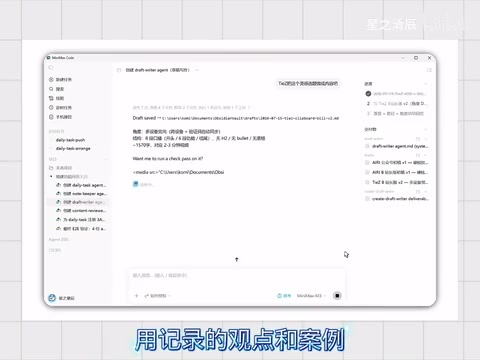
You may not notice at first, but it has a "gets better the more you use it" quality — because it continuously remembers your tone, writing rhythm, and expressive preferences. This kind of personalized learning capability is something general-purpose large models cannot directly provide on their own. Technically, the Draft Agent's ability to learn personalized style relies on continuously vectorizing the user's historical writing samples and injecting those style samples as "few-shot examples" into the prompt at generation time, guiding the model to mimic the target tone and writing rhythm while preserving the underlying creative logic.
Review Agent
Before a piece of content is published, the Review Agent conducts a comprehensive audit based on the SOP (Standard Operating Procedure) derived from historical content, publishing performance data, and recent retrospective insights. Every lesson learned from past reviews is automatically appended to the SOP, forming a continuously iterating quality control loop that ensures content goes through internal revision before being published externally.
Treating the SOP as a dynamic knowledge base means that every retrospective lesson can be automatically structured and appended to the rule library, forming a closed-loop iteration cycle of "execute → review → update → re-execute." This aligns closely with the core idea of Reinforcement Learning: continuously optimizing strategy through environmental feedback. From an engineering perspective, this typically relies on Function Calling capabilities — the Review Agent actively invokes an SOP retrieval tool during audits to check content against historical best practices item by item, rather than relying solely on the model's implicit memory.
The Real Value Lies in End-to-End Integration
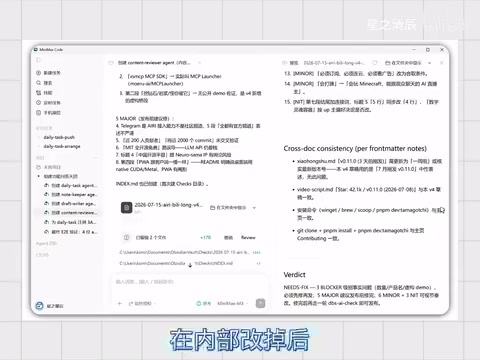
After using it for some time, it becomes clear that M-Code's true value doesn't lie in how powerful any single agent is, but in its ability to organically connect the entire content creation pipeline — from capturing inspiration and planning schedules to writing drafts and conducting quality reviews, with a dedicated team member handling each step.
This also reveals a core trend in AI productivity tools: the paradigm shift from "tool" to "team." A single AI assistant solves point-in-time problems; an Agent team solves process problems. The Stanford AI Index Report notes that the bottleneck in enterprise AI adoption is shifting from "point-in-time capability" to "process integration" — that is, how to embed AI into existing workflows rather than requiring users to change their habits to accommodate AI. When multiple agents can work in concert, share memory, and continuously learn, the value they create compounds linearly — or even exponentially.
More critically, as persistent memory and personalized learning continue to accumulate, the system will "understand you better the more you use it," consistently maintaining your own style and tone. In the words of the Bilibili creator: using M-Code "is like assembling a team for yourself, not just getting another AI assistant."
Conclusion
From a technical standpoint, M-Code leverages MiniMax M3's long-context and multimodal capabilities to achieve coordinated orchestration across a multi-agent team. From a product standpoint, it precisely addresses real pain points for content creators. That said, the content of this article is primarily based on a single Bilibili creator's demonstration — the actual stability, ease of use, and long-term effectiveness still await validation from a broader user base.
What is clear, however, is the direction: "AI teams" rather than "AI assistants" are emerging as an important form factor for the next generation of productivity tools. For users who frequently handle content creation, material organization, and workflow management, multi-agent collaboration tools powered by models like MiniMax M3 are well worth ongoing attention and hands-on exploration.
Key Takeaways
Related articles

AgentCore in Practice: Connecting Custom Tools and MCP Servers to Agents
DebuggerCafe tutorial shows how to connect custom tools and MCP servers to Amazon Bedrock AgentCore agents, covering tool contract design, MCP reuse, and production concerns.

816B Parameters Scores Only 39? The Real Cost-Effectiveness of the Open-Source LLM Parameter Race
Meta's 816B Muse Spark Open scores just 39 on Artificial Analysis, while 180B Qwen3.8-Flash-Next scores 40. This article analyzes 11 open-weight models' parameters vs. scores, exploring the real impact of activated parameters, quantized size, and deployment cost.

Aerial Manipulators: The Next Step for Drones from 'Seeing' to 'Changing'
Starting from a Reddit discussion, this article analyzes the technical challenges, potential applications, and deployment bottlenecks of aerial manipulators, exploring the key challenges for drones moving from environmental perception to physical manipulation.