AI Test Development Learning Path: A Practical Guide from Prompt Engineering to RAG Knowledge Bases

A six-phase learning path for test engineers to master AI-empowered testing from prompts to RAG.
This guide presents a comprehensive AI test development learning path refined over two years, covering six phases: LLM cognition and data compliance, prompt engineering, PyTest AI collaboration, contract-driven API test generation, RAG vector knowledge bases for leveraging historical test data, and MCP/Agent tool chains for giving LLMs execution capabilities. It provides test engineers with a clear roadmap to transform AI from an unreliable assistant into a controllable productivity tool.
Introduction
The rapid evolution of large language model technology is reshaping how software testing works. But many test engineers face the same dilemma when actually using AI: AI-generated test cases have high error rates, outputs are uncontrollable, and what appears intelligent isn't actually useful.
The root cause is the lack of a systematic methodology. Transforming AI from an "unreliable assistant" into a productivity tool that truly delivers value requires a step-by-step approach across three dimensions: cognition, standards, and engineering practice.
This article is based on an AI test development learning path that was refined over two years through hundreds of iterations. It covers LLM cognitive foundations, prompt engineering, automated testing collaboration, RAG knowledge base construction, and Agent tool chain enhancement — providing a complete technical framework and implementation roadmap for AI-empowered testing.
LLM Cognition and Data Compliance: The First Lesson in AI Test Development
Understanding What LLMs Can and Cannot Do
Before getting hands-on with AI tools, you must first build the right mental model. Large language models excel at content generation and logical reasoning, but they're not omnipotent — understanding the mechanism behind LLM hallucinations allows you to make sound judgments in practice and avoid blindly trusting AI outputs.
The first phase of the learning path covers core AI concepts: Prompt, RAG, Agent, Tool, MCP, Token, context window, and more. These terms are not only technical foundations but also essential vocabulary for team collaboration and job interviews.
Data Compliance Is a Prerequisite for Enterprise AI Adoption
When introducing AI into enterprise environments, data security is a non-negotiable boundary. This phase focuses on three key areas:
- Data red lines: Clearly defining what data must never be fed into external LLMs
- Data anonymization: Sanitizing sensitive information from PRDs (Product Requirements Documents)
- Token cost control: Optimizing token usage within compliance constraints to reduce costs
Combined with hands-on practice using AI coding tools like Cursor, this ensures teams can use AI in a controllable, compliant, and traceable manner.
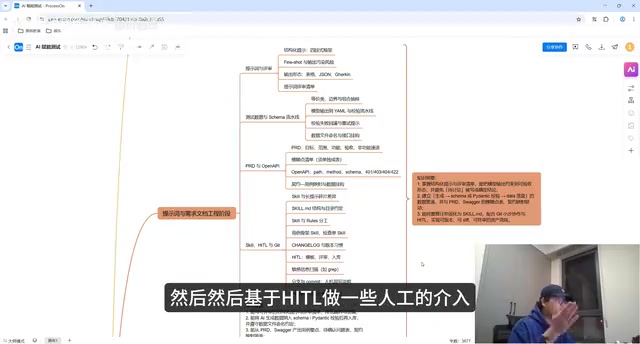
Prompt Engineering: Making AI Produce Truly Usable Test Content
Structured Prompt Design Methods
The quality of your communication with AI directly determines the quality of its output. The core goal of Prompt Engineering is: getting more precise, better-formatted results with fewer interaction rounds.
Key skills to master at this stage include:
- Designing reusable structured prompt templates
- Communicating efficiently with AI based on requirements documents
- Using Schema (structure definitions) to constrain output format, ensuring deliverables are immediately usable
AI Input Optimization Based on PRDs and OpenAPI
In testing work, the primary input sources for AI are PRDs and API documentation. The learning path covers two practical scenarios in detail: first, how to get AI to accurately extract key features and test points from PRDs; second, how to leverage the OpenAPI specification to help AI understand endpoint paths, request methods, data formats, response status codes (such as 401, 403), and relate them to contract testing requirements.
Skill Libraries, HITL Mechanisms, and Git Version Management
An often overlooked but critically important concept is Skill — the difference between a Skill and an ordinary prompt is that a Skill is a reusable, accumulable structured capability unit. Encapsulating repetitive workflows into Skills can significantly boost overall team efficiency.
Meanwhile, the HITL (Human-In-The-Loop) mechanism is indispensable. AI-generated content often carries a "machine flavor" and requires human review and correction to ensure natural wording, logical coherence, and results that meet expectations. Combined with Git for version management and team collaboration, this enables the gradual accumulation of code assets, documentation assets, and Skill assets.
PyTest and AI Collaboration: Substantial Improvements in Automation Testing Efficiency
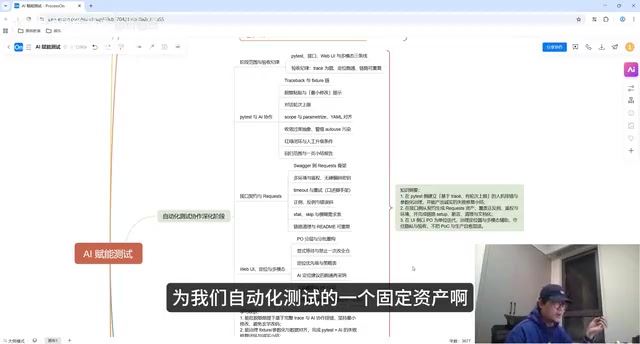
Four Scenarios for AI-Assisted PyTest Development
Automated testing is a core skill for test engineers and the area where AI empowerment delivers the most visible results. At the PyTest level, AI can assist with:
- Fixture definitions and Scope optimization
- Auto-generation of Parametrize data
- Batch generation of test cases based on YAML
- Test code refactoring and optimization suggestions
The key metric is the accuracy rate of AI-generated test cases — AI collaboration only creates real value when the output reaches the level of "directly usable or requiring only minor modifications."
API Automation: Contract-Driven Generation of Five Types of Test Cases
Based on Swagger or API documentation, combined with AI, this achieves systematic coverage for API automated testing. The learning path defines auto-generation strategies for five types of test cases:
- Positive test cases: Verifying that normal business flows meet expectations
- Negative test cases: Verifying handling logic for abnormal inputs
- Error test cases: Verifying that error codes and exception responses are accurate
- Ambiguous requirement scenarios: Covering boundary cases where requirements are unclear
- Data encoding scenarios: Handling character sets, encoding formats, and other special cases
Through this framework, AI connected to Swagger can produce API test code that can be directly integrated into CI/CD pipelines, becoming part of the team's automated testing assets.
UI Automation Self-Healing: Multimodal LLMs Solving Element Locator Challenges
The biggest pain point in UI automated testing is element locator maintenance. Once a frontend page is redesigned, numerous locators break, and maintenance costs remain persistently high.
The learning path proposes a cutting-edge solution: a UI self-healing system based on multimodal LLMs. The core approach includes:
- Using the POM (Page Object Model) design pattern to refactor existing code in batches
- Introducing multimodal LLMs for visual page understanding
- When element location fails, AI automatically analyzes page screenshots and updates locator strategies
- Achieving automatic locator repair, dramatically reducing UI automation maintenance costs
This means AI is no longer just "writing code" — it's participating in decision-making during test execution. This is the true form of intelligent testing.
RAG Knowledge Base: Unlocking Continuous Value from Historical Test Data
Activating Historical Data with Vector Databases
Enterprises typically accumulate vast amounts of historical test data, bug records, and solutions, but these materials are scattered across various documentation systems, making them difficult to find and rarely reused.
By building a test vector database, historical materials are unified into a single repository, and RAG (Retrieval-Augmented Generation) technology enables intelligent retrieval. Here's a practical scenario: when an API repeatedly returns 500 errors, AI can quickly locate answers based on historical data — why did this API return 500 in the past? What were the root causes in similar scenarios? What were the solutions?
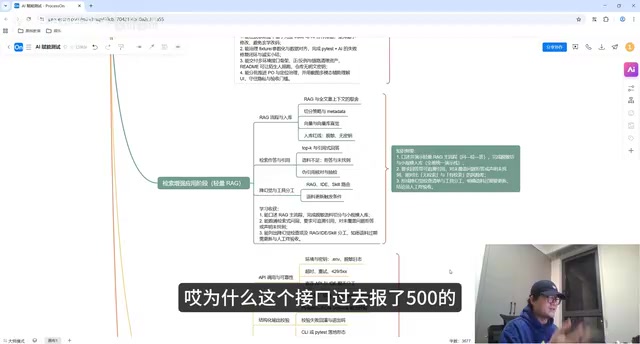
Three Key Values of RAG Technology in Testing
RAG delivers value to testing teams on three levels:
- Reducing AI hallucinations: Answering questions based on real historical data rather than fabrication
- Improving retrieval efficiency: Materials that previously took hours to review are now accessible in seconds
- Preserving knowledge assets: Ensuring valuable experience isn't lost due to personnel turnover
It's worth noting that RAG is also a frequently tested topic in current QA job interviews. Interviewers often ask: How do you reduce AI hallucinations? How do you quickly access historical data? Mastering the RAG framework enables you to give compelling answers.
MCP and Agent Tool Chains: Giving LLMs Execution Capabilities
The Critical Step from "Thinking" to "Doing"
A large language model is essentially a "brain" — it can reason and generate content, but it cannot directly execute operations. Having AI write a Selenium script is fine, but having it directly launch a browser and run tests? Not possible.
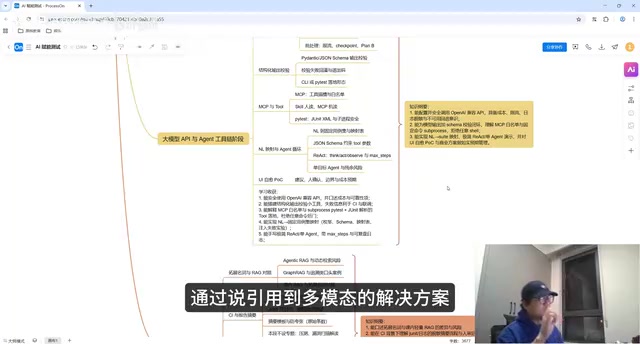
This is where MCP (Model Context Protocol), Function Calling, and Tools come in. Through these technologies, LLMs gain the ability to interact with external tools:
- MCP: A standardized protocol for model-to-external-tool interaction, defining communication specifications
- Function Calling: Enabling models to invoke predefined functions to complete specific tasks
- Tools: Expanding the model's tool usage range, connecting to more external systems
The learning path also covers LLM API configuration methods and strategies for calling cloud-based models, helping test engineers access stronger AI capabilities even with limited hardware resources.
Career Development and Interview Preparation for AI Test Engineers
Keeping Up with AI's Iteration Pace
The AI field evolves at breakneck speed. Before March this year, everyone was focused on OpenAI's latest developments, then Claude Code emerged and changed how developers work, followed by new systems like Hermes — the cycle from technology inception to adoption to replacement is getting shorter and shorter. Maintaining a habit of continuous learning has become a mandatory course for test engineers.
New Trends in QA Job Interviews
The content of QA job interviews has clearly shifted and is no longer limited to traditional UI automation, API automation, and Python programming. Interviewers now probe deeper:
- What AI tools have you used? Have you practiced Vibe Coding?
- How is your prompt engineering system designed?
- Have you built a vector data retrieval system using RAG?
- How do you enhance LLM execution capabilities through MCP and Function Calling?
The ultimate goal of this learning path is to enable test engineers to present tangible AI-empowered deliverables — PyTest AI collaboration code, UI self-healing systems, API contract testing solutions, RAG knowledge bases — demonstrating in interviews their progression from "test development" to "AI test development."
Conclusion
The core logic of this AI test development learning path is: build cognition first, establish standards second, then enhance capabilities. Starting from understanding the boundaries of LLM capabilities, moving to standardizing data compliance and prompt engineering, then deepening automated testing collaboration and RAG knowledge base construction, and finally expanding LLM capabilities through MCP and Agent tool chains.
It doesn't aim to solve the question of "can AI be used" but rather "how to use AI in a way that truly delivers value." Transforming an LLM with high error rates and uncontrollable outputs into a controllable, more accurate, and continuously productive tool — this is the core significance of AI-empowered software testing.
Related articles
 Tech Frontiers
A Rare Quiet Day in AI: Recursive Self-Improvement Stirs Beneath the Surface
A rare quiet day in AI sees multiple sources go silent simultaneously. Behind the calm, Recursive Self-Improvement (RSI) research continues. What this means for the industry.
 Tech Frontiers
Reve 2 vs. Ideogram 4: A Deep Dive into Layout Control in AI Image Generation
A deep comparison of Reve 2 and Ideogram 4's layout control capabilities, covering technical approaches, real-world use cases, and industry trends for designers and creators.
 Tech Frontiers
In the Weights: Check Your Influence Score in the AI World
In the Weights is an AI influence search engine that quantifies your presence in the AI world with a score. Explore how it evaluates practitioners and what it means for digital identity.