AI Weekly | OpenAI Codex Upgrade, Xiaomi Open-Sources Autonomous Driving Model, NVIDIA Open-Sources 2.6B Parameter World Model

A dense week in AI: open-source models, developer tools, security threats, and massive funding rounds.
This week saw multiple parallel advances in AI: NVIDIA open-sourced its 2.6B parameter world model 3A AWM; Xiaomi open-sourced Xiaomi One VL for autonomous driving; OpenAI Codex and Alibaba's Tongyi Lingma upgraded developer tools; Google and XAI embedded AI deeper into platform products; Microsoft released the multi-model security audit framework MDASH while NPM supply chain poisoning raised security alarms; Anthropic sought $30B funding at a $900B valuation; and OpenAI launched enterprise deployment services and an education program.
This week (May 11-17) was packed with AI developments, from open-source models to enterprise deployments, code security to funding battles. Here's a roundup of the most noteworthy events.
Open-Source Models: NVIDIA and Xiaomi Make Big Moves
NVIDIA Open-Sources 2.6B Parameter World Model 3A AWM
NVIDIA's research team open-sourced 3A AWM (Autonomous World Model) this week — a 2.6 billion parameter world model capable of generating up to 1-minute 720P videos. The model targets long-video generation R&D scenarios, marking NVIDIA's significant push into video generation.
World Models are AI systems that internally model the dynamics of the physical world, with theoretical roots traceable to Yann LeCun's "autonomous machine intelligence" framework. Unlike traditional generative models, world models must not only produce visually realistic content but also understand object motion, causality, and temporal consistency — this is their core value: enabling AI to understand how the physical world operates, not just generate content that "looks right." While 2.6B parameters isn't massive, generating 720P video for a full minute means the model must maintain physical coherence across the time dimension, which is computationally extremely challenging. The open-source strategy allows the research community to iterate rapidly, which is important for democratizing video generation technology.
Xiaomi Open-Sources Xiaomi One VL Autonomous Driving Model
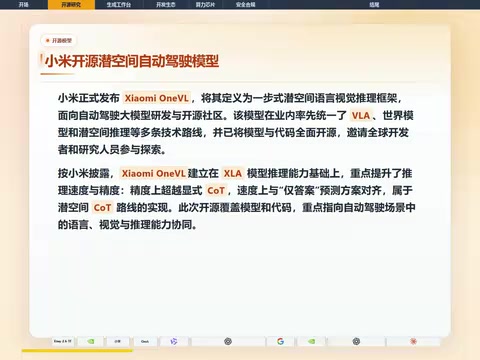
Xiaomi released and open-sourced Xiaomi One VL, a vision-language model for autonomous driving that unifies three technical approaches: VLA (Vision-Language-Action), world models, and latent space reasoning.
VLA models are multimodal architectures that unify visual perception, language understanding, and action decisions within a single neural network framework, representing a paradigm shift in autonomous driving from modular pipelines to end-to-end learning. Latent Space Reasoning refers to the model completing reasoning in high-dimensional compressed representation spaces rather than operating at the raw pixel or symbolic level, significantly reducing computational redundancy while preserving semantic information. This architectural design is quite forward-looking — traditional autonomous driving solutions typically handle perception, decision-making, and planning separately, while Xiaomi chose unified reasoning in latent space. This parallels Tesla FSD's end-to-end neural network strategy but is more aggressive in architecture design, potentially reducing information loss during inter-module transfers. For Xiaomi's automotive business, open-sourcing attracts community contributions while establishing authority in technical standards.
Entling AGI Open-Sources Ring 2.6 ET
Entling AGI open-sourced Ring 2.6 ET and launched it on Open Router, targeting complex agent tasks and workflow scenarios. As AI Agents become an industry consensus direction, models specifically optimized for agent scenarios are becoming a new competitive track.
Developer Tools: Codex and Tongyi Lingma Continue Evolving
OpenAI Codex Supports Custom Keyboard Shortcuts
OpenAI Codex now supports custom keyboard shortcuts, allowing users to adjust configurations according to personal work habits and reduce friction in daily development operations. This seemingly minor update actually reflects the evolution of AI programming tools from "usable" to "pleasant to use" — the polish of developer experience details often determines actual adoption rates.
Alibaba Cloud Releases Tongyi Lingma Q-Coder 1.0
Alibaba Cloud released Q-Coder 1.0, upgrading from an AI IDE to an agent-based autonomous development workbench. The new version supports task management and multi-task parallelism, with an official claim of 11% improvement in code retention rate. The positioning shift from "coding assistant" to "autonomous development workbench" signals that AI programming tools are evolving from copilot to pilot.
Platforms & Products: Tech Giants' AI Penetration Strategy
XAI Launches Grok Imagine Image Generation
XAI launched Grok Imagine image generation, now available to all users on the X platform. Users can generate images from text input with support for multiple aspect ratios. Musk's strategy of embedding image generation directly into a social platform — "AI capability as platform feature" — gives hundreds of millions of users zero-barrier access to generative AI.
Google Pushes Gemini to More Scenarios
Google is pushing Gemini into Chrome, Android Auto, and more scenarios, with new capabilities spanning video generation, web operations, and in-car intelligence. One detail worth noting: some features have high hardware requirements, which may limit adoption speed in the short term. Google's strategy is clear: make Gemini the AI foundation layer across all Google products.
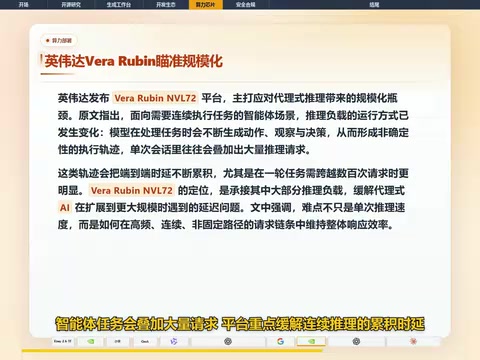
NVIDIA Launches Vera Rubin NVL72 Platform
NVIDIA launched the Vera Rubin NVL72 platform, specifically targeting agentic reasoning scenarios. Agent tasks characteristically stack large volumes of sequential requests, and this platform focuses on mitigating cumulative latency during continuous reasoning. This confirms a trend: scaled deployment of AI Agents poses entirely new challenges for infrastructure.
Security & Compliance: Undercurrents Not to Be Ignored
Microsoft Releases Multi-Model Agent Scanning Framework MDASH
Microsoft released MDASH, a multi-model agent scanning framework for code security auditing. In the CyberGem benchmark, the framework identified 16 new vulnerabilities, outperforming GPT-4.5.
The multi-model agent security audit paradigm MDASH represents is a significant upgrade over traditional single-model code scanning tools. The core idea is having models with different specializations handle different dimensions of vulnerability identification — for example, one model focuses on memory safety while another focuses on logic vulnerabilities — then aggregating conclusions through a coordination layer. This "collective intelligence" approach is similar to red team/blue team adversarial mechanisms in security, covering the cognitive blind spots of any single model. This demonstrates that in security, specialized multi-model collaboration may be more effective than a single large model, confirming the general principle that specialized architectures outperform general-purpose LLMs in vertical scenarios.
TenStack NPM Packages Hit by Supply Chain Poisoning
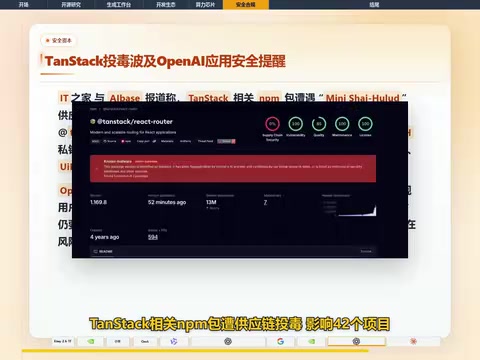
TenStack-related NPM packages suffered a supply chain poisoning attack, affecting 42 projects. OpenAI stated no user data breach was found but required affected macOS users to complete updates.
Supply Chain Attacks involve attackers indirectly compromising large numbers of downstream users by polluting upstream dependency packages, build tools, or code repositories. The NPM ecosystem is particularly vulnerable due to its extremely fragmented dependency tree structure — a medium-sized Node.js project often depends on hundreds or even thousands of third-party packages. The 2021 ua-parser-js incident and 2022 node-ipc incident both caused large-scale impact. In today's world where AI toolchains heavily depend on open-source ecosystems, attackers only need to pollute one widely-referenced base package to plant malicious code in AI development environments, with a blast radius far exceeding traditional software scenarios. Supply chain security is increasingly critical in the AI era — when more AI tools depend on open-source ecosystems, a single poisoned dependency can trigger chain reactions.
Business Developments: Funding and Strategic Moves
OpenAI Launches Deployment Company and Education Program
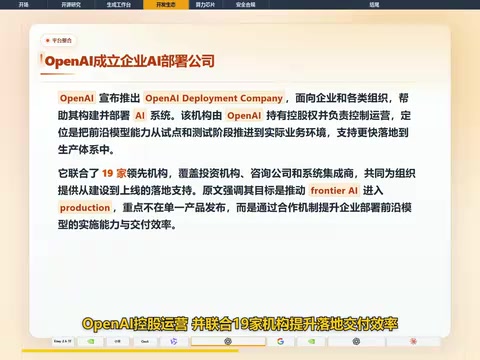
OpenAI was busy this week: it launched OpenAI Deployment Company for enterprise AI deployment, majority-owned and operated by OpenAI, partnering with 19 organizations to improve delivery efficiency. It also offered one year of ChatGPT Plus benefits to Maltese citizens — available free after completing an AI course and passing certification. The former targets the enterprise market; the latter is an innovative approach to AI education accessibility.
Anthropic Seeks $30B Funding at $900B Valuation
Anthropic is in discussions for a new funding round, seeking to raise $30 billion at a $900 billion valuation. Amazon plans to invest up to an additional $25 billion and strengthen AWS cloud collaboration.
Behind this valuation is the capital market's pricing logic around "AI infrastructure scarcity." The compute, data, and talent required to train top-tier large language models are highly concentrated, creating extremely high barriers to entry that give leading companies quasi-platform monopoly characteristics.
Related articles
 Tech Frontiers
A Rare Quiet Day in AI: Recursive Self-Improvement Stirs Beneath the Surface
A rare quiet day in AI sees multiple sources go silent simultaneously. Behind the calm, Recursive Self-Improvement (RSI) research continues. What this means for the industry.
 Tech Frontiers
Reve 2 vs. Ideogram 4: A Deep Dive into Layout Control in AI Image Generation
A deep comparison of Reve 2 and Ideogram 4's layout control capabilities, covering technical approaches, real-world use cases, and industry trends for designers and creators.
 Tech Frontiers
In the Weights: Check Your Influence Score in the AI World
In the Weights is an AI influence search engine that quantifies your presence in the AI world with a score. Explore how it evaluates practitioners and what it means for digital identity.